In the field of AI, it has been pointed out that the time it takes for open models to catch up with closed models is shrinking dramatically.

AI models released by various companies can be divided into 'closed models,' where the model itself is not made public and only the service is provided, and 'open models,' where the model itself is made public. Open models have generally been considered to have lower performance than cutting-edge closed models, but Semi Analysis, a semiconductor blog, has pointed out that the time it takes for open models to catch up to the performance of closed models is rapidly decreasing with each stage of the AI field.
Are Open Models Catching Up?
Since the advent of ChatGPT, closed models have held advantages in terms of both performance and integration, so many companies adopting AI have been using closed models. However, in 2026, open models with superior performance, such as ' Kimi K3 ' and ' GLM-5.3, ' began to appear one after another, increasing the advantages of open models for companies that prioritize privacy, customization, and cost.
In this context, Semi Analysis points out that 'if open models become available at a much lower cost that offer performance equivalent to closed models developed by major technology companies with massive investments, the value of cutting-edge AI will diminish and it will become commoditized .' Such a situation would be a blow to major AI development companies like OpenAI and Anthropic, which have raised trillions of yen in investment.
In this Semi Analysis study, to predict how the performance gap between closed and open models will change in the future, we defined three eras: 'Initial Scaling Era (2022-2024),' 'Inference Era (2024-2025),' and 'Agent Era (2025-Present).' We evaluated AI models using different benchmarks for each era and investigated the time it would take for open models to catch up to the 'early cutting-edge closed models of each era.' Since benchmarks that measure AI performance saturate as AI advances, our strategy is to divide the data into eras and change the benchmark used as the indicator to obtain meaningful figures.
The analysis results for each era are as follows.
◆1: The initial scaling era (2022-2024)
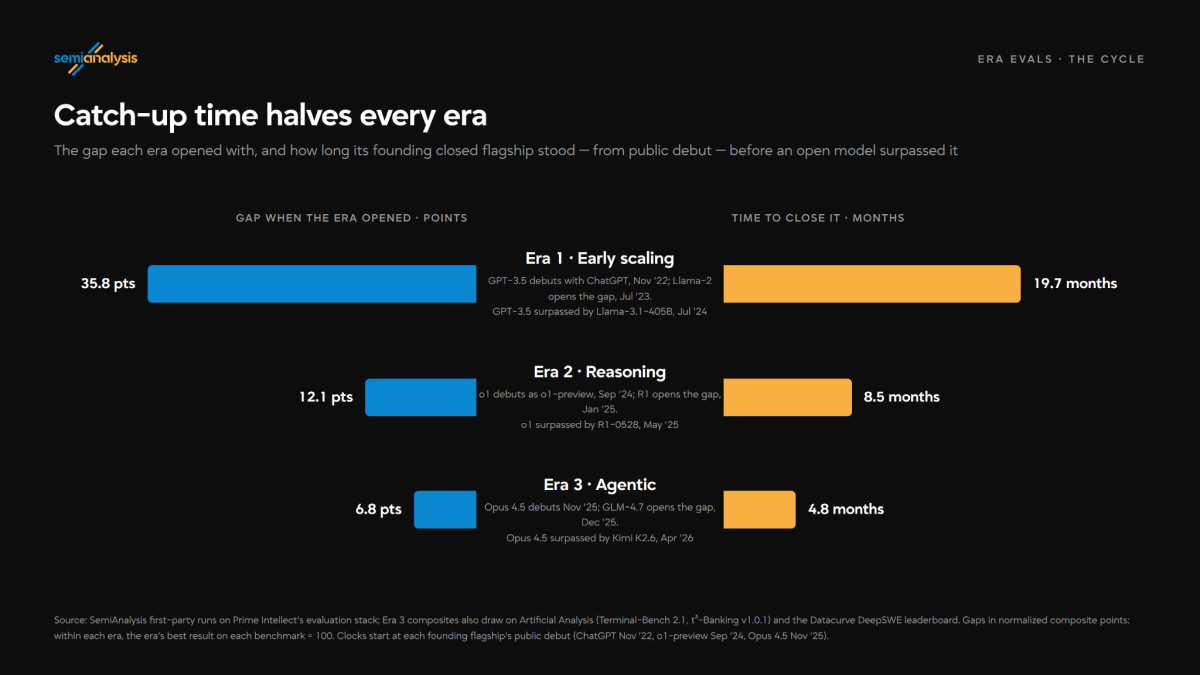
The first cutting-edge model chosen for the early scaling era was OpenAI's 'GPT-3.5 (GPT-3.5 Turbo),' released in November 2022, with benchmarks including 'GSM8K,' 'HumanEval,' 'TriviaQA,' and 'MMLU-Pro.' The gap between the Open model and GPT-3.5 Turbo was finally closed in July 2024 with the release of Meta's ' Llama-3.1-405B ,' a gap of 19.7 months from its initial release.
◆2: Reasoning era (2024-2025)
The model chosen as the cutting-edge model for the early stages of inference was OpenAI's ' OpenAI o1, ' released in September 2024, with benchmarks including 'GPQA-Diamond,' 'AIME 2026,' 'SimpleQA Verified,' and 'Humanity's Last Exam.' The gap with the open model was closed when DeepSeek released ' DeepSeek-R1-0528 ' in May 2025, catching up in just 8.5 months since its introduction.
◆3: Agent era (2025 - present)
The first cutting-edge model chosen for the agent era was ' Claude Opus 4.5, ' released by Anthropic in November 2025, with benchmarks including 'Terminal-Bench 2.1,' 'BrowseComp-Plus,' 'τ 3 -Banking,' and 'DeepSWE.' While Claude Opus 4.5 was capable of performing complex agent tasks such as coding and PC operation, it was overtaken by open models in just 4.8 months by ' Kimi K2.6 ,' released by Moonshot AI in April 2026.
The blue graph on the left shows the difference in benchmark scores between the initial closed model and the initial open model, while the orange graph on the right shows the time it took for the open model to catch up. From top to bottom, the graphs represent the initial scaling, inference, and agent stages, and as time progresses, the initial score difference decreases, and the time it takes to catch up is reduced by almost half.
Semi Analysis acknowledges that the results highlight the fact that benchmarks do not fully reflect actual work, and that model developers can intentionally manipulate the models to achieve high benchmark scores.
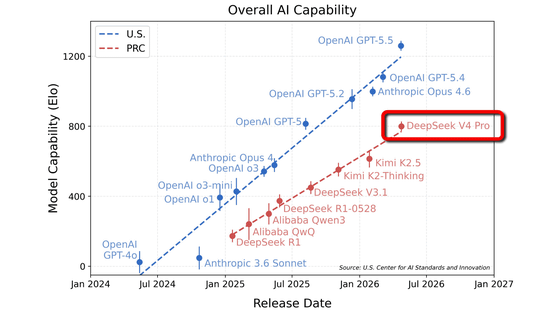
Bloomberg, a business newspaper, has reported that the gap between the United States and China in the AI development race is rapidly narrowing, and that in terms of usage and cost, Chinese-made AI is sometimes taking the lead.
US vs China AI Race: How ChatGPT, Gemini, Deepseek, Kimi Agents Compare
https://www.bloomberg.com/graphics/2026-us-china-ai-race/
In fact, in July 2026, several American startup companies sent an open letter to the Donald Trump administration urging them not to ban Chinese-made OpenWaite AI.
American startup appeals to Trump administration not to ban Chinese-made OpenWaite AI - GIGAZINE

Related Posts:




in AI, Posted by log1h_ik