Ghostty developers launch new company 'Superlogical' to build terminal infrastructure that integrates human and AI work.
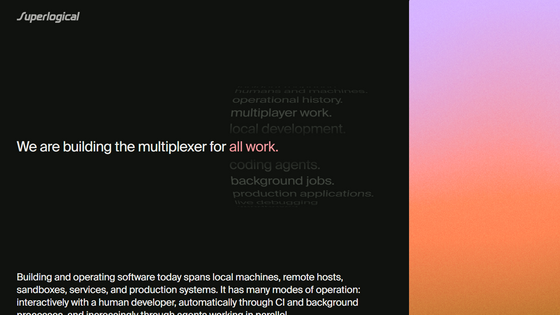
Mitchell Hashimoto, co-founder of HashiCorp and developer of the terminal emulator 'Ghostty,' has announced the establishment of a new company, 'Superlogical.' Superlogical will begin by developing a new terminal multiplexer that can maintain and share work across multiple terminals over long periods, and in the future aims to build a platform that integrates various software tasks performed by humans and AI agents.
Superlogical – Mitchell Hashimoto
https://mitchellh.com/writing/superlogical
Superlogical
https://www.superlogical.com/
In 2023, Mr. Hashimoto left HashiCorp after 11 years in management. Since then, he has mainly focused on raising his children and engaging in charitable activities, while continuing to write technical articles and develop software. During this time, Mr. Hashimoto particularly dedicated himself to Ghostty, a high-speed, cross-platform terminal emulator. Ghostty started as a personal project with no intention of being released to the public, but as of the time of writing, it has grown into a large open-source project with millions of users daily, approximately 12 core maintainers, about 50 translators, and community moderators.
Why Ghostty, a free, fast, feature-rich, and cross-platform terminal emulator, is so appealing - GIGAZINE

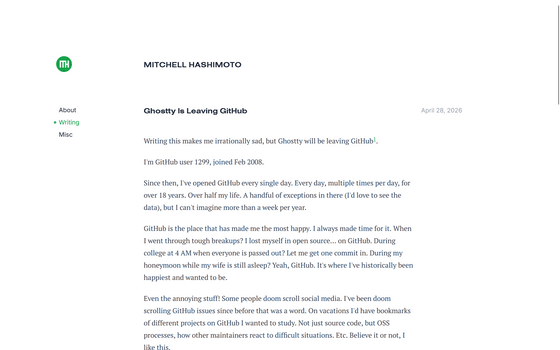
Hashimoto has no intention of commercializing Ghostty, and in 2025 he donated the entire project to a U.S. federally recognized non-profit organization. This ensures that Ghostty remains an open software platform serving the public good. Hashimoto also explains that its mission, operational structure, licensing, technical goals, and development roadmap will not change with the establishment of Superlogical.
The proliferation of AI is leading to an increase in low-quality code submissions to open-source projects, and a 'system for managing contributor trustworthiness' has emerged, developed by the creator of Ghostty - GIGAZINE

Furthermore, Hashimoto has indicated a policy of reducing reliance on GitHub with Ghostty, raising concerns about entrusting project management and community management to the services of specific for-profit companies. On the other hand, libghostty, a reusable library spun off from Ghostty under the MIT license, is provided as a public component that anyone can use.
Popular terminal 'Ghostty' announces departure from GitHub; developers explain 'what they're unhappy about' - GIGAZINE
Hashimoto says that as he continued developing Ghostty, he became interested not only in the terminal itself, but also in the development workflow surrounding it. While tasks spanning local PCs, remote servers, sandboxes, various services, and production environments are now performed in parallel not only by humans but also by CI, background processes, and multiple AI agents, the tools that handle these processes remain fragmented.
For example, interactive tools designed for human use assume a user is present in front of the screen, while automated processes become buried in jobs and logs, requiring separate management systems and access controls when deployed to a production environment. Superlogical points out that while the proliferation of AI has made this fragmentation problem more prominent and increased costs, the problem itself has existed for decades in areas such as system administration, continuous integration, and remote development.
Superlogical believes what's lacking is a persistent session centered around individual tasks. This session, they describe, would be maintained across multiple applications and execution environments, possessing the necessary context, structured data, operational capabilities, and work history, while being automated by software and accessible and controllable by humans.
The first step in this development is a terminal multiplexer that organizes multiple terminals within a single, long-term session. It will allow users to resume work from where they left off, even after closing the app or connecting from a different device, and will support access from web browsers and native apps for macOS and iOS, as well as live session sharing with other users from the start.
Superlogical states that it will improve aspects of existing terminal multiplexers that often cause frustration, such as scrolling back, text selection, and scrolling, to align with the standard user experience of operating systems and applications. Furthermore, it plans to create a structure that allows for the combination of these functions, ultimately developing it into a system that can be safely operated in production environments.

While Superlogical's product is not the same as Ghostty, it uses components from the publicly available libghostty under the MIT license. The plan is to reinvest any commonly used terminal-related improvements back into libghostty, so that libghostty users other than Superlogical users can also benefit.
In addition to Hashimoto, Superlogical's co-founders include Jack Parks, who previously served as Vice President of Engineering at HashiCorp; Alasdair Monk, who led the design department at Poolside and Vercel; and Hector Simpson, who has worked on developer products at Poolside and Heroku. The company has also received investment from Notable Capital and Amplify Partners, as well as Aaron Levy of Box, Patrick Collison of Stripe, and Tobi Lütke of Shopify.
Hashimoto explained that the terminal multiplexer is just the starting point for Superlogical's overall concept. Since the terminal is a common point of contact connecting human developers, AI agents, various tools, and infrastructure, he indicated that the plan is to first integrate work on the terminal and then expand from there to a system that can handle interactive work, automated processing, and production environment operations on the same platform.
Related Posts: