Cloudflare data reveals that Linux desktop usage surged by 22% in a single day.

Cloudflare data has revealed that web access from Linux desktops surged to approximately 22% of all desktop traffic on a single weekday. This is an unusually high figure, as typical OS market share statistics often estimate Linux's desktop share at around 5%.
Linux desktop use surged to 22% on one workday, Cloudflare data shows | ZDNET
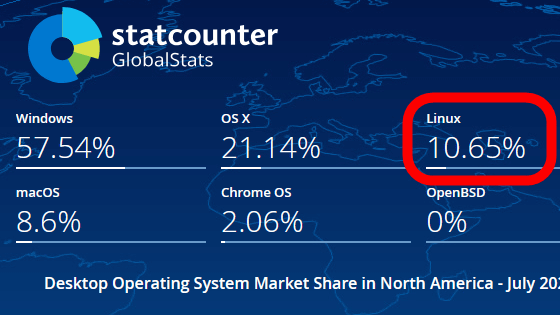
According to a July 2026 report by the web traffic analysis site StatCounter , the market share of each OS on US desktop PCs was 57.54% for Windows, 21.14% for OS X (macOS 2012-2016), 10.65% for Linux, 8.6% for macOS, 2.06% for Chrome OS, and 0% for OpenBSD, with Linux holding over 10% of the market share. This figure is so large compared to previous Linux market shares that even Linux fans suspected it was fake news. However, Linux's global market share was recorded at 7.53%, which is noteworthy as it has nearly doubled compared to previous reports.
Linux is used in over 10% of desktop PCs in the United States - GIGAZINE
Furthermore, data from Cloudflare, a popular content delivery network, also shows a growing popularity of Linux desktops. Cloudflare Radar allows users to analyze web traffic passing through their network, including device types such as desktops and mobile devices, as well as operating systems.
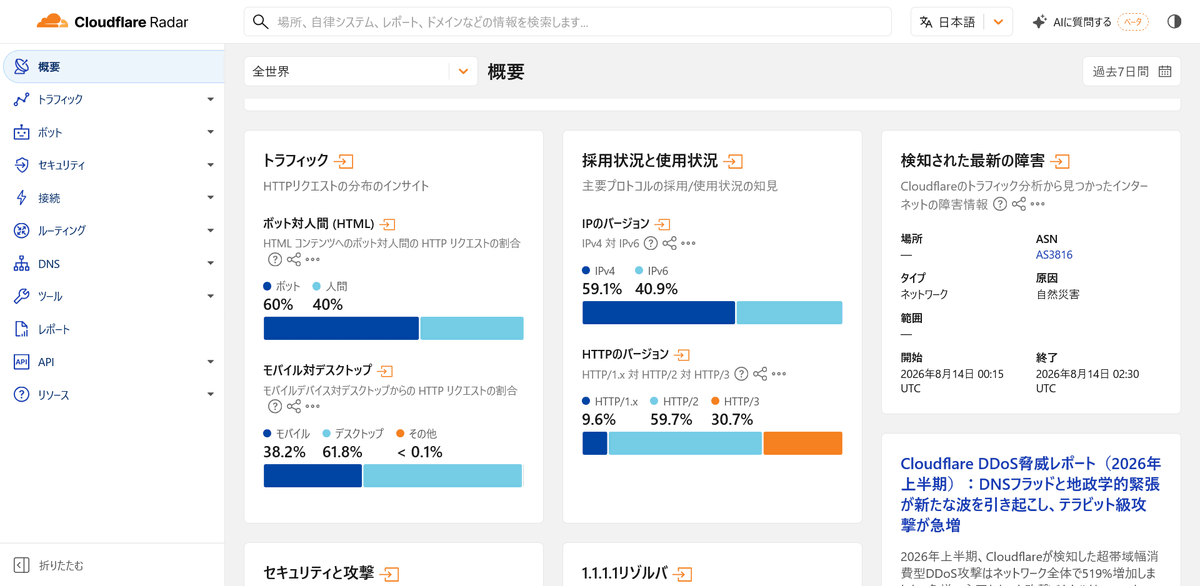
Cloudflare's network spans over 330 cities worldwide, and more than 20% of the web is behind Cloudflare's network. Furthermore, anonymized and aggregated data from the company's public DNS service '1.1.1.1' is also used in Radar's analysis. While StatCounter monitors approximately 1 million websites, Cloudflare monitors over 24 million websites, resulting in a significantly larger dataset and a more accurate representation of market share.
According to Cloudflare data, desktop Linux market share in North America reached 6.4% in July 2026. While this percentage is not as high as StatCounter's figures, it represents significant growth considering that Linux market share in North America was 4.1% in July 2025.
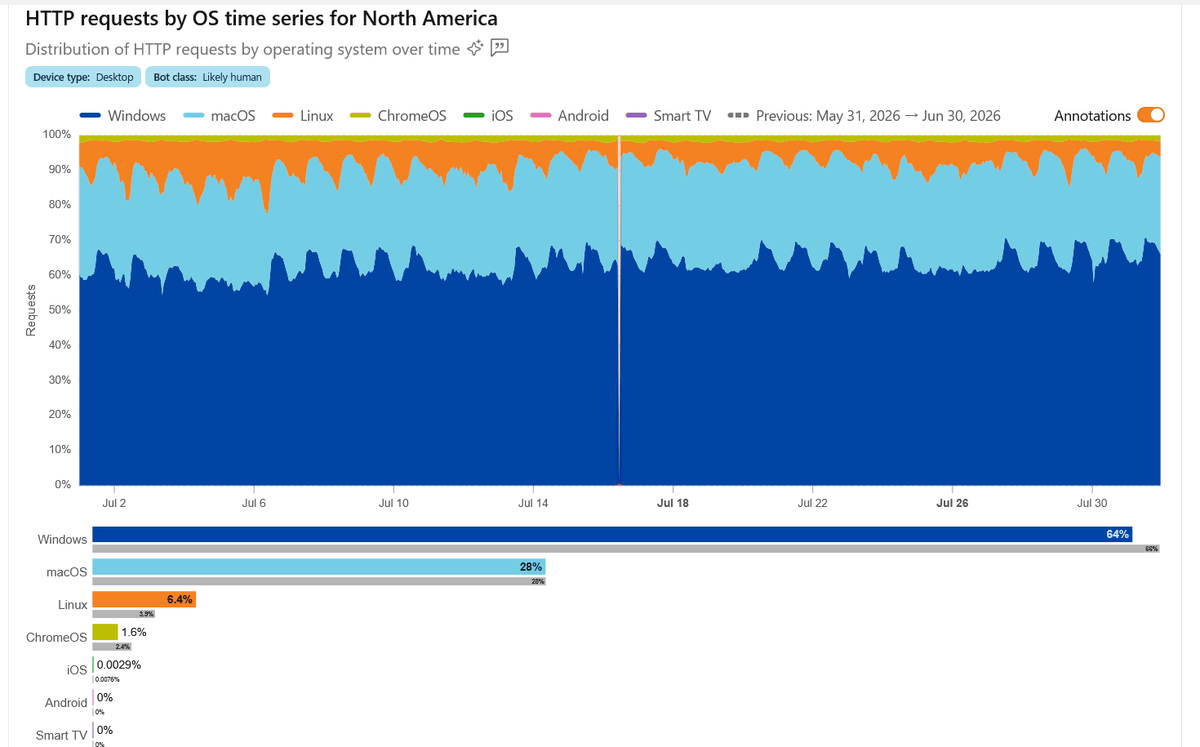
Further analysis of the data indicates that desktop Linux usage tends to peak on weekdays. Of particular note is the data showing that Linux usage rose to a high level of 22% on Monday, July 6, 2026, following the national holiday on July 4 (American Independence Day).
According to the IT news media outlet ZDNET, this data excludes AI agents and bots, representing the human share. Cloudflare's count indicates that 19% of Linux users are bots, and when humans and bots are combined, Linux's market share comes to 9.7%.
ZDNET states, 'These figures show that workers are leading the shift to Linux desktops. This result is not surprising. Historically, they have been people who value control over their PCs, prefer open systems, or are engaged in specific tasks where Linux is well-suited, such as programming or system administration.'
Furthermore, AI and cloud influencer David Linticham stated, 'While Windows 11 is technically capable of running local AI workloads, friction begins to emerge when you start using multiple tools, managing different projects, and installing various dependencies. Linux, on the other hand, provided an experience that truly deserves to be called an 'AI desktop.' Setup was easy, mainstream AI instructions matched what you see in real-world environments, and GPU-accelerated apps ran stably. I spent significantly less time troubleshooting and was able to spend more time running projects,' explaining why Linux is superior as an OS for using AI.
Other reasons cited for Linux's continued slow growth, despite remaining a niche market, include its use to make effective use of machines that can no longer be upgraded from Windows 10 to 11, the spread of Linux-based gaming environments such as Steam Deck , and the popularization of ' WSL (Windows Subsystem for Linux),' which allows the use of a Linux environment on Windows.
The data presented here was measured by Cloudflare. While tools like StatCounter aggregate page views from measurement codes embedded in the websites being surveyed, Cloudflare Radar aggregates HTTP requests passing through Cloudflare's network. Therefore, Cloudflare's figures include automated communications such as bots and scrapers, and there are differences in how tablets and other devices are classified. Consequently, Cloudflare's Linux share does not directly reflect the overall trend of PC users. Furthermore, the '22%' figure observed is a temporary peak, so it remains to be seen whether this trend will continue long-term or if it was a temporary inflation caused by specific workloads or automated communications.
Related Posts:







in Software, Posted by log1e_dh