Inkling, an open-weight AI model with approximately 1 trillion parameters, capable of understanding and coding images and audio, and adjustable for various applications, has been released.
AI company Thinking Machines Lab has announced a new AI model called ' Inkling ' that emphasizes additional learning tailored to specific applications. It is an open-weight model where the model's weights are publicly available, and it can handle not only text but also images and audio, and the amount of computation used for thinking can be adjusted.
Inkling: Our open-weights model - Thinking Machines Lab
Today, we are introducing Inkling.
— Thinking Machines (@thinkymachines) July 15, 2026
Inkling reasons efficiently across text, image, and audio modalities. We are making the full weights available. https://t.co/Ghebq5mG30
Available today for fine-tuning on Tinker. Play with it in the Inkling Playground. 🧵
When training an AI to handle customer inquiries to learn a company's return policy, or when training a programming support AI to adhere to internally specific design rules, simply introducing a general-purpose AI model may not produce the desired results. Because the knowledge and behaviors required by companies and developers differ depending on the application, 'fine-tuning'—adding further training to existing models—becomes necessary.
Inkling is not a model that simply boasts overall performance; it was developed as a foundation that users can customize to suit their specific needs. Thinking Machines Lab explains that 'there are practical problems that are difficult to solve with just a good general-purpose model, and fine-tuning using organization-specific knowledge can bridge the performance gap.'
Inkling is a Mixture-of-Experts (MoE) Transformer model with a total of 975 billion parameters and 41 billion effective parameters used during processing. MoE is a mechanism that operates only a portion of the specialized domains depending on the input, reducing computational complexity compared to using all parameters every time. It can handle contexts of up to 1 million tokens and has been pre-trained on 45 trillion tokens, including text, images, audio, and video.
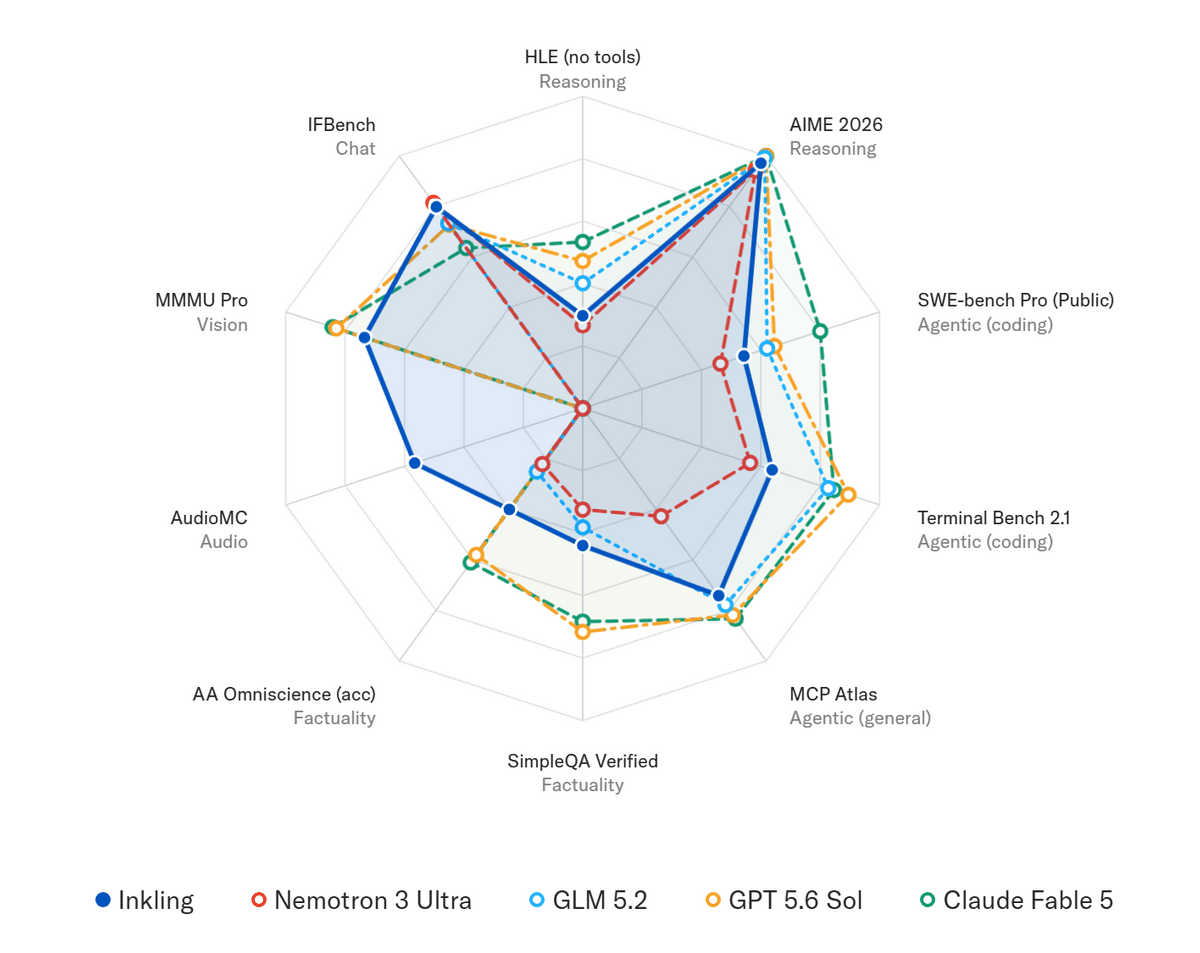
Inkling doesn't focus its performance on a single area; instead, it learns a wide range of skills including reasoning, programming, tool operation, following instructions, fact-finding, image recognition, and speech understanding. Thinking Machines Lab states that 'a broad range of starting capabilities is crucial for models that can learn to perform a variety of tasks.'
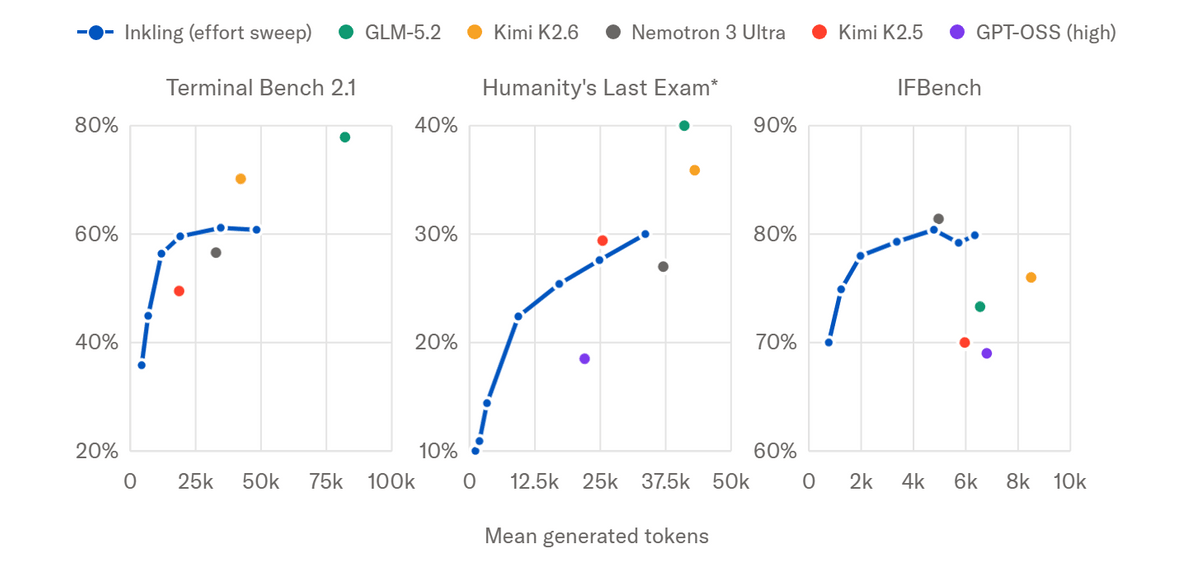
Allowing AI to think deeply increases its chances of solving difficult problems, but the more tokens it generates, the greater the processing time and cost. The appropriate amount of computation varies depending on the application; sometimes you want an immediate response to casual conversation, while other times you want AI to take its time to consider complex code modifications.
Inkling allows you to adjust the 'thinking effort,' switching between settings that prioritize speed and those that prioritize performance. Thinking Machines Lab reports that in Terminal Bench 2.1 tests, it achieved a score comparable to the '
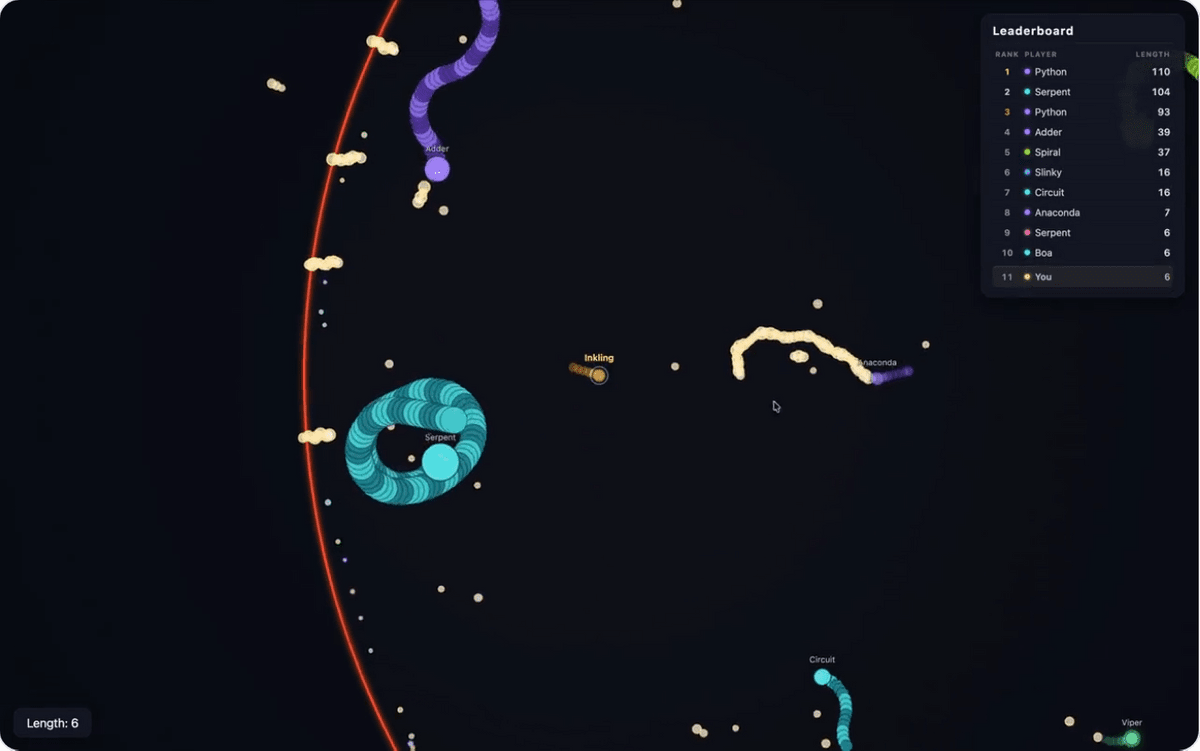
In programming and tool operation demonstrations, a web application for job applications is created in one go based on instructions, and another AI agent fills in the input fields using a saved profile. Furthermore, experiments have been conducted to create a 9-page travel magazine-style PDF while researching information and photos via web search, and to improve a competitive game while receiving feedback from the GPT Codex 40 times. The company envisions applications not only for single code generation but also for navigating long-term work processes using the tools.
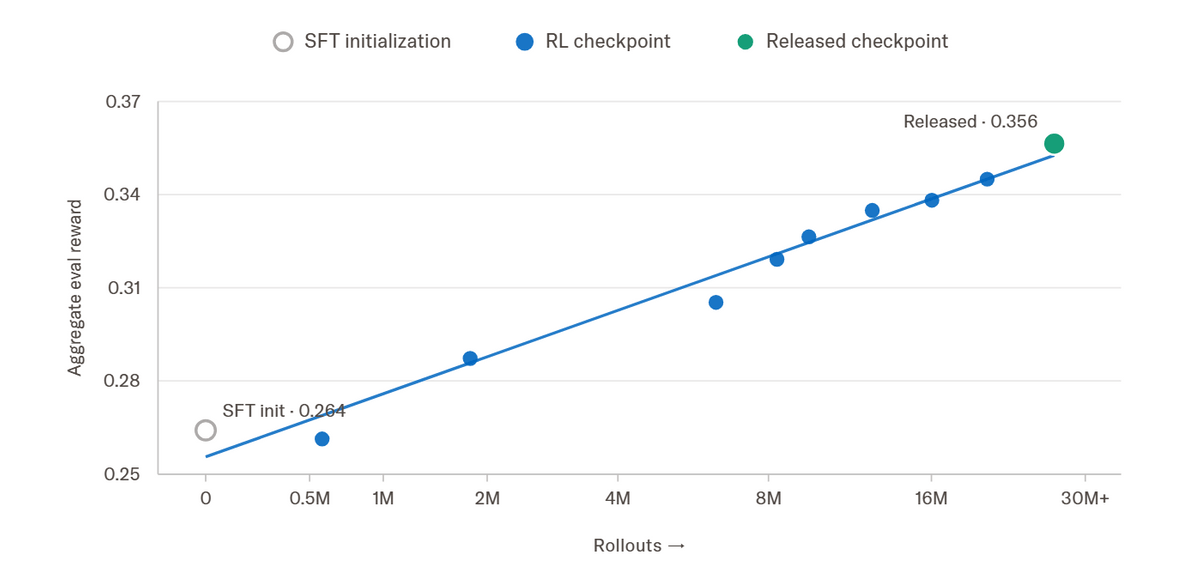
Inkling's learning process involved over 30 million reinforcement learning trials, starting with supervised fine-tuning. The combined metric for mathematical and reasoning performance increased from 0.264 to 0.356, showing steady improvement as the number of trials increased. Supervised fine-tuning is a method of learning by using correct examples as models, while reinforcement learning is a method of acquiring desirable behaviors by using evaluations of the answers as clues.
Thinking Machines Lab has also released a demo where they run Inkling on OpenCode and fine-tune Inkling itself using their proprietary additional learning service, 'Tinker.' When they instructed Inkling to 'fine-tune itself to a model that does not use the letter 'e' at all in its answers,' Inkling created training data and evaluation methods, executed the training process with Tinker, verified the results, and switched to new weights. The total time taken was approximately 27 minutes.
Inkling is available from Tinker with context lengths of 64K or 256K tokens, and also offers the Inkling Playground where you can try out chat and web search. The full weights are published on Hugging Face, and a lightweight NVFP4 version for NVIDIA Blackwell is also available.
thinkingmachines/Inkling · Hugging Face
https://huggingface.co/thinkingmachines/Inkling
Furthermore, there are plans to release a smaller version called 'Inkling-Small.' Inkling-Small has a total of 276 billion parameters and 12 billion effective parameters. At the time of writing, it was still under testing, but the weights will be made public once testing is complete.
Thinking Machines Lab positions Inkling as the first public release of a set of models that will be expanded in the future, and states that they will continue to improve its multimodal performance and learning infrastructure.
Related Posts:

in AI, Posted by log1d_ts