NVIDIA is already planning its second and third generations of SoCs for Windows laptops, and CEO Jensen Huang aims to develop robots like R2-D2 in the future.
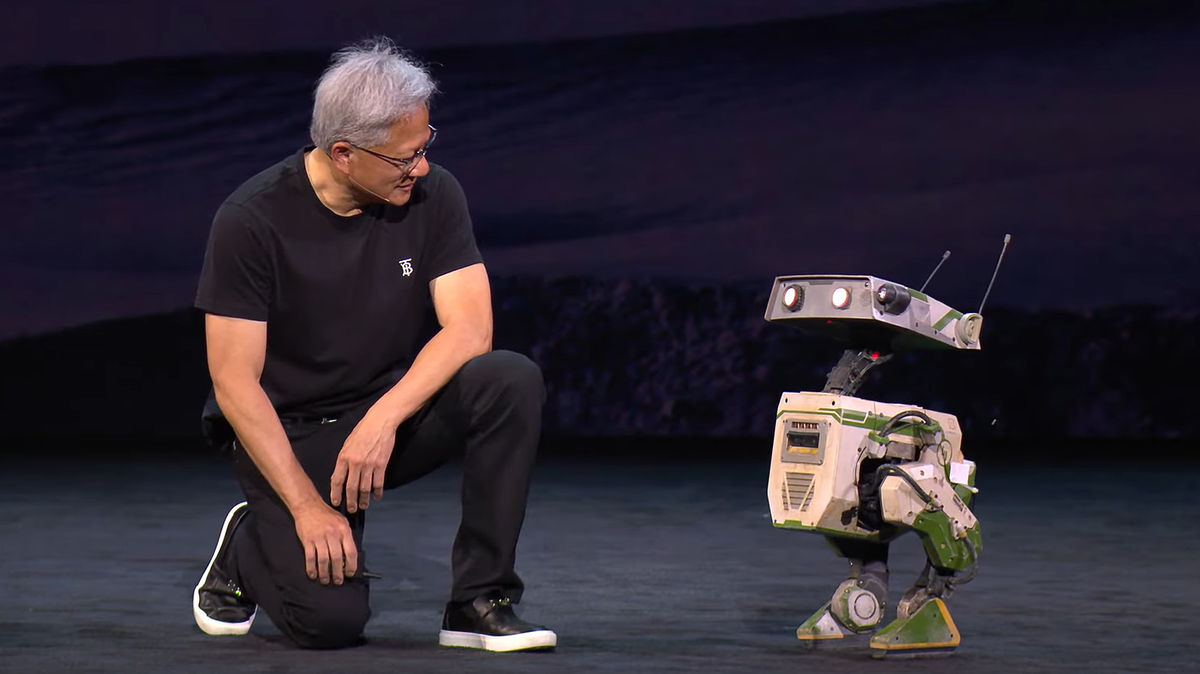
On June 1, 2026, NVIDIA announced the RTX Spark, a notebook PC SoC that enables local execution of high-performance AI. NVIDIA CEO Jensen Huang has spoken about this SoC in several interviews, stating that he hopes to eventually create a system like R2-D2 from Star Wars. He also mentioned that they are already working on developing the next generation of chips to achieve that goal.
Nvidia CEO Jensen Huang tells us about RTX Spark — why this is more 'R2-D2' than a laptop CPU | Tom's Guide
Nvidia is already planning N2X and N3X chips — the goal is the Star Trek computer | The Verge
https://www.theverge.com/tech/942588/nvidia-rtx-spark-n2x-n3x-r2-d2-star-trek-star-wars-plan
High-performance AIs such as ChatGPT and Claude are deployed as cloud services, and there is a growing need to accelerate the development of locally executable AI in fields that handle confidential and private information. However, running high-performance AI locally requires a high-performance GPU and a large amount of memory. The RTX Spark is an SoC developed with local AI execution in mind, and it can run AI models with up to 128GB of memory and 120 billion parameters.
NVIDIA finally announces 'NVIDIA RTX Spark,' a SoC for laptops, featuring 128GB of memory, an NVIDIA GPU, and an Arm-based CPU for high-performance local AI execution - GIGAZINE
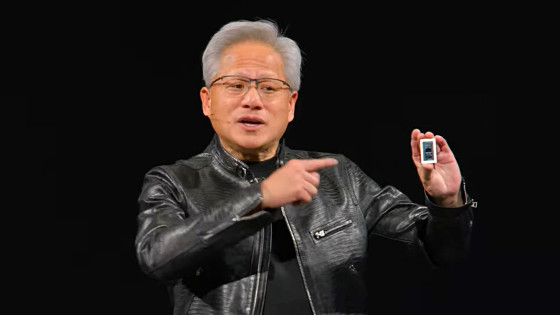
According to CEO Huang, the RTX Spark is not a one-generation product, and they anticipate the release of second and third generations of RTX Spark. Prior to the RTX Spark's release,leaked information revealed devices named 'N1' and 'N1X,' but according to CEO Huang, the RTX Spark is actually the N1X, and the N1 will be a 'smaller' version of the RTX Spark.
The second and third generation RTX Spark cards are codenamed N2X and N3X, respectively. An official roadmap has also been announced, indicating that after the Blackwell generation, the Rubin generation will be released in 2027 and the Feynman generation in 2029.
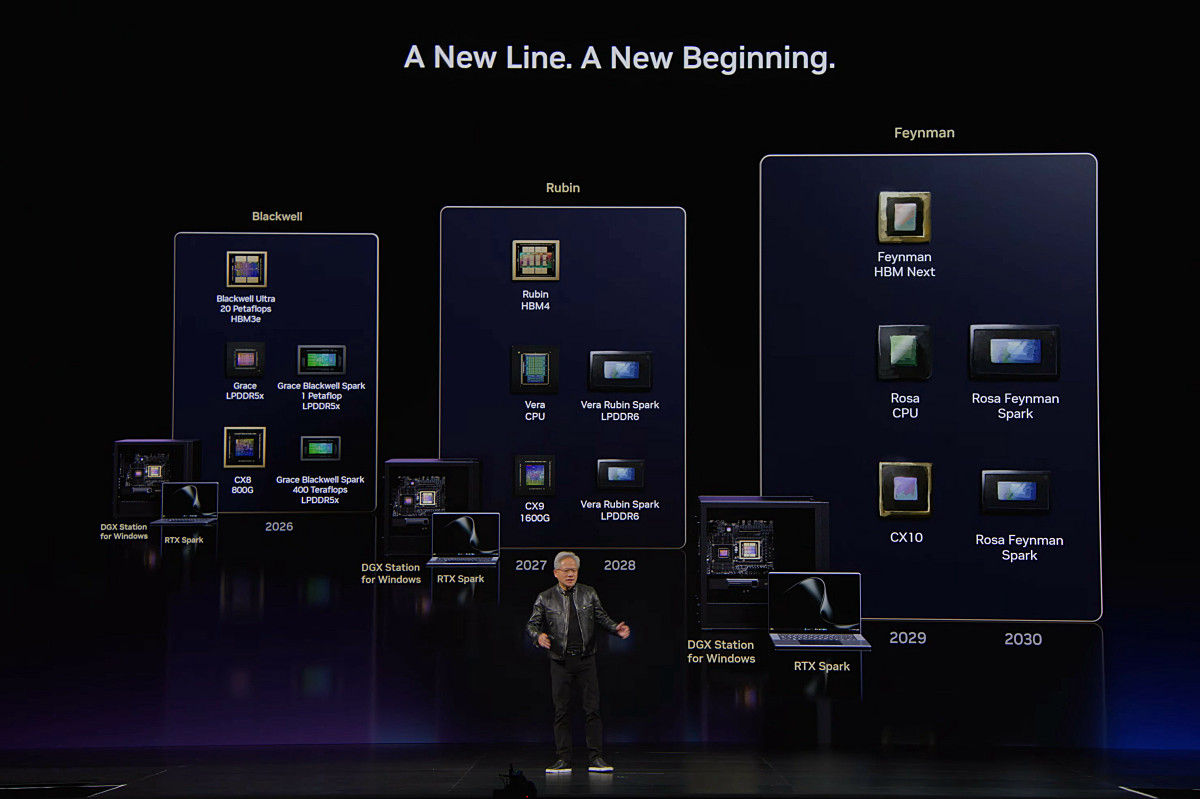
CEO Huang spoke of his dream to create a system like R2-D2 in the future that will allow people to control their PCs with their voices. 'Right now, if I want to talk to my laptop, I have to wait until I get back to my room. In the future, if I want my laptop to do something, I'll just send a message on WhatsApp. I'll say, 'R2-D2, there's a problem with one of my PowerPoint slides. It's slide number 17. The image size or title is wrong. It should say CX10, not CX9.' Then R2-D2 will open PowerPoint, fix it, convert it to a PDF, and send it to me. Can you imagine? It's that simple,' said CEO Huang.
CEO Huang insisted on local processing rather than cloud computing, stating, 'Nobody borrows a washing machine, right? Computers that we use every day should be able to process things locally.' He added, 'In the future, computers will be AI. Everything will be AI. You'll even be able to talk to your vacuum cleaner and say, 'Wipe that spot.''
The first-generation RTX Spark features up to 128GB of memory, providing sufficient performance to handle an AI agent with 120 billion parameters. However, with memory prices soaring, an SoC with 128GB of memory is inevitably expected to be expensive. CEO Huang also agreed with the question, 'Will the first generation be bought primarily by power users?'
Information revealed about Microsoft Surface Laptop Ultra and ASUS ProArt P16, which feature NVIDIA's new SoC 'RTX Spark' - GIGAZINE
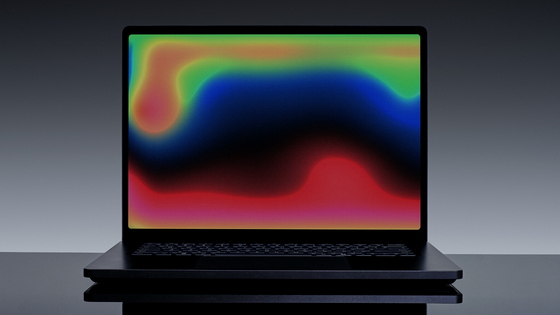
CEO Huang stated, 'Physical AI will become a reality in just a few years. I am confident that having laptops ready for that will be extremely important for the future of computing as a whole.'
Related Posts:


in Hardware, Posted by log1p_kr