A personal account of mastering Japanese thanks to Magic: The Gathering.
Ricardo Basaro, who studied Japanese at a language school in Ehime and obtained an 'intermediate to advanced level' qualification, says he felt that the Japanese used in qualification exams and the Japanese used in actual life and work are completely different. He talks about his experience of mastering Japanese through the globally popular card game '
How Magic: The Gathering Took Me from N2 to Japanese Fluency | TokyoDev
https://www.tokyodev.com/articles/how-magic-the-gathering-took-me-from-n2-to-japanese-fluency
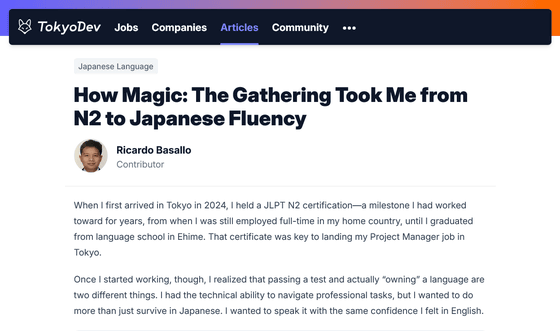
Basaro works as a product manager at Allegis Group , an American multinational talent management company that manages development teams spanning Japan and India, and moved to Tokyo in 2024. Before moving to Tokyo, he studied at Kawahara Electronic Business College in Ehime Prefecture from 2022 and obtained the 'N2' level of the Japanese Language Proficiency Test . 'N2' is the second highest level from N1 to N5 and indicates a level of proficiency that allows one to understand Japanese used in a wider range of situations, including everyday conversation, newspapers, and magazines.
According to Mr. Basaro, obtaining the N2 level of the Japanese Language Proficiency Test was a goal he had been working towards for many years, and this qualification was key to him landing a project manager job in Tokyo. However, after actually starting work, he realized that passing the exam and actually 'making the language your own' are two completely different things.
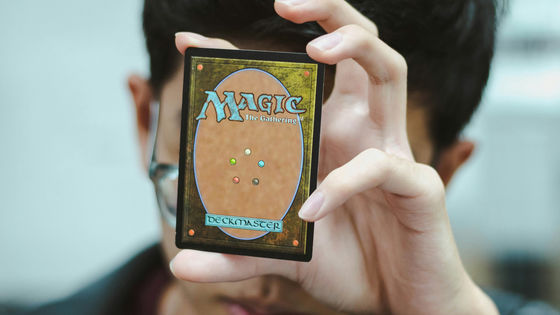
That's where Magic: The Gathering, a hobby he'd pursued for over 10 years, came to Basaro's rescue. While there were few opportunities for his hobby when he lived in Ehime, moving to Tokyo allowed him to experience a vibrant gaming community. Basaro says that through card games, he repeatedly applied his skills to real life and had the opportunity to 'make N2 level Japanese his own.'
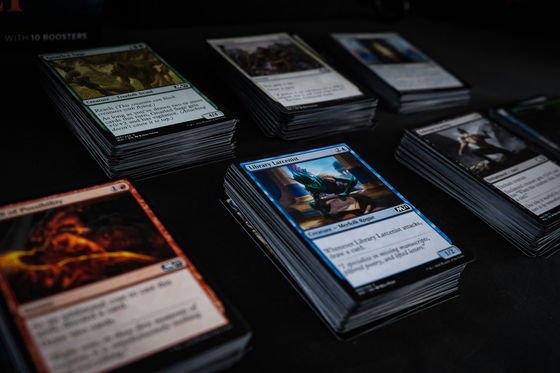
Many card games played worldwide allow players to mix in overseas versions with information in other languages. However, in a Japanese-speaking community, using English cards can make it difficult to understand the information on the cards, sometimes leading to interruptions in the game as players have to search the internet or call a referee. Therefore, Basaro imposed a rule on himself to 'use Japanese cards as much as possible.'
By deciding to use Japanese cards, Basaro also faced the burden of 'explaining things clearly in Japanese,' so he selected a deck that matched his communication goals. Specifically, he chose an aggressive type of deck called an 'aggro deck' so that it would be easy for his opponents to understand and for him to explain things accurately in Japanese. Basaro said that he was able to practice until he could speak naturally by repeatedly pronouncing things like casting spells, declaring creature names, and frequently used keywords and phrases like 'damage.'
Furthermore, Basaro said he anticipated common questions his opponents might have and thoroughly researched countermeasures. For example, he explained that the deck he was using required him to be able to accurately explain changes in abilities and damage numbers, so he prepared to answer those questions accurately and continue the game no matter when they came up unexpectedly.
Basaro said, 'Consistency is my most powerful weapon. By practicing every week without fail, I can transform new words from short-term memory into something I can use reflexively. During a card game competition, you don't have five minutes to think of the perfect sentence. You have to react to real-time changes in seconds, and you have to do that over and over again. Through this repetition, I naturally acquired set phrases. I'm not just reciting memorized words; I'm learning the rhythm and timing of Japanese conversation, interjections, and nonverbal cues that make communication feel natural rather than mechanical.'
Basaro won an event held at Hareruya Kichijoji in 2025 and was featured on Official X. Basaro said, 'Winning itself was a personal achievement, but what I truly felt was when the results were published in Japanese on Official X. It was concrete evidence that my strategy of not only learning the language but also using it in real-world situations is working in a community of native speakers.'
[Tournament Information]
— Hareruya Kichijoji Store @WPN Premium Store (@hareruya_kcjoji) May 31, 2025
The final winner of the 'Year of the Dragon Promo 《Mountain》 Competition Standard' starting at 1 PM is...
It was Ricardo Basallo! 🎉
Congratulations on acquiring the 'Mountain' card!!
We'll be holding the 'Year of the Dragon Promo 《Mountain》 Competition Standard' again tomorrow, June 1st (Sun)!
Please join us! 🥰 pic.twitter.com/3ZdGDkXIcc
Furthermore, the ability to quickly make real-time decisions and understand and use Japanese, which he acquired through card game tournaments, naturally came into play in his work as a project manager. Although his superiors told him that it was okay to speak in English at gatherings of Japanese stakeholders, Basaro was able to speak perfectly in Japanese. He also said that while he used to get very nervous, he now welcomes meetings as opportunities to 'apply' Japanese.
Magic: The Gathering was Basaro's hobby and the best choice for learning, but the same idea applies to a variety of hobbies. Basaro advises, 'My advice to foreign language speakers living in Japan who want to get beyond their current language level is simple: find a hobby that forces you to use 'real Japanese' on a regular basis. The goal is to find a community where Japanese becomes the 'operating system' for something you already love.'
Related Posts:



in Game, Posted by log1e_dh