Separating between 'recoverable decisions' and 'irrecoverable decisions' reduces hesitation

Decisions that come at turning points in life, such as changing jobs, moving, or starting a new business, are often associated with the anxiety that 'if I fail, it's the end.' Herbert Louis, a writer, editor, and content strategy advisor, suggests dividing decisions into 'recoverable decisions' and 'irrecoverable decisions' as a way to sort out these anxieties.
Recoverable and irrecoverable decisions – Herbert Lui
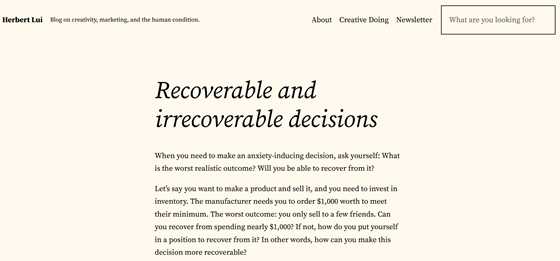
According to Louis, a major cause of hesitation is the idea that 'if the worst-case scenario occurs, it will be irreversible.' Therefore, Louis says that you should first clarify 'what is the worst-case scenario that could realistically occur' and consider whether there is any prospect of recovery from that situation.
Louis uses the example of the decision of whether to make and sell a product. Purchasing inventory requires a certain amount of expenditure, and if the inventory is not sold, a loss will be incurred. Louis explains that in this case, the key is whether you can maintain your livelihood or business even if a loss occurs. If the loss would be fatal, it is an 'irrecoverable decision,' but if there is a way to cover the loss, it can be treated as a 'recoverable decision.'
Louis also suggests ways to increase the likelihood of recovery, such as 'checking demand by requiring advance reservations,' 'securing additional sources of income,' and 'selling unwanted items to raise funds.' The idea is that if you create an exit strategy in case of failure, you can make the same attempt within the realm of recovery.
An everyday example is 'cutting your hair.' Even if you don't like the result, your hair will grow back over time, so Louis treats this as an example of 'recoverable decision-making.' Louis says that by categorizing this, we can reframe the magnitude of our anxiety in relation to the nature of the decision.

In the business world, there is a way of thinking about decision-making in terms of 'reversible' and 'irreversible,' and Amazon founder Jeff Bezos explains this using the metaphors of a 'one-way door' and a 'two-way door.' Louis, on the other hand, argues that the focus should not be on 'can it be undone,' but rather 'can it be rebuilt.' Even irreversible choices can be treated as recoverable if they can compensate for the damage or improve the situation, but even if they seem reversible, they approach irreversibility if the lost trust or opportunity could be fatal, Louis explains.
Louis argues that this perspective is useful in situations where decisions are made one after another, such as in starting a business or freelancing, and that rather than searching for choices that are guaranteed to fail, it's important to 'increase the number of recoverable decisions by designing them so that they can be recovered even if they fail.' Louis also summarizes that the bigger the decision, the easier it is to sort out the true nature of your doubts by separating the 'worst possible outcomes' from the 'possibility of recovery from them.'
Related Posts:






in Note, Posted by log1b_ok