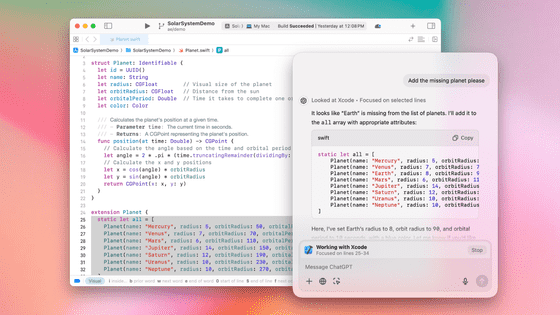
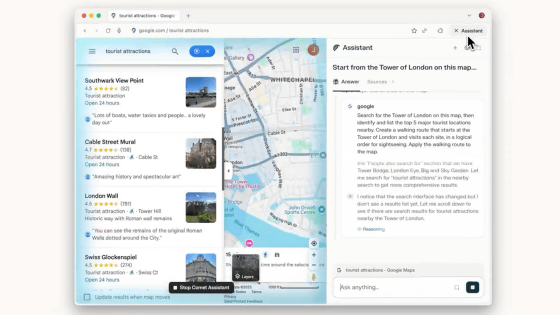
The official ChatGPT desktop app has finally arrived for Linux, supporting Ubuntu, Debian, and Fedora, and allowing access to ChatGPT Work and Codex.
On August 11, 2026, OpenAI released a preview version of its official ChatGPT desktop application for Linux. In addition to the standard ChatGPT, the Linux version also offers 'ChatGPT Work,' which allows users to delegate tasks in batches, and 'Codex,' which is designed for software development.
Now in preview: The ChatGPT desktop app for Linux.
— OpenAI (@OpenAI) August 11, 2026
Use ChatGPT, ChatGPT Work, and Codex where you already work and build, with your projects and browser workflows on supported Linux systems. pic.twitter.com/OtsPt5N5QC
In July 2026, OpenAI released a new desktop application that combined 'Chat' for asking questions and having conversations, 'Work' for conducting research and creating deliverables, and 'Codex' for assisting with programming tasks into a single application. However, as of July 2026, it was only available for macOS and Windows, and no Linux version was available.
'ChatGPT Work,' a tool that integrates ChatGPT and Codex to autonomously handle a wide range of tasks, has been released, based on GPT-5.6 - GIGAZINE
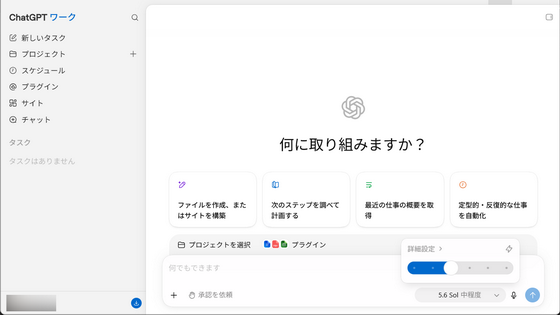
While ChatGPT and Work were available on Linux via a web browser, the web version of Work couldn't directly access local files or desktop applications on a PC. With the release of this Linux version, ChatGPT's integrated desktop environment is now available on Linux, allowing for more direct integration between ChatGPT and work on a PC.
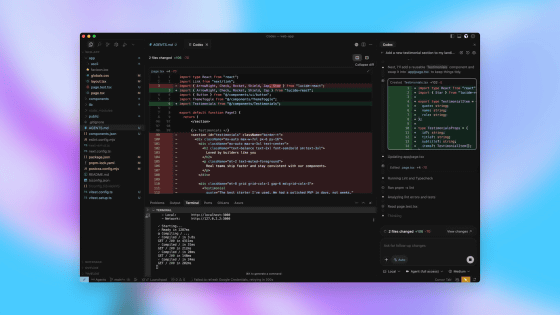
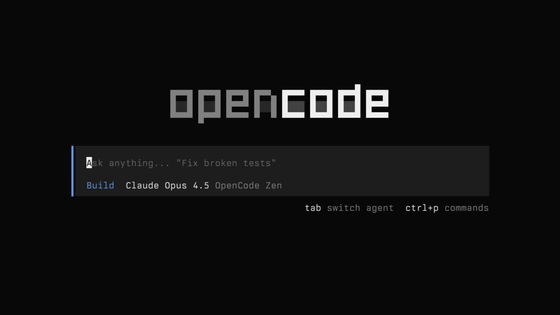
Codex has previously been available on Linux via the CLI and IDE extensions, but for the first time, it is now available through the ChatGPT desktop application for Linux. Codex is an AI agent for software development that not only generates code but also allows developers to explore and edit files within their projects as they work. OpenAI's official developer account explains that this means 'development can now proceed directly in the environment where the code is located' on Linux.
Build where your code already lives.
— OpenAI Developers (@OpenAIDevs) August 11, 2026
Codex is coming to Linux in the ChatGPT desktop app, so you can keep your projects, development workflows, and supported browser tools together.
Available in preview. https://t.co/3SP1qY9w5l
However, the features available in the Linux version of the official ChatGPT desktop app are not exactly the same as those available in the macOS and Windows versions. According to James Sun of OpenAI, the Linux version has features that are quite similar to the macOS and Windows versions, but as of the time of writing, it does not support 'Computer Use,' which allows the AI to look at apps on the desktop and perform actions such as clicking and typing on them to control native apps. On the other hand, the browser built into the ChatGPT desktop app and Google Chrome can be controlled by the AI agent. Sun explained that they plan to support Computer Use for native apps in the future.
ChatGPT desktop is now on Linux!
— James Sun (@JamesZmSun) August 11, 2026
I'm really excited about bringing ChatGPT to people where they already work.
There is feature parity across the board with the exception of native app Computer Use, which is coming soon. Your agents will still be able to drive the in-app… https://t.co/RcstsHS70f
As of the time of writing, the Linux versions supported are Ubuntu 24.04 LTS, Ubuntu 26.04 LTS, Debian 13, Fedora 43, and Fedora 44. The CPU architecture supported is not only the x64 architecture commonly used in PCs, but also ARM64. Installation packages are available in '.deb' format, used by Debian and Ubuntu-based systems, and '.rpm' format, used by Fedora and other systems.
The Linux version is only a preview release, and Sun explained that prioritizing the quick availability meant that some minor issues remain. At the time of writing, specific information regarding the timing of the official release and whether the number of supported distributions will be expanded is not yet available.
Related Posts: