Android 17 has been released, packed with features such as App Bubbles, Post-Quantum Cryptography, Screen Reactions, and Interactive PiP.
Android 17 was released on June 16, 2026. It includes features such as 'App Bubbles,' which allows you to turn any app into a floating bubble; a function that strictly enforces app memory limits and forces processes that exceed those limits to terminate; and 'Screen Reactions,' which allows you to record yourself while simultaneously capturing your smartphone screen.
Android Developers Blog: Android 17 is here
Android 17 has new features for productivity, gaming and security
https://blog.google/products-and-platforms/platforms/android/android-17-features/
Android 17 features enhanced multitasking capabilities.
'App Bubbles' is a feature that converts any app icon into a floating bubble by long-pressing it on the launcher. You can then quickly access and use the app from the floating bubble. This feature is available on smartphones, flip phones, and tablets. On tablets and flip phones, a dedicated 'bubble bar' is added to the system taskbar, allowing you to organize, switch between, and dock floating app bubbles.

In a desktop environment, unlike traditional read-only PiP windows, an 'interactive PiP' is provided that is always displayed on top and fully operable.
Additionally, a new 'Continue On' feature has been implemented, which allows users to transfer tasks running on one device to another. Users can now see the last app opened on their smartphone from the tablet's taskbar and launch the app with a single tap. The app also supports migration from the app to the web, and can fall back to the web version if the app is not installed on the device.
New 'Continue On' feature allows users to move tasks between Android devices - GIGAZINE
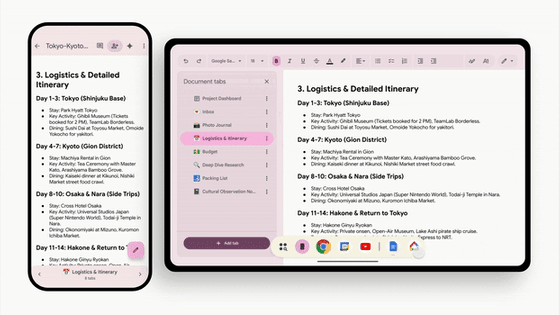
A 'Screen Reactions' feature has also been implemented, which allows you to record yourself using the front camera while simultaneously capturing your smartphone screen. Google describes it as 'making it easy to post your thoughts and opinions to websites, apps, and trending videos without using a green screen or switching between apps. It's very simple.'
In addition, significant improvements have been made to the app's performance.
One feature is app memory limits, where the system enforces strict app memory limits based on the device's total RAM capacity, immediately terminating any process that exceeds the limit.
Another feature is the system isolation function, which significantly reduces CPU usage, power consumption, and UI lag by separating systems that run for short periods from those that run for longer periods.
Security has also been enhanced. Previously, apps required broad and persistent permissions to access contacts, precise location information, media, and more, but in Android 17, temporary and session-based access is granted only to data that the user explicitly selects. For example, instead of accessing all contacts, access may be granted only to specific email addresses or phone numbers.
Android 17 also supports next-generation security, 'post-quantum cryptography.' Compatible devices can generate ML-DSA keys in-hardware to create quantum-resistant signatures. The v3.2 APK Signature Scheme, which combines traditional and ML-DSA signatures to protect app distribution, is also introduced.
Android 17 is available on Pixel devices from Pixel 6 onwards .
Related Posts:


in Software, Smartphone, Posted by log1p_kr