How did technology industry leaders transform from 'charming geeks' to 'unpleasant rich people'?

In recent years, more and more founders and executives of technology companies are actively posting on social media and appearing on podcasts, but some make statements that are out of touch with public opinion and end up causing controversy. Technology blogger Mr. Market has compiled a list of reasons why leaders in the technology industry have transformed from 'charming geeks' to 'unpleasant rich people.'
What the Fuck Happened to Nerds – Mr. Market
Mr. Market has many friends in the IT industry, whom he describes as very thoughtful, intelligent, intellectually curious, and eccentric. On the other hand, he points out that there are also people in the IT industry who are unimaginably self-centered, delusional, and irritating to others, and he dislikes the current trend of technology industry leaders actively promoting themselves.
Mr. Market argues that until about 10 years ago, the image of 'technology industry leaders' was built by Apple co-founders Steve Jobs and Steve Wozniak. While Jobs was ambitious and sometimes arrogant, this stemmed from his dedication to products, and it was the performance and aesthetics of the final products that attracted people.
On the other hand, Wozniak was something of a 'patron saint of computer science,' a shy yet generous and humble man who avoided possessing wealth beyond a reasonable amount. Wozniak transferred or sold his shares to friends, family, and fellow engineers early on, and he was also involved in information education activities for children.
Mr. Market cites one reason people trusted Jobs and Wozniak as the fact that they didn't seem to be seeking our attention. 'They were rich geeks who basically just wanted to focus on their own projects. That's why it seemed like it made sense for them to be in charge of our digital experience,' he says.

While Steve Jobs and Steve Wozniak were hailed as 'ideal leaders in the technology industry,' the landscape has changed dramatically in recent years, with founders and executives now actively promoting themselves. Mr. Market explains the reasons for this change by outlining three stages.
◆1: The era when the founder was an enigmatic charismatic figure (late 1970s to 2007)
Even back then, founders of technology companies appeared in the media, but the focus of the coverage was on 'the products the company created.' Founders would pose for photos surrounded by gleaming machinery in their garages, give keynote speeches, and interview magazines, but they never flaunted their wealth or influence. Even Bill Gates, the Microsoft founder who was portrayed as a global villain at the time, had little known about his private life beyond being a competitive and avid reader.
◆2: The era when the founder's story began to spread as a fable (2007-2015)
During this era, TED Talks, in which founders shared their experiences, became popular, and the film '
◆3: The era of rampant fraudulent practices in the technology industry (2015-present)
Mr. Market points out that in modern times, technology has come to be seen as an 'unethical means of getting rich quickly.' He notes that we now see founders like Elon Musk, the founder of Tesla and SpaceX, who are excessively keen on self-promotion, and that technology companies are increasingly transforming into media companies, such as OpenAI's acquisition of TBPN , a live television network featuring celebrities. Mr. Market states, 'In the public eye, it appears that the founders' interests have shifted from their original sacred and niche work to the obviously shallow pursuit of power, money, and fame.'
Mr. Market is particularly critical of the video media of Founders Fund, a venture capital firm where PayPal co-founder Peter Thiel is a partner. In June 2026, Founders Fund released a video in which OpenAI co-founder Sam Altman, defense technology company Anduril Industries co-founder Palmer Luckey, and logistics startup Flexport co-founder Ryan Petersen played a Werewolf-type game.
Can Tech Legends Find the Liar? (Mafia Episode 1) - YouTube
Mr. Market acknowledges that these videos are designed to make technology company founders appear more appealing, and that they may indeed work in the short term. However, he criticizes them, saying that no matter how appealing the founders may seem through video editing and publicity, they will inevitably become a laughingstock in the end.
For technology companies, promoting the 'founder brand' has become essential. Nevertheless, Mr. Market argued that founders should always operate with humility and integrity, and avoid any embarrassing displays of pride or self-promotion.
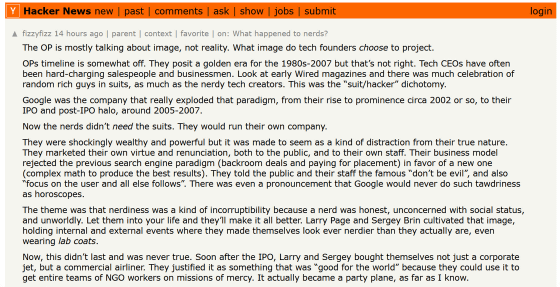
Mr. Market's observations have also become a topic of discussion on the social news site Hacker News.
What happened to nerds? | Hacker News
https://news.ycombinator.com/item?id=48538229
One user pointed out that Mr. Market's timeline is slightly off, arguing that from the 1980s to the early 2000s, CEOs of technology companies were often energetic businessmen. This was broken by the rise of Google around 2002, which the user claims heralded the arrival of an era where 'geeks no longer needed suit-wearing executives and could run their own companies.' The user also noted that, ultimately, the Google founders eventually bought private jets and joined the ranks of the more unsavory founders.
Related Posts:





in Note, Posted by log1h_ik