MRI scans reveal surprising effects of yawning on the brain

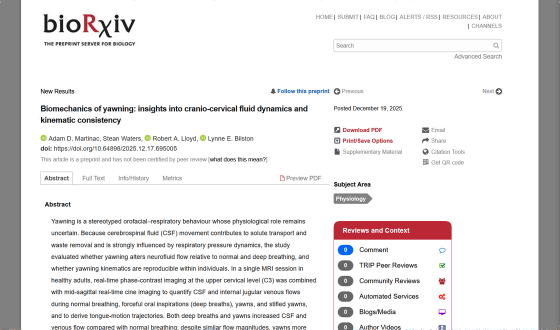
Biomechanics of yawning: insights into cranio-cervical fluid dynamics and kinematic consistency | bioRxiv
https://www.biorxiv.org/content/10.64898/2025.12.17.695005v1
Yawning has an unexpected influence on the fluid inside your brain | New Scientist
https://www.newscientist.com/article/2513692-yawning-has-an-unexpected-influence-on-the-fluid-inside-your-brain/
Yawning Does Something Surprising in Your Brain, MRI Scans Reveal : ScienceAlert
https://www.sciencealert.com/yawning-does-something-surprising-in-your-brain-mri-scans-reveal
While humans and most vertebrates yawn, the reasons for yawning remain a mystery. Proposed theories include increasing oxygen delivery to the lungs, regulating body temperature, improving fluid circulation around the brain, and regulating hormone levels, but no definitive answer has been found.
'Crocodiles and dinosaurs probably yawned, too. It's a behavior that's remarkably conserved through evolution, so why has it persisted in humans?' said Adam Martinak, a researcher at Neuroscience Research Australia , a non-profit medical institution in Australia.
To investigate the effects of yawning on the body, Martinak and his team conducted an experiment on 22 healthy adult men and women. In the experiment, the subjects were asked to perform four different breathing patterns: 'normal breathing,' 'yawning,' 'holding back a yawn,' and 'intentional deep breathing,' while undergoing MRI scans of their heads and necks.

Because yawning and deep breathing have similar mechanisms, the researchers expected the MRI scans of both to produce similar results. However, to their surprise, the MRI scans showed that yawning and deep breathing have different effects on the brain.
When participants took a deep breath, the pattern observed was consistent with previous research
'Yawning caused cerebrospinal fluid to move in the opposite direction to deep breathing,' Martinak said. 'We just sat there and thought, 'Wow, we didn't expect this.'' The exact mechanism by which cerebrospinal fluid is expelled during yawning is unknown, but it's thought that the amount of cerebrospinal fluid expelled at one time is only a few milliliters.
The study also found that yawning increases the amount of blood flowing into the internal carotid artery by more than one-third compared to deep breathing. This is thought to be because yawning also expels cerebrospinal fluid, creating more space for blood to flow into the artery.
Furthermore, the tongue movements during yawning varied from subject to subject, each with their own unique pattern, suggesting that yawning patterns are not learned, but rather innate and programmed in the central nervous system.

One of the next mysteries the research team hopes to unravel is the physical benefits of yawning's release of cerebrospinal fluid. 'Maybe it's for thermoregulation, maybe it's for waste disposal, or maybe it's neither,' Martinak said. 'You could live without yawning, but it's also possible that there are six to eight very small cumulative effects that help with waste disposal, thermoregulation, and even regulating the emotional dynamics of a group.'
The paper has not yet undergone formal peer review, but is available to view on bioRxiv.
Related Posts:








in Free Member, Science, Posted by log1h_ik