Research results show that lack of sleep leads to cerebrospinal fluid leakage while awake, resulting in decreased alertness

Lack of sleep can make it difficult to concentrate and leave you feeling spacey even when you need to. New research from the Massachusetts Institute of Technology has revealed what happens in the brain when sleep-deprived people lose their focus.
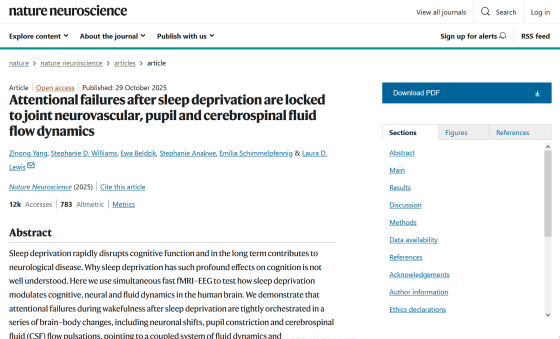
Attentional failures after sleep deprivation are locked to joint neurovascular, pupil and cerebrospinal fluid flow dynamics | Nature Neuroscience
This is your brain without sleep | MIT News | Massachusetts Institute of Technology
https://news.mit.edu/2025/your-brain-without-sleep-1029
Sleep is a vital biological process, and lack of sleep has been shown to lead to declines in attention and other cognitive abilities. A 2019 study by Associate Professor Laura Lewis of the Massachusetts Institute of Technology and others suggested that the flow of cerebrospinal fluid (CSF) that fills the brain during sleep helps to remove brain waste that accumulates during the day.
High-quality sleep may help reduce the risk of Alzheimer's disease - GIGAZINE

In a new study, Lewis and his team conducted an experiment to investigate the effects of sleep deprivation on cerebrospinal fluid flow. Twenty-six participants participated in the experiment, and the flow of cerebrospinal fluid was measured during cognitive tasks in two separate sessions: after a night of sleep deprivation in the laboratory and after a night of adequate sleep.
The participants were asked to complete a task commonly used to assess the effects of sleep deprivation in the morning after a night's sleep. While performing the task, they entered a functional magnetic resonance imaging (fMRI) scanner and wore an electroencephalogram (EEG) cap, which records brain waves.
In this study, the researchers used a modified version of fMRI that can measure not only blood oxygenation in the brain, but also the flow of cerebrospinal fluid into and out of the brain, as well as the subjects' heart rate, breathing rate, and pupil diameter.
Participants performed two attention tasks in an fMRI scanner: visual and auditory. In the visual task, participants were instructed to look at a screen displaying a fixation cross and press a button when the cross changed to a square. In the auditory task, participants were required to press a switch when a beep sounded.

As expected, the sleep-deprived participants performed significantly worse on these tasks than well-rested participants. Not only were their reaction times to stimuli slower, some participants were unable to respond to stimuli at all.
The researchers also found that cerebrospinal fluid was drained from the brain as participants lost attention during the task, and that this fluid returned to the brain once attention was restored.
The research team hypothesizes that sleep deprivation may cause the brain to produce more cerebrospinal fluid during waking hours to compensate for the cleansing process that occurs during sleep. 'When we don't sleep, these normally invisible cerebrospinal fluid waves begin to appear during wakefulness, and these cerebrospinal fluid waves contribute to a decline in alertness,' Lewis said.
The study also found that loss of attention was associated with physiological changes, including a decrease in breathing rate, a decrease in heart rate, and constriction of the pupils, which began approximately 12 seconds before cerebrospinal fluid left the brain. The pupils then dilated again once attention was restored.
The researchers believe that the close connection they found between attention loss, cerebrospinal fluid outflow, and other physiological changes suggests the existence of a single circuit that controls attention and various bodily functions.
'What's fascinating is that this isn't just something that happens in the brain, but appears to affect the whole body,' Lewis said. 'The results suggest that these systems are tightly coupled. When our attention is distracted, we may feel it perceptually and psychologically, but it reflects something that's happening throughout our brain and our body.'
Related Posts:





in Science, Posted by log1h_ik