A post that claims that 'if you arrange Apple's icons in reverse chronological order, it looks like a portfolio of someone who is really good at icon design' sparks a huge response
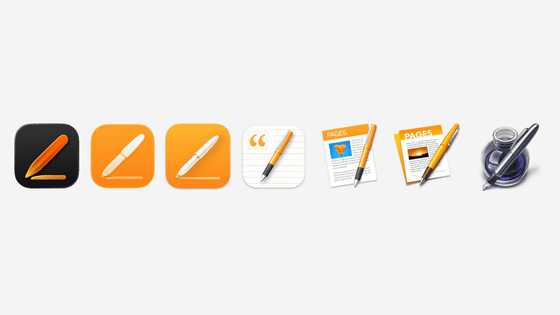
Héliographe Studio , a developer of tools for independent developers, posted a picture of Apple's icons in reverse chronological order, which has sparked a huge reaction on social media.
Héliographe: 'If you put the Apple icons in …' - Mastodon
https://mastodon.social/@heliographe_studio/115890819509545391
Here's the original post from Héliographe Studio: The example given was the icon for the presentation app Pages . The older the icon, the more realistic it is, while the newer the icon, the simpler it is.
In response to this, comments were made on social media such as, 'The new icons are simple, clear, and very Macintosh. Apple has strayed far from the Macintosh philosophy with skeuomorphism , but they're getting back on track.'
Héliographe Studio responded to this comment by writing, 'This is what Apple's Human Interface Guidelines (HIG), published in 1992, say about application icon design. If we follow the original philosophy, I would argue that the fifth or sixth icon from the left (the icon from OS X Mavericks or macOS Catalina era) is the design that most closely matches what Apple calls the 'Macintosh way.' Apple's HIG defines a good app icon as one that 'clearly represents the document the application creates' and 'uses graphics that convey the meaning of what the application does.' According to these criteria, the three latest versions of app icons appear to be those of a drawing app, not a word processor.' They also point out that the Pages app icon is not designed to suit its content.
Héliographe Studio also picked up on the post on the social message board Hacker News , pointing out that the original HIG defines a good app icon as one that 'clearly represents the documentation the application creates' and 'uses graphics that convey the meaning of what the application does.'
Furthermore, Héliographe Studio pointed out that the Pages app icon is not in line with the HIG released in 1992, saying, 'It may be a bit outdated. We live in a 'post-doc' world, especially on mobile. The second point is that it is broad enough that, from that perspective, an image of a pen or stylus is not the most appropriate for a word processing app.'
In addition, he pointed out the problems with the three latest Pages app icons: 'These three are very hard to defend. Their main advantage is that they're simpler and more monochromatic, making them easier to fit into a broader design system or icon family. Still, simple shapes don't improve readability. Some people have commented that the orange icon on a black background was 'something related to a device.' The latest icon has a 'line' (or shadow?) under the pencil that's almost the same thickness as the pencil, which blends in with the pencil from a Gestalt psychology perspective .'
Furthermore, regarding the oldest ink bottle icon, the seventh from the left, he wrote, 'I admit that there are some issues that make it not necessarily the best choice as an icon. Still, the precision of the craftsmanship that went into it makes it a true masterpiece to me. Even though the details are lost at smaller sizes, it still retains a fairly distinctive and legible shape, so it still seems like a solid icon.'
Finally, Héliographe Studio said, 'Icons need to be immediately recognizable, but at the same time, icons are not glyphs . Therefore, an illustrative approach is also effective. This is particularly true on devices with large screens, where icons appear much larger in most situations. The biggest problem is that the old icons clearly require more advanced technology than the newer icons. And regarding these issues, Apple was once the absolute standard and there was no room for debate. As a software designer for many years and having worked on Apple's hardware interaction design until the 2010s, I am very disappointed that this is no longer true. '
Related Posts: