Experts predict OpenAI's advertising strategy as it finally starts advertising on ChatGPT

AI is spreading rapidly around the world, and AI-related stocks are soaring. Major companies like OpenAI are trying to increase their profitability by
Opinion | AI Is Real. But OpenAI Might Still Fail. - The New York Times
https://www.nytimes.com/2026/01/13/opinion/openai-ai-bubble-financing.html
The A in AGI stands for Ads | Ossama Chaib
https://ossa-ma.github.io/blog/openads
OpenAI's weekly active user count will exceed 800 million by the end of 2025, and continues to reach new highs in 2026. Its corporate value is expected to exceed $260 billion (approximately ¥41 trillion), and its annual recurring revenue is expected to reach $20 billion (approximately ¥3.16 trillion) in 2025, showing no signs of slowing down. However, the significant costs of providing this unprecedented technology to such a large number of users have led some to point out that OpenAI is running a massive deficit. Given this situation, experts are divided on whether OpenAI will reign as a major global company generating significant revenues, or whether it will be outdone by other AI companies.
OpenAI is a huge money-eater and needs to raise at least 32 trillion yen by 2030 - GIGAZINE
The New York Times points out that 'the reality is that most users aren't paying for the service,' and while it says that profitability cannot be secured unless users are forced to switch to paid plans or an ad-display system, it also suggests that timing is important, and that if the company takes steps to secure profitability at the point when users become so engrossed in the current service that switching to another service becomes a hassle, it may be possible to prevent users from leaving.
However, the New York Times believes that the situation is different for OpenAI. While established large companies like Google, Meta, and Microsoft have the financial means to invest in AI because they generate revenue from their traditional businesses, the situation is different for startups like OpenAI. Given the scaling law, where model performance improves dramatically while costs rise exponentially, the current rounds of fundraising are like walking a tightrope. The Times predicts that OpenAI's funding will dry up in the second half of 2027, and it will eventually be absorbed by a larger, more well-funded company.

AI expert Osama Chaib countered this, pointing out that OpenAI's shift to advertising business will change the situation, and predicted OpenAI's future based on the difference in annual revenue rate compared to other services.
OpenAI is testing a feature that will display ads at the end of responses if there are sponsored products or services related to the current conversation. A limited beta version will be rolled out to selected advertisers in the first quarter of 2026, followed by ChatGPT for free users in the second and third quarters of 2026. The global rollout is scheduled to be completed by 2027.
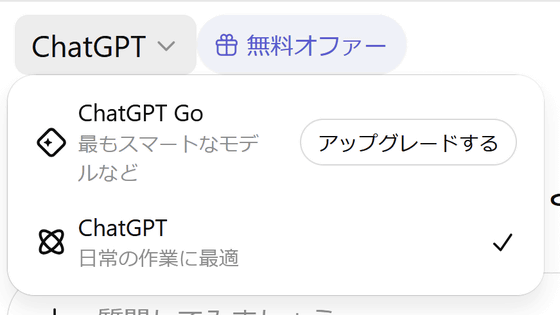
This integration will likely be identical to the method used by Google, where advertisers bid for placements, and will likely be an affiliate model with a built-in payment system that allows for purchases within ChatGPT, or a sponsored content display in the sidebar.
Several platforms are adopting this approach. For example, Google, mentioned above, is expected to achieve an ARPU (annual revenue per user) of $59.12 (approximately ¥9,300) from advertising by the third quarter of 2025. Meta's ARPU is expected to be $49.63 (approximately ¥7,800) by the first quarter of 2025, and X's is expected to be $5.54 (approximately ¥900).
The reason why profitability differs depending on the platform is because the path that users take to reach the ads is different. For example, Google displays ads in search results, making it easy to advertise the exact product that users are looking for, while X has less relevance. Meta is similar, but its distinctive feature is that it is larger in scale than X, which means it generates more profit.
So where does OpenAI fit in? Chive believes it's 'above X but below Meta.' OpenAI's flagship product, ChatGPT, is a system that, like Google Search, makes it easy for users to advertise what they're looking for. This allows it to secure much more revenue than X, but it's smaller in scale than Meta, so it's positioned this way.

One benchmark for measuring OpenAI's profitability is Perplexity, which has been integrating advertising into its AI since 2024. Perplexity's CPM (cost per 1,000 ad impressions) is $50 (approximately 7,900 yen). This price is equivalent to premium video or high-end search systems, and is about 10 times the CPM of ads that appear in social media feeds. In a bullish scenario, Chaive believes that OpenAI will initially set a CPM of around a few dollars, raise prices every few years, and by 2029 will be offering the same CPM as Perplexity, approaching Google's ARPU.
'OpenAI has a very talented product team and I believe they have the ability to occupy users' subconscious with advertising,' said Chive. 'Advertising is the key to monetization. The A in AGI (artificial general intelligence) stands for Ads! It's all advertising,' he said, predicting a bright future for OpenAI.
Related Posts: