Why does simply 'reviewing at intervals' significantly improve learning efficiency?

Even when people learn new knowledge, they easily forget it over time. It's not uncommon to quickly forget what you crammed for an exam, or to be unable to recall a passage you've read countless times. Psychological research has shown that there are certain tendencies in the way we forget, and that reviewing learning material over time, rather than cramming it all at once, can sometimes lead to longer-term retention. Author and researcher Gwern Branwen summarizes research on '
Spaced Repetition for Efficient Learning · Gwern.net
https://gwern.net/spaced-repetition
◆Why do memories get lost so quickly?
The starting point of forgetting research is known to be an experiment conducted by German psychologist Hermann Ebbinghaus in the 19th century. Ebbinghaus memorized meaningless strings of letters and measured how their retention rate changed over time. His results showed a pattern in which memory was significantly lost immediately after learning, followed by a gradual decline. A diagram of this trend is known as the ' forgetting curve .'
Research since Ebbinghaus has also shown a typical visualization of the forgetting curve, which shows that memory retention drops significantly immediately after learning, and then the rate of forgetting slows down as time passes.
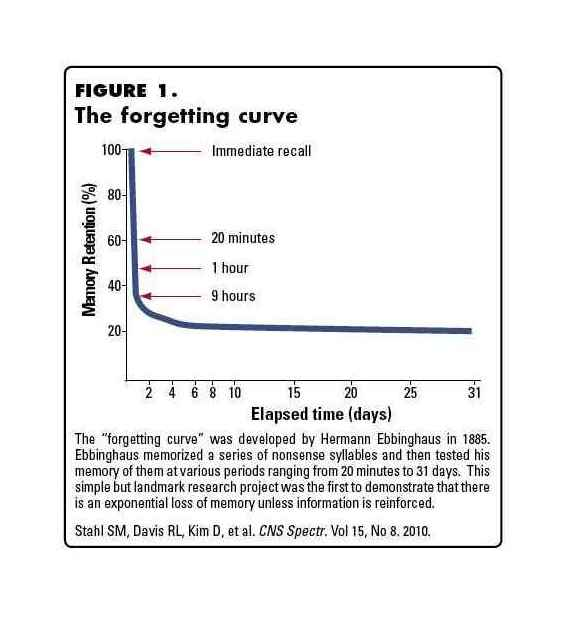
Branwen states, 'The metaphor of the half-life of radioactive decay is sometimes used to explain the shape of the forgetting curve,' but this is merely an explanation to help with intuitive understanding and is not the same mechanism. Since the shape of the forgetting curve varies greatly depending on the conditions and there is no definitive explanation for the biological mechanism, Branwen says, 'it is appropriate to treat it as an approximate model to explain the behavior of memory rather than a strict law.'
◆Why does the “spacing effect” occur?
Over the years, several hypotheses have been proposed as to why the spacing effect is observed. Branwen puts these hypotheses in order.
The first is the '
The second, the ' variable context hypothesis ,' focuses on the fact that the learning context changes over time. Spaced learning means exposure to the same information in different contexts, providing more cues for recall.
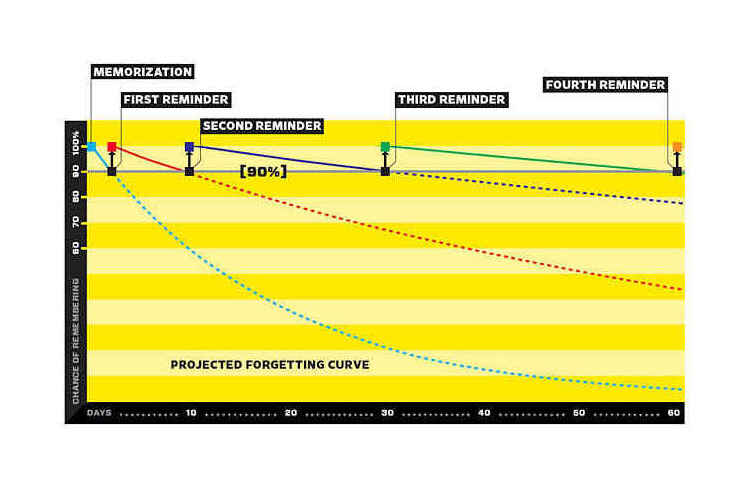
The third, the ' recall strength hypothesis ,' posits that the amount of effort required to recall something is important when learning it: the longer the interval between learning sessions, the more difficult it becomes to recall, and the stronger the memory.
None of these hypotheses has been conclusively supported, and Branwen concludes that 'the spacing effect is likely not caused by a single factor, but by multiple factors depending on the conditions.'
The 'testing effect': The act of trying to recall strengthens memory
Numerous studies have shown that recalling answers rather than repeatedly rereading what was learned leads to long-term memory retention. A 2006 study comparing rereading and recall confirmed that even though there was no significant difference in performance immediately after learning, the recall group tended to perform better after some time had passed, demonstrating a clear difference in memory retention between the two groups.
Additionally,
◆ Why rereading makes you feel like you've memorized something
A 2009 study found that while rereading improves learning fluency, recall tests tend to be more effective for long-term retention. This discrepancy between subjective judgment and actual memory retention has been discussed (PDF file) as a way for learning difficulty and ease of processing to influence learning judgment.

・What is SRS, a systematized spaced repetition learning?
SRS (Spaced Repetition Learning System) was developed as a way to incorporate spacing and testing effects into actual learning. To address the problem that 'it is difficult to manage when to review what content based solely on human intuition, and the optimal timing changes depending on the success or failure of review,' research has been conducted that attempts to mathematically handle spacing in repetitive learning. For example, one paper proposed a method for calculating the repetition interval to maintain a certain level of memory retention in paired learning. This research was later referenced in establishing the theoretical foundation of SRS.
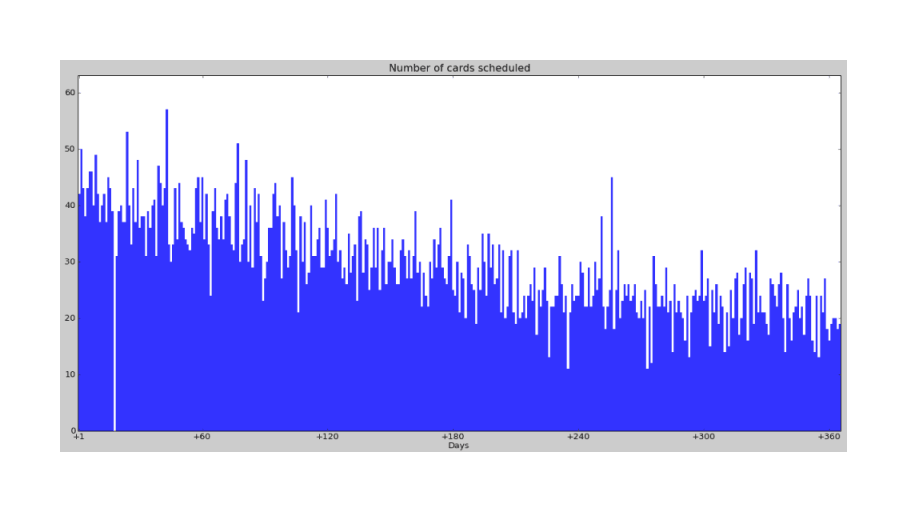
With SRS, the timing of review is set individually for each learning item. As a result, newly learned items and previously learned items are presented in different proportions each day, and the amount of review is not consistent. The image below is an example of a visualized review schedule output by SRS software, which visually shows the variation in the amount of review, making it clear why it is difficult for people to manage it based on intuition alone.
◆Study areas where SRS is suitable and not suitable
SRS is not a panacea for all learning. It tends to be effective for knowledge where 'recall' is important, such as vocabulary and factual relationships, but Branwen says that its effectiveness varies depending on the conditions when it comes to understanding abstract concepts.
While SRS is highly effective, it can also be counterintuitive. Because learners have to review the material when they are about to forget it, they tend to feel like they haven't mastered it and are less likely to achieve a sense of accomplishment in the short term.
The reason why this learning method is difficult to adopt in the educational field is also pointed out in a 1988 paper that discussed the difficulty of translating the results of psychological research into practice.
Branwen, reviewing research on the forgetting curve, testing effect, and spaced repetition learning, points out that learning effectiveness must be considered with the understanding that memory changes over time. He also points out that ease of learning does not necessarily correlate with long-term retention, and that providing spaced recall opportunities can be effective.
Related Posts: