OpenAI discovered a memory corruption vulnerability in the OpenJDK's Base64 decoder, known as 'Java4Shell,' on its Codex, and successfully demonstrated an attack within just three hours.
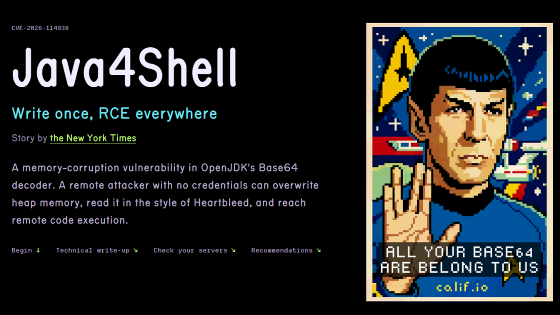
On November 17, 2026, security research firm Calif announced a critical vulnerability, ' Java4Shell ( CVE-2026-114938 ),' in OpenJDK , an open-source implementation of Java. Exploiting Java4Shell would allow attackers to steal confidential information and perform remote code execution (RCE). Calif reported discovering the vulnerability in just one hour using OpenAI's AI coding agent, 'Codex.'
Java4Shell: Write once, RCE everywhere
https://calif.io/java4shell
Oracle Critical Security Patch Update Advisory - November 2026
https://www.oracle.com/security-alerts/cspunov2026.html
OpenJDK Vulnerability Advisory: 2026/11/17
https://openjdk.org/groups/vulnerability/advisories/2026-11-17
Java4Shell was discovered in the Base64 decoding process of OpenJDK. Base64 is a method for converting binary data into text format and is widely used for user authentication, file uploads, and data transmission over networks.
Java is known as a highly memory-safe programming language because it automates memory management and has mechanisms to prevent unauthorized memory access. However, the Java execution environment itself is implemented using languages such as C, C++, and assembly language, which leaves room for vulnerabilities that can lead to memory corruption.
OpenJDK utilizes the AVX-512 VBMI instruction set, an extension for compatible x86-64 processors, to speed up Base64 decoding. Calif discovered a bug in the assembly code responsible for this acceleration process. When processing invalid Base64 data, the data is written to memory beyond the allocated area.
Calif demonstrated that it can execute remote code without authentication for default configurations of Keycloak, Atlassian Jira, Atlassian Confluence, JFrog Artifactory, Jenkins, and PingFederate. It also successfully executed authenticated remote code with Apache Kafka, Apache Solr, Elasticsearch, Gerrit, and Netflix Spinnaker.
The following video shows how Calif successfully exploited Java4Shell to execute remote code in various applications.
Java4Shell RCE Demos: Keycloak, Jira, Confluence, Kafka, Elasticsearch, etc. - YouTube
Furthermore, it is possible to attack Java programs that have established a TLS connection to a malicious server, meaning that not only servers accepting external connections but also client-side applications can be targeted. Java4Shell's CVSS 4.0 score, which indicates its severity, is 9.2 out of 10, classifying it as the most serious 'Critical' category. Java4Shell affects unpatched versions of OpenJDK 17.0.6 and later, and also impacts OpenJDK-based applications such as Amazon Corretto, Eclipse Temurin, Microsoft Build of OpenJDK, and Oracle Java SE.
On the other hand, since the vulnerability exists in code optimized for specific CPUs, not all Java runtime environments are affected. The affected environments are those using x86-64 processors that support AVX-512 VBMI, such as some Intel Xeon processors from the Ice Lake generation onwards, and AMD EPYC and Ryzen processors from the Zen 4 generation onwards. ARM64 processors are not affected.
Quan Luong, a security researcher at Calif who discovered Java4Shell, focused on the JIT compiler and encryption processes, which handle complex operations within the Java Virtual Machine (JVM), and had the Codex investigate the code. Initially, only vulnerability candidates that were not realistic to exploit were presented, but after repeated instructions, the Codex discovered a flaw that could lead to memory corruption in the Base64 decoding process. It took Luong just one hour to discover the vulnerability, and only two hours to develop the initial attack code. The token costs for using the AI totaled less than $200 (approximately 30,000 yen).
Because Java4Shell attacks vary depending on the application, Calif first had researchers formulate an attack strategy and set up the development environment for the AI to use. After that, the AI agent followed the strategy prepared by the researchers and developed most of the subsequent attack code almost autonomously.
Calif likens the modern era to the centaur, a creature from Greek mythology that is half-human and half-horse, and describes it as the 'age of centaur hackers,' where humans and AI work together. With AI providing immense processing power and human researchers contributing expertise and situational judgment, Calif argues that the best hackers in the modern age are neither AI nor humans, but centaur hackers—a combination of both.

Calif points out that Java4Shell is an example of how code added to speed up processing in some applications can create significant security risks even in applications that don't really need that speedup. Calif also advocates 'Vibe Uncoding,' which reduces software complexity by identifying and removing unnecessary functions and code, as well as discovering vulnerabilities through collaboration between humans and AI.
Oracle released a fix patch for Java4Shell on November 17, 2026. Calif is urging Java users to apply the update promptly and is also providing instructions on how to disable the CPU extensions used to speed up Base64 decoding as a temporary workaround.
Related Posts: