Paying attention to 'three risk factors' in middle age may delay the onset of dementia by up to 13 years.

Dementia is a dreaded disease that drastically reduces quality of life, and its risk factors are diverse, ranging from unchangeable factors like genes to environmental factors like air pollution, and even changeable lifestyle habits. A new study that tracked 12,409 subjects for an average of 26 years found that eliminating 'three risk factors' in middle age can extend the period of dementia-free life.
Midlife Vascular Risk Burden and Dementia-Free Survival Years | Neurology Open Access
Study finds three midlife health factors that could delay dementia for 13 years | Dementia | The Guardian
https://www.theguardian.com/society/2026/aug/05/midlife-health-factors-delay-dementia-study
What You Do Between 45 And 65 Could Buy You 13 Extra Dementia-Free Years, Study Finds : ScienceAlert
https://www.sciencealert.com/avoiding-these-3-things-in-middle-age-linked-to-delayed-dementia
A research team at NYU Langone Medical Center used data from the 'Atherosclerosis Risk in Communities Study,' a regional study that tracked Americans for several decades until old age to measure risk factors for vascular disease and dementia in middle age, to analyze risk factors for dementia and the time to onset.
The average age of the 12,409 participants was 56, and all were alive at age 55 and had not been diagnosed with dementia. The participants were evaluated for three risk factors for dementia: hypertension, type 2 diabetes, and smoking, and were followed up for approximately 30 years.

The average follow-up period for the participants was 26 years, during which 3,008 people developed dementia, and 5,238 died before developing dementia. The research team investigated how much the dementia-free period changed depending on the presence or absence of dementia risk factors.
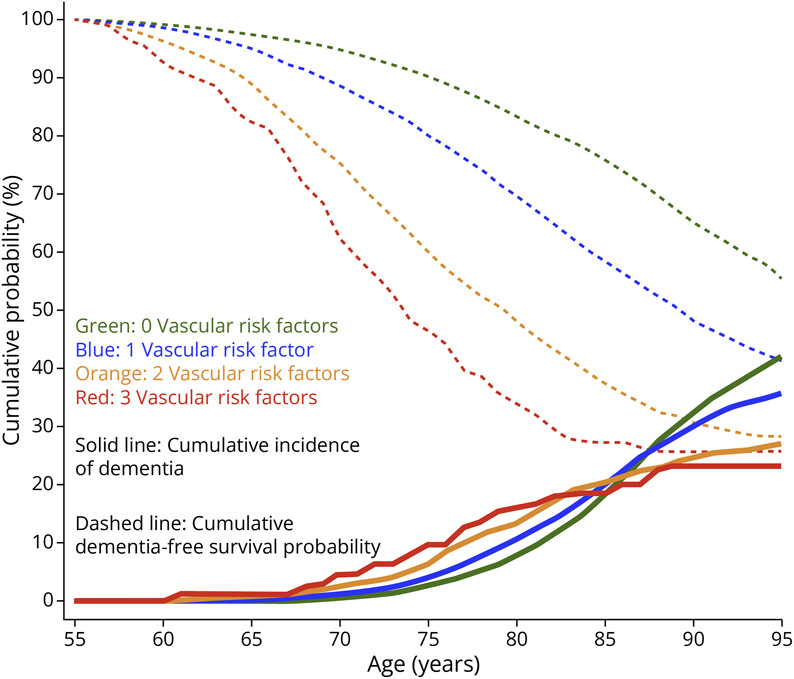
Analysis of the data revealed that subjects who had none of the three risk factors—high blood pressure, type 2 diabetes, and smoking—lived an average of 30.1 years without developing dementia. On the other hand, those with one risk factor lived an average of 26.3 years without developing dementia, those with two risk factors lived an average of 21 years, and those with three risk factors lived an average of 17.5 years.
In other words, people who had normal blood pressure, did not have type 2 diabetes, and did not smoke in middle age were approximately 13 years longer in terms of living without developing dementia compared to those who had all three of these factors. It has also been reported that people with these three risk factors were more likely to die at a younger age.
In their paper, the research team stated, 'Maintaining optimal vascular health in middle age is associated with extending dementia-free survival by up to 12.6 years, reflecting both an increased risk of dementia and a significant increase in competing mortality risks.'
The graph below shows percentages on the vertical axis and age on the horizontal axis. Green represents the group with no risk factors (5271 people), blue represents the group with one risk factor (5154 people), orange represents the group with two risk factors (1808 people), and red represents the group with three risk factors (176 people). The solid line shows the 'cumulative incidence rate of dementia,' and the dashed line shows the 'probability of surviving without developing dementia.' It can be seen that the fewer risk factors there are, the higher the probability of living without developing dementia. On the other hand, the proportion of the group with fewer risk factors in the cumulative incidence rate increases with age. This is because the group with more risk factors has a higher rate of death from other diseases before developing dementia. Therefore, up to around age 85, the fewer risk factors there are, the lower the cumulative incidence rate.
The data also shows that there are differences in the risk of developing dementia depending on the group, such as 'women with all three risk factors had an average dementia-free period of 18.1 years, compared to 16.6 years for men' and 'white subjects had an average dementia-free period of 19.6 years, compared to 16 years for black subjects.'
Dr. Joseph Koresh, co-author of the paper and director of the Institute for Optimal Aging at NYU Langone Medical Center, said, 'Our findings suggest that proactively avoiding these factors in middle age is a strategy for people to maintain brain health for more than 10 years. We hope these results will encourage people to quit smoking and pay close attention to their vascular health after age 45.'
Related Posts:








in Free Member, Science, Posted by log1h_ik