Qwen-AgentWorld, an AI model that replicates seven different execution environments, has been released, allowing AI agents to be trained to predict behavioral outcomes in advance without the need for a real-world environment.
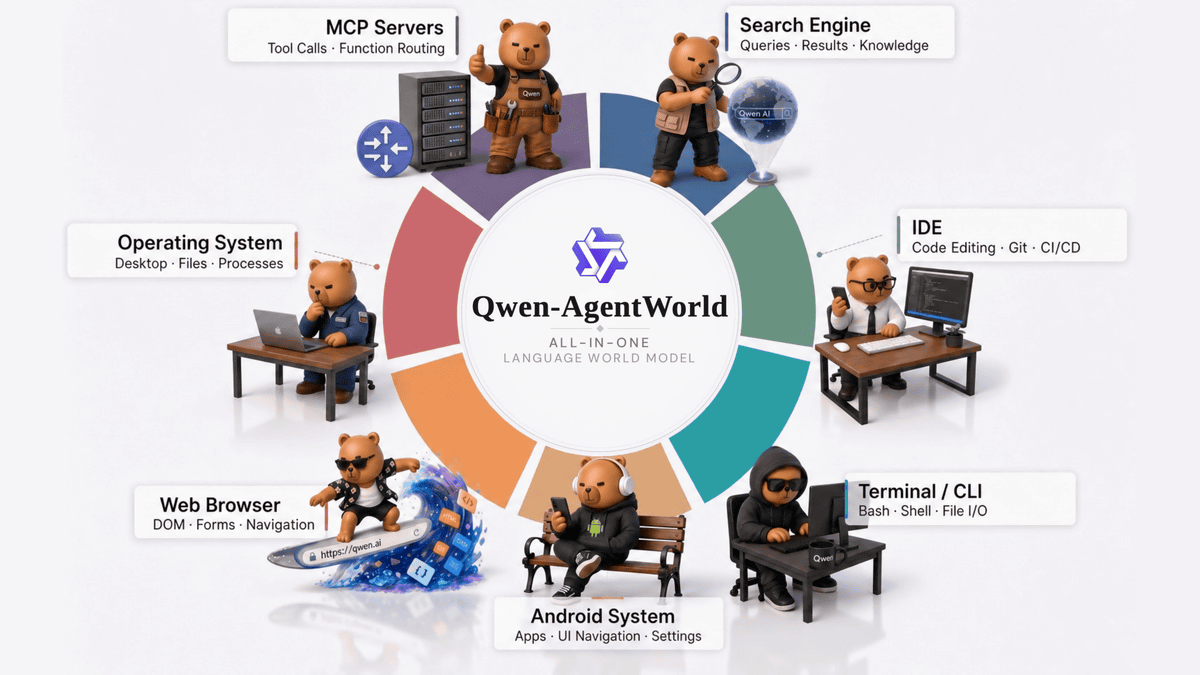
Qwen, the AI research team at Alibaba, a major Chinese technology company, released ' Qwen-AgentWorld ' on June 23, 2026. According to Qwen, Qwen-AgentWorld is a world model built on a language model, and this approach may be a way to push the limits of general-purpose agent capabilities.
Qwen-AgentWorld: Language World Models for General Agents
Qwen-AgentWorld is a 'native language world model' that simulates seven agent environments within a single model. These seven agent environments include MCP (a standard protocol for connecting AI applications to external systems), a search engine environment, a command-line environment (Terminal) such as Linux, a software development environment (SWE), a web browser environment, a desktop OS environment, and an Android smartphone environment. It is considered the first model that can reproduce these seven types of agent execution environments within a single model.
📣📣 Meet Qwen-AgentWorld — a native language world model that simulates 7 agent environments (MCP, Search, Terminal, SWE, Web, OS, Android) within a single model. Environment modeling is the training objective from day one, not a post-hoc adaptation.
— Qwen (@Alibaba_Qwen) June 24, 2026
🤔 LLMs are trained to be… pic.twitter.com/ahvxH66uxT
According to Qwen, while language agents are trained to operate in interactive environments, no language model is explicitly trained to model the environment itself, such as predicting what will happen next based on the current state and the agent's actions. Qwen-AgentWorld is a language world model trained in three stages: continuous pre-training (CPT), supervised fine-tuning (SFT), and reinforcement learning (RL), based on more than 10 million actual agent operation logs. Because the environment can be freely changed within the simulator and situations that are difficult to reproduce in the real environment can be created, it is possible to run a large number of simulations under conditions that are difficult in the real environment, and train agents more efficiently.
Qwen validated the effectiveness of the language world model in two ways. The first method involved using the world model as a simulator instead of a real environment to reinforce-learn an AI agent. This method allowed for free control of the environment, resulting in higher performance than training in a real environment alone. The second method involved using the language world model as a pre-trained model for the agent. In this case, the capabilities could be transferred to seven different benchmarks without additional reinforcement learning for each agent, demonstrating that the language world model can serve as a foundation for high-performance AI agents.
Qwen explains that interaction with real-world environments remains the most important method for training AI agents, and that language world models are neither a replacement nor simply a cost-saving measure. Instead, he argues that language world models have two advantages as a new method that complements real-world environments. First, they enable large-scale, controllable learning that is difficult to achieve in real-world environments. Second, while traditional AI agents focus on 'deciding the next action from the current state,' language world models allow agents to acquire the 'ability to predict the world' itself, enabling them to predict first and then act.
Qwen explains that three things are important for realizing a general-purpose language world model: 'learning in diverse environments,' 'transferring skills between different fields,' and 'acquiring real-world knowledge through continuous pre-learning (CPT).' By incorporating knowledge from specialized fields such as law, medicine, finance, and cybersecurity through continuous pre-learning, they have made it possible to simulate environments that are close to real-world conditions.
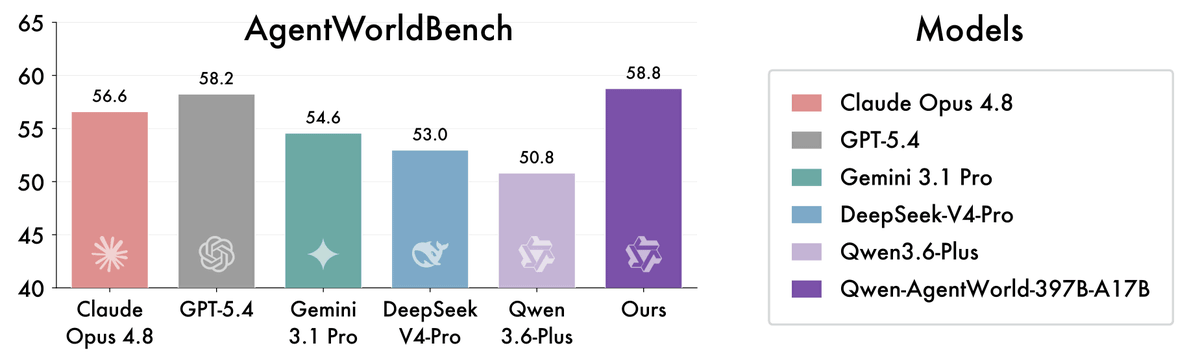
Qwen also released 'AgentWorldBench,' a 7-domain benchmark that evaluates simulation quality using responses obtained in real environments as ground truth data. Based on AgentWorldBench, 'Qwen-AgentWorld-397B-A17B' achieved overall simulation quality that surpassed GPT-5.4 , Claude Opus 4.8 , and Gemini 3.1 Pro .
Two versions have been released: 'Qwen-AgentWorld-35B-A3B' with a total of 35 billion parameters and 3 billion parameters enabled during inference, and 'Qwen-AgentWorld-397B-A17B' with a total of 397 billion parameters and 17 billion parameters enabled during inference. These are available on Hugging Face and ModelScope. They can be used via the APIs of common inference frameworks, and Hugging Face also provides example commands for starting an OpenAI-compatible API server.
Qwen-AgentWorld - a Qwen Collection
https://huggingface.co/collections/Qwen/qwen-agentworld
Qwen-AgentWorld collective story-come from Qwen · Demon Tower Shrine
https://modelscope.cn/collections/Qwen/Qwen-AgentWorld
Related Posts:


in AI, Posted by log1e_dh