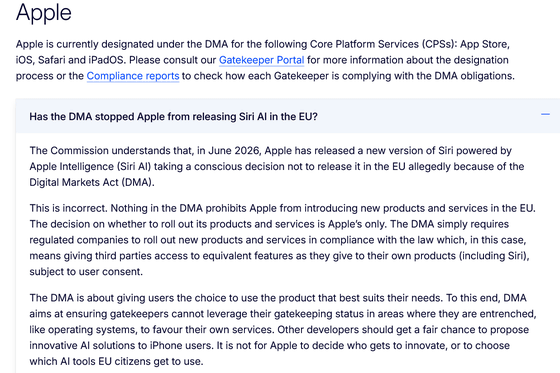
Apple claims it cannot release 'Siri AI' in Europe due to EU regulations, but the European Commission counters that 'there are no provisions whatsoever that prohibit Apple from introducing new products or services within the EU.'
At its
EU Citizens Q&A - Digital Markets Act (DMA) - European Commission
https://digital-markets-act.ec.europa.eu/citizens-and-whistleblower-portal/eu-citizens-qa_en
Apple's game of chicken with EU over Siri AI: Who will blink first? | The Verge
https://www.theverge.com/ai-artificial-intelligence/947051/apple-europe-dma-siri-ai
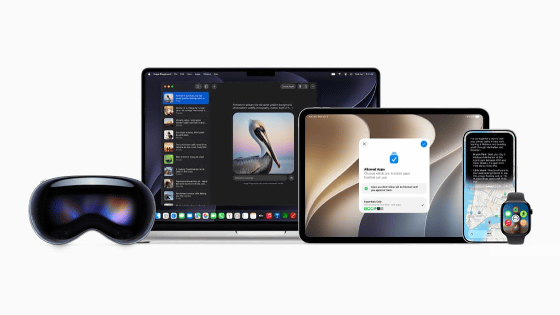
Siri AI is an AI assistant that integrates the new Apple Intelligence, and compared to the previous Siri, it offers significantly improved functionality such as 'composing emails,' 'understanding images,' 'automatic proofreading,' 'password management,' and 'displaying information during phone calls.' Siri AI will be available simultaneously with the release of 'iOS 27,' 'iPadOS 27,' 'macOS 27,' 'visionOS 27,' and 'watchOS 27,' which are scheduled for Fall 2026. However, Apple has announced that 'due to the impact of the Digital Markets Act, the availability of Siri AI in iOS 27 and iPadOS 27 will be delayed within the EU.'
iOS 27's flagship feature, 'Siri AI,' has been delayed in the EU - GIGAZINE
According to Apple, EU regulators, based on the DMA, have demanded that Apple 'grant third-party AI systems other than Siri AI access to user data and control apps,' 'provide virtually unlimited access to users' devices for all AI systems,' and 'enable all AI systems to act autonomously based on their access without continuous user oversight or control.' To comply with these regulations while mitigating user risks, Apple designed a system called 'Trusted System Agent' that allows AI assistants other than Siri AI to securely access various functions. However, the European Commission rejected Apple's proposal, leading Apple to decide to postpone the launch of Siri AI within the EU, taking into consideration the risks to users.
Apple's senior vice president of global marketing, Greg Joswiak, said at a press conference, 'Let me be clear, Apple is a strong supporter of interoperability. The issue lies in the strict interpretation of the DMA, which would require providing others with 'unrestricted access' to virtually all information on a user's device. I can't imagine anything more irresponsible and concerning to privacy and security than opening up an entire OS to third-party systems.'
However, immediately after Apple's announcement, the European Commission countered that its regulations do not prevent Apple from introducing new features.
Following Apple's announcement, the DMA's official website was updated, adding the following statements: 'The DMA contains no provisions that prohibit Apple from introducing new products or services within the EU,' and 'The European Commission has been in regular contact with Apple regarding this matter, but Apple has not developed a proposal for an interoperability solution that complies with the DMA.' In other words, according to the European Commission, while it is true that the DMA is involved in the delay of Siri AI, the problem lies not with the DMA itself, but with Apple's design.
On the other hand, in response to the European Commission's counterarguments, Joswiak further countered, 'The European Commission has not held any meaningful discussions about our proposal. Given that the proposal has been rejected and the European Commission is not involved, there is no solution that we can design at this time.'
Professor Friso Bostoen, who specializes in competition law and digital regulation at the University of Tilburg in the Netherlands, supported Apple's concerns, stating, 'Forcing platforms to expose their systems carries very real security and privacy risks.' However, Professor Bostoen explained that Apple's emphasis on privacy and security may not necessarily reflect Apple's intentions, and in fact, in the lawsuit between Apple and Epic Games over proprietary payment systems in the app store, the judge expressed skepticism about Apple's privacy and security arguments.
Apple loses appeal in antitrust lawsuit against Epic Games, but 'appropriate fees' are recognized - GIGAZINE

Michael Beale, professor of technology law and policy at University College London, pointed out, 'The core issue is that Apple is making exceptions to its long-established privacy and security mechanisms in order to maintain its competitiveness in AI. Apple's privacy and security model is built on extreme vertical control by the company and is in danger of collapsing when interoperability is introduced. In other words, Apple is willing to change its practices for Siri AI and give the AI the ability to access vast amounts of data across various apps, but when competitors request similar access, it claims it is too dangerous.' According to Beale, the solution that Apple has proposed to the European Commission has not been made public, so it cannot be properly evaluated.

Jan Penflat, senior policy advisor at the European Digital Rights Advocacy Group (EDRi), argues that Apple's move is a means of pressuring the European Commission to allow the DMA to be terminated. 'This is a lobbying tactic. The problem is not the DMA, but Apple's refusal to open up a software ecosystem that stifles competition,' Penflat said, pointing out that the problem lies with Apple, not the EU's DMA.
Related Posts: