Claude Fable 5 is a 'relentlessly proactive' AI that will even open a browser to track down bugs without being told.

Anthropic has reported a debugging case involving its new AI model, 'Claude Fable 5,' which developer Simon Willison described as operating autonomously and 'relentlessly aggressively.'
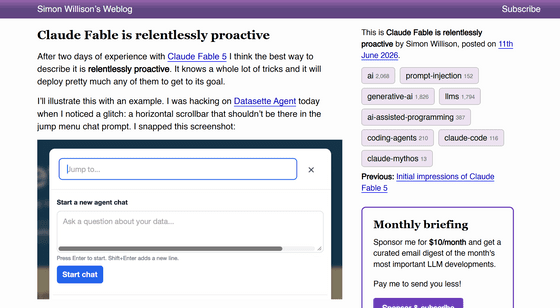
Claude Fable is relentlessly proactive
Claude Fable 5 is a consumer-oriented model of the 'Mythos class' announced by Anthropic on June 9, 2026. While it shares the same core components as the limited-release 'Claude Mythos 5,' Fable 5 incorporates security measures related to cybersecurity, biology, and chemistry. It is positioned as a version with added safety features to make a powerful model more accessible to the general public.
The official version of 'Claude Mythos' has finally been released, and 'Claude Fable,' a version with no user restrictions, has also been released, making it available to everyone - GIGAZINE
While Mr. Wilson was using the data analysis tool 'Datasette Agent,' he noticed an unnecessary horizontal scrollbar appearing in the chat input field displayed in the jump menu. Web application bugs, such as display issues only occurring in specific browsers, strange behavior in components using external libraries, or display issues arising from minor CSS adjustments, are difficult to pinpoint simply by looking at the code. A human developer would typically verify the issue across multiple browsers, investigate the impact of display size and CSS, and write test code as needed.
Mr. Wilson opened a new session on Claude Code using Claude Fable 5, handed out screenshots, and instructed us to 'look at the dependencies and figure out why the horizontal scrollbar is showing.'
What was distinctive about Mr. Wilson's case was that Fable 5 didn't try to answer based on guesswork alone. Fable 5 found a way to start a local development server and tested Chrome, Firefox, and WebKit browsers using a browser automation tool called Playwright. When they couldn't reproduce the problem on Playwright, they created test HTML and checked how it displayed in actual Firefox and Safari browsers.
Furthermore, Fable 5 added JavaScript to the Datasette template to automatically display the input fields for questions. This creates a mechanism that simulates the '/' key being pressed after the page loads, in situations where a human would normally need to press a keyboard shortcut.
Because the cause couldn't be narrowed down by appearance alone, Fable 5 even set up a small web server to collect numerical data on the width and scroll state of input fields. Although the final fix only required two lines of CSS, the process involved testing on multiple browsers, taking screenshots, creating verification code, and building a measurement server.

While convenient, Wilson also points out security concerns. Coding agents like Claude Code can execute commands in the terminal, rewrite files, open browsers, and start local servers. The more proactive the AI is in solving problems, the greater the impact of errors or malicious instructions.
Wilson said that while he found it interesting how Fable 5 tried one extreme measure after another for a small CSS fix, it also served as a strong warning that coding agents should not be run outside of a sandbox. Claude argued that Fable 5's 'relentless aggressive' behavior demonstrates the possibility of AI approaching answers without waiting for human confirmation, while at the same time raising the question of how much terminal control should be allowed for AI.
Related Posts:





in AI, Posted by log1d_ts