YouTube to automatically detect AI-generated content, displaying labels without requiring uploaders to declare it.
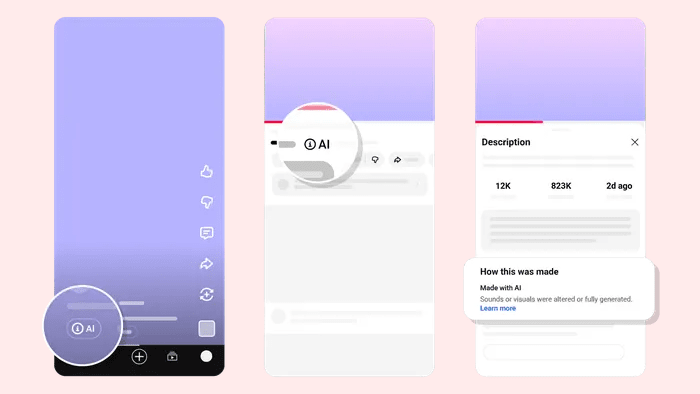
YouTube has announced that it will introduce a system to automatically detect AI-generated content and apply disclosure labels even if the creator has not declared it.
Improving AI labels for viewers and creators - YouTube Blog
Simplified AI Labels & Auto-Detection: What You Need to Know - YouTube
Since 2024, YouTube has been displaying disclosure labels to inform viewers that some or all of a video may have been modified or generated by AI if the creator declares the use of AI tools. This is especially helpful for realistic footage that could be mistaken for real people, places, or events, as it helps viewers understand the context of the video.
According to YouTube, the community has consistently expressed a desire for greater transparency regarding generated AI content. Based on its operations since 2024, YouTube has learned what viewers and creators find useful about disclosing AI usage, and has announced changes to two aspects: how disclosure labels are displayed and how AI is automatically detected.
First, disclosure labels displayed on realistic and meaningful AI-generated content will be moved to a more prominent location. For regular full-length videos, the disclosure label will appear directly below the video player and above the description box. For short videos, the disclosure label will be overlaid on top of the video.
On the other hand, for clearly unrealistic images or animations, or content that only undergoes minor changes, disclosure will be made in the expanded description section. For example, changes such as color correction, lighting filters, background blur, and special effects that alter the atmosphere of the video are likely to be treated as changes that are unlikely to mislead viewers into believing they are witnessing real events.
Furthermore, YouTube is gradually introducing new internal signals to identify AI-generated content starting in May 2026. Even if a creator does not declare whether they used AI, if YouTube's system detects significant use of photorealistic AI, a disclosure label will be automatically applied. This means that instead of relying solely on creator self-declarations, YouTube's detection system will supplement the information displayed to viewers.
However, YouTube is not eliminating the requirement for creators to manually disclose their use of AI. Creators will still need to declare any photorealistic AI use. AI-powered automatic detection is intended as a supplementary mechanism to address any undeclared instances.
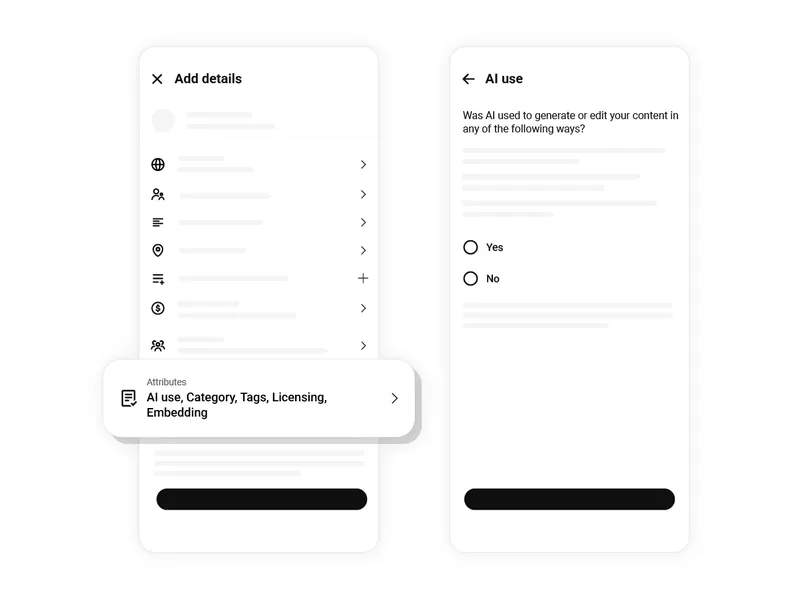
If a creator believes their content has been incorrectly identified as AI-generated by YouTube's AI automatic detection, they can change the disclosure status from YouTube Studio. However, in some cases, the disclosure label will remain permanent. Examples given by YouTube include content created using YouTube's own AI tools, Veo and DreamScreen, or content that includes C2PA metadata indicating it was entirely generated by AI.
Furthermore, the purpose of the disclosure label is not to impose penalties, but to provide information that makes it easier for viewers to understand the background of the video. YouTube explains that 'the mere presence of a disclosure label does not affect whether a video is recommended or whether it can be monetized.'
Related Posts:




in AI, Video, Web Service, Posted by log1d_ts