The record for superconductivity at atmospheric pressure has been broken for the first time in 33 years, reaching -122°C, just 140°C away from room temperature.

A research team from the University of Houston and the Texas Superconductivity Center at the University of Houston in the United States has reported raising the record for the superconducting transition temperature at ambient pressure to 151K (approximately minus 122°C).
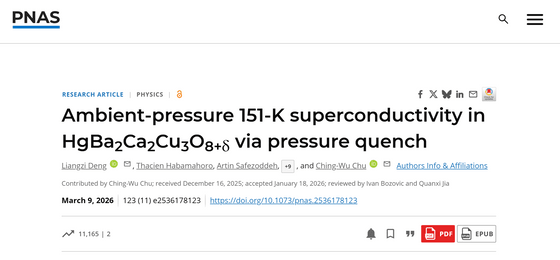
Ambient-pressure 151-K superconductivity in HgBa2Ca2Cu3O8+δ via pressure quench | PNAS
Scientists break 30-year superconductivity record at normal pressure | ScienceDaily
https://www.sciencedaily.com/releases/2026/05/260527023220.htm
When electricity flows through a metal, some of the energy is lost as heat due to electrical resistance. On the other hand, superconductors have zero electrical resistance below a certain temperature. Although they are expected to have applications in power lines, electronic devices, MRI, and nuclear fusion technology, many superconductors need to be cooled to extremely low temperatures, which has been a major obstacle to practical application.
The 'transition temperature,' which is the temperature at which a material switches to a superconducting state, is a crucial value that affects the usability of superconductors. A higher transition temperature reduces the amount of equipment and cost required for cooling, so researchers have spent many years searching for 'materials that become superconducting at higher temperatures.'
In this study, the research team reported that they were able to raise the superconducting transition temperature to approximately -122°C under normal pressure using 'Hg1223,' a mercury-based copper oxide ceramic reported in 1993. While some superconductors exhibit high transition temperatures under high pressure, materials that require equipment to maintain high pressure are difficult to handle, making it important for them to exhibit high transition temperatures at normal pressure.
The previous atmospheric pressure record was 133K (approximately minus 140°C) using Hg1223. In this study, while using the same Hg1223, the transition temperature was increased by 18K, resulting in a new atmospheric pressure record after 33 years.
The key technology behind this record-breaking achievement is 'pressure quenching,' a technique that aims to 'trap properties that arise under high pressure even after the pressure is released.' The research team first applied very high pressure to Hg1223 to create a state that is conducive to superconductivity. Then, while maintaining the pressure, they cooled the material to a predetermined temperature, and after that, rapidly removed the pressure.
Applying high pressure can alter the atomic arrangement and electronic state of a material, potentially enhancing its superconducting properties. However, if the material returns to its original state the moment the pressure is released, it won't function as a superconductor at normal pressure. The research team reported that the superconducting properties enhanced under high pressure by pressure quenching were maintained at normal pressure, and a transition temperature of 151K was confirmed.

The research team explained that they 'applied pressure equivalent to up to 300,000 times normal atmospheric pressure while cooling Hg1223 to near absolute zero.' They reported that the high transition temperature was maintained even after the pressure was rapidly removed, the effect lasted for two weeks, and it was reproducible in five different samples.
'While other researchers have shown that room-temperature superconductivity can be achieved under high pressure, this research team's method suggests the possibility of maintaining a high-pressure state without maintaining the pressure,' said Qin Wu Chu of the University of Houston.
The 151K temperature reported this time is approximately -122°C, which is still about 140°C below room temperature. While this is not yet the stage where superconductors can be used directly in the normal temperature environments of homes and factories, the increase in the temperature recorded at atmospheric pressure from 133K to 151K is a significant step forward in reducing cooling costs.
If superconductors can conduct electricity with zero electrical resistance, it could potentially reduce energy loss during power transmission. Mr. Chu states, 'About 8% of electricity is lost in the power grid, so reducing this loss would lead to significant savings and help reduce the environmental impact.' Potential applications include MRI in the medical field, nuclear fusion in the energy field, and quantum technology and high-speed electronics in the computer field.
Rohit Prasankumar, who is in charge of superconductivity research at the technology investment firm Intellectual Ventures, said, 'Room-temperature superconductivity has been considered a 'holy grail' for scientists for over a century.' He also pointed out that while the University of Houston team's work has brought them closer to the goal than ever before, bridging the approximately 140°C gap from 151K to room temperature will require a deliberate and coordinated effort from the entire research community, including not only physicists but also materials scientists, chemists, and engineers.
Related Posts:



in Science, Posted by log1d_ts