Huawei proposes 'Tau Scaling Law' as an alternative to 'Moore's Law,' and plans to achieve a density equivalent to a 1.4nm process by 2031.

In the semiconductor industry, Moore's Law, which states that 'the number of transistors on an integrated circuit doubles every 24 months,' is well known. However, Huawei, a global tech company headquartered in China, has proposed a new law, the ' Tau (τ) Scaling Law ,' as a guide for the future development of the industry.
HUAWEI Presents the Tau (τ) Scaling Law, Enabling Breakthroughs in Transistor Density and System Performance - Huawei
IEEE ISCAS 2026 | Keynote Speakers
China's Huawei unveils new sanctions-busting chip architecture that replaces Moore's Law - SiliconANGLE
Huawei Says It Has Workaround to Match Leading Chips - WSJ
https://www.wsj.com/tech/huawei-says-it-has-workaround-to-match-leading-chips-c6075fd1
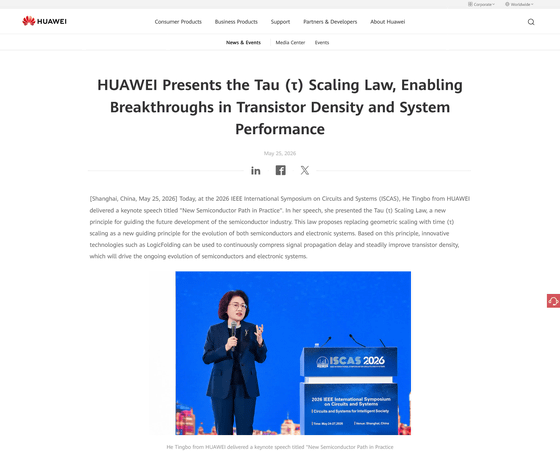
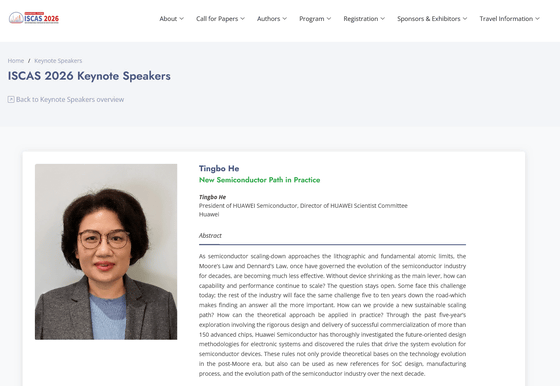
At the IEEE ISCAS 2026 technical symposium held in Shanghai, Mr. He Tingbo, who leads Huawei's semiconductor business unit, delivered a keynote speech.
In his lecture, Mr. He proposed the 'Tau (τ) Scaling Law,' which adopts time (τ) as a new guideline for the evolution of semiconductors and electronic systems, rather than using geometric scales.
Based on this principle, Mr. He argues that by utilizing innovative technologies such as the newly announced 'LogicFolding' architecture, signal propagation delay can be continuously reduced, stably increasing transistor density and thus driving the continuous evolution of semiconductors and electronic systems.
Moore's Law, originally proposed in 1965 by Gordon Moore, co-founder of Intel, is known as 'Moore's Law' or 'the number of transistors in a semiconductor integrated circuit doubles every 24 months,' or 'the integration density (integration rate) of transistors in a semiconductor integrated circuit doubles every 24 months,' as revised in 1975. Semiconductor technology has evolved in accordance with this law, which Moore derived from empirical observation.
However, the 'Moore's Law Limitation Theory' has been repeatedly put forward, arguing that there is a limit to how long it can continue to 'double every 24 months.' In 2017, Morris Chang, chairman of TSMC, a major semiconductor manufacturer, declared that 'Moore's Law is no longer valid.'
'Moore's Law has reached its limits,' says the chairman of TSMC, a semiconductor giant that supplies chips to iPhones - GIGAZINE

On the other hand, in 2023, then-Intel CEO Pat Gelsinger expressed the view that 'the pace is slowing down, but it's still effective.'

by Fortune Brainstorm TECH
Mr. He describes the 'Tau scaling principle' in four levels.
First, at the device level, we optimize the resistance and parasitic capacitance of transistors and wiring to minimize the device-level time constant τ of the underlying physical layer.
At the circuit level, the LogicFolding architecture eliminates the physical boundaries of conventional layouts, significantly shortening critical path routing. This effectively reduces resistive and capacitive loads in signal propagation, improving transistor density and circuit performance.
At the semiconductor level, full-stack collaborative design of software, architecture, and silicon is introduced to achieve workload-driven, fine-grained control over instruction and data flow, thereby increasing system-level parallelism and efficiency and significantly reducing end-to-end execution time.
At the system level, UnifiedBus redefines the interconnection protocol for computing systems, enabling SuperPoD's unified memory addressing and native memory semantics, and significantly reducing system communication latency.
Huawei has designed, produced, and provided services for 381 chips based on the 'Tau Scaling Law' over the past six years. In the fall of 2026, a new Kirin chip using the LogicFolding architecture will be released, significantly improving chip performance. Furthermore, by 2031, they plan to achieve transistor density equivalent to a 1.4nm process with high-end chip designs based on the 'Tau Scaling Law.'
Related Posts:






in Hardware, Posted by logc_nt