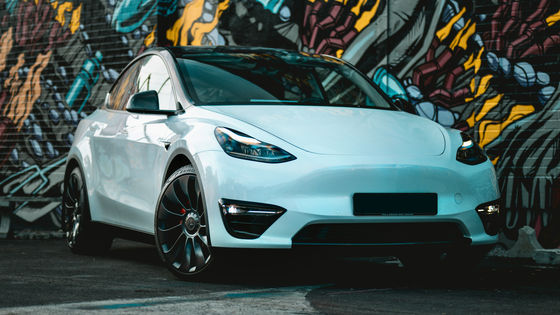
Tesla recalls 14,500 Model Y vehicles due to a sticker defect.
On May 22, 2026,
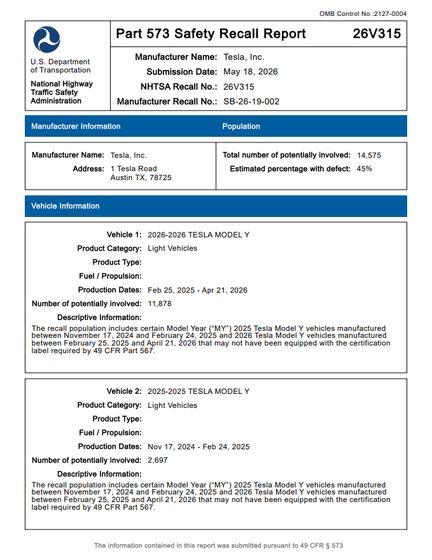
Part 573 Safety Recall Report 26V315
https://static.nhtsa.gov/odi/rcl/2026/RCLRPT-26V315-5410.pdf
Tesla recalls 14,575 Model Ys because they may be missing a sticker | Electrek
https://electrek.co/2026/05/22/tesla-is-recalling-14575-model-ys-because-they-may-be-missing-a-sticker/
Tesla to recall over 14,500 Model Y SUVs in US over missing weight certification label | Reuters
https://www.reuters.com/legal/litigation/tesla-recall-over-14500-model-y-suvs-us-over-missing-weight-certification-label-2026-05-22/
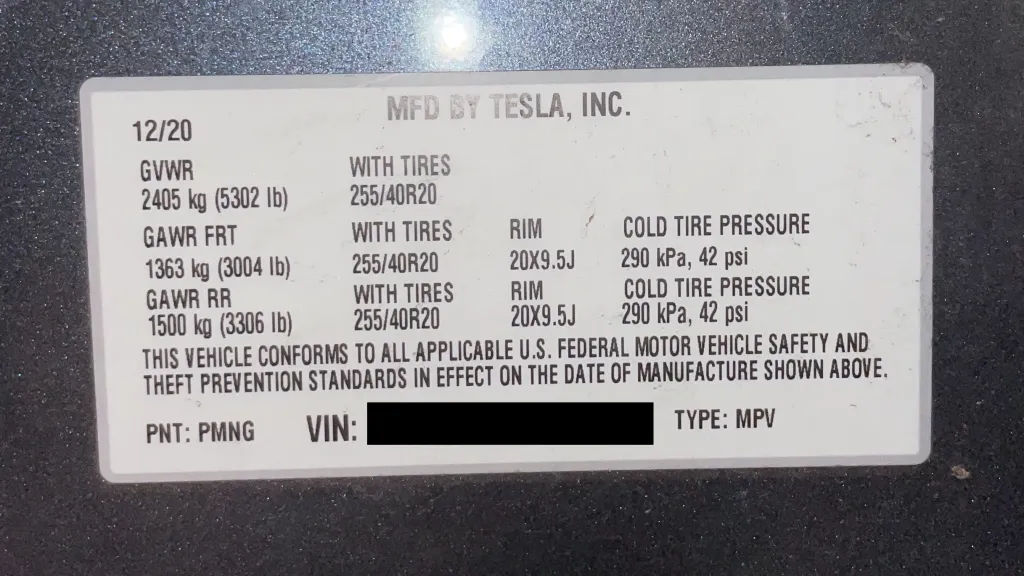
All vehicles have a label on the inside of the driver's side door indicating the vehicle's maximum load capacity. This label also contains useful information about the tires and the vehicle's manufacturing date.
The application of the maximum load capacity label is mandated by 49 CFR Part 567 .
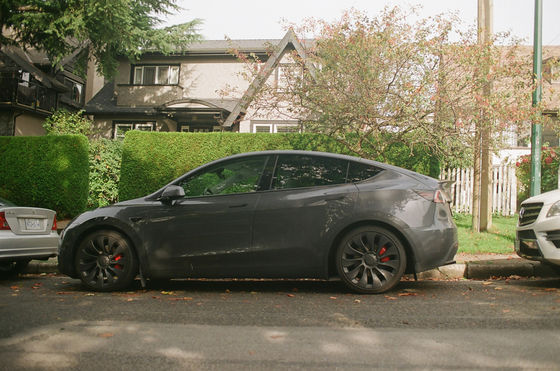
The recall affects 14,575 Model Y vehicles manufactured between November 2025 and April 2026 because they lack the maximum load capacity label. According to the NHTSA, the absence of the label could lead customers to overload their vehicles, increasing the risk of collisions.
14,575 vehicles that may not have the label attached are subject to the recall, but Tesla estimates that only about 45% of them actually lack the label. Tesla plans to inspect the recalled vehicles and attach the labels.
While the absence of a 'maximum load capacity label' may seem like a minor detail, automotive media outlet Electrek points out that 'there's a reason why maximum load capacity labels are present. It's to prevent overloading vehicles. Overloading a vehicle can compromise safety by reducing handling, causing the suspension to bottom out, increasing the risk of tire blowouts, putting strain on the powertrain, and increasing braking distances.'
The flaw in the maximum load capacity labels came to light when it was discovered that an automated image scanning tool at Tesla's Fremont plant was malfunctioning between November 17, 2025, and April 21, 2026. The automated image scanning tool's role was to verify that each vehicle had the label attached.
Tesla became aware of the problem on April 17, 2026, when they noticed that some vehicles were missing labels. It was later discovered that the cause was a faulty tool. Tesla has repaired the automated image scanning tool, and as of the time of writing, workers are now manually double-checking whether the stickers are applied during the manufacturing process.
According to the NHTSA, there have been no reports of collisions, fatalities, or injuries caused by defects in the maximum load capacity label. Electrek also notes, 'Cars usually have two labels with a lot of overlapping information, and it just looks like one of them is missing, so it doesn't seem like a big deal in practice. But rules are rules.'
Electrek also points out that it's far too long for these problems to go unnoticed for nearly six months, even though production continues. While each issue may seem minor individually, a car is made up of thousands of tiny parts that must all work together. Therefore, it's not desirable for one of them to malfunction for an extended period. 'While applying the stickers itself is a cost-free task for Tesla, inspecting 14,575 vehicles will be a time-consuming task for service centers,' Electrek wrote.
It should be noted that Tesla did manufacture Model 3s without a maximum load capacity label in 2019, but the manufacturing period at that time was only 5 days, so the situation is significantly different from the current case.
Related Posts:


in Vehicle, Posted by logu_ii