How do 'non-animation directors' who aren't animators direct anime? A talk event at Machi★Asobi Vol.30 featuring directors Seiji Mizushima (Expelled from Paradise) and Tomoyuki Kurokawa (King Dedede)
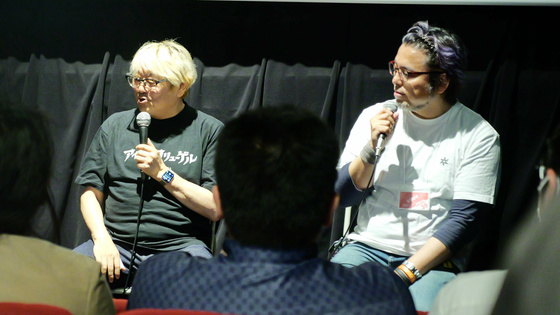
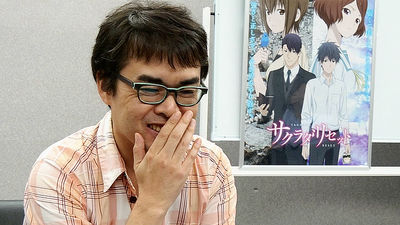
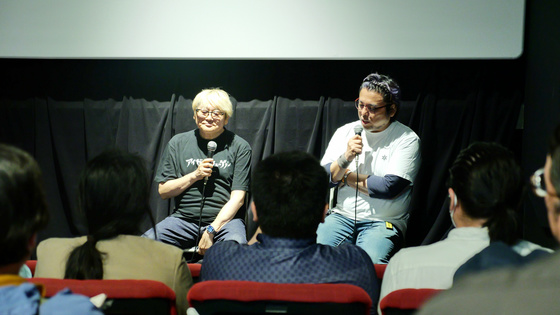
A talk show titled 'How do non- animation-focused directors direct ?' featuring Seiji Mizushima, director of ' Expelled from Paradise : Resonance of the Heart' (to be released on November 13, 2026), and Tomoyuki Kurokawa, director known for the theatrical anime 'Dead Dead Demon's Dedededede Destruction' and ' Our Dawn, ' was held at Machi★Asobi Vol.30 on May 16, 2026, and here is a report on it.
A talk show about how non-animation directors approach directing (Seiji Mizushima x Tomoyuki Kurokawa)
https://www.machiasobi.com/event/580/
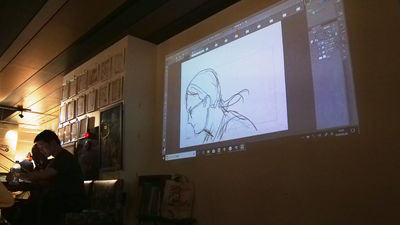
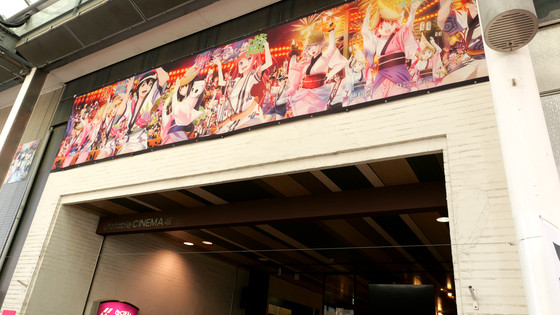
The talk show was held at Cinema 2 of ufotable CINEMA.
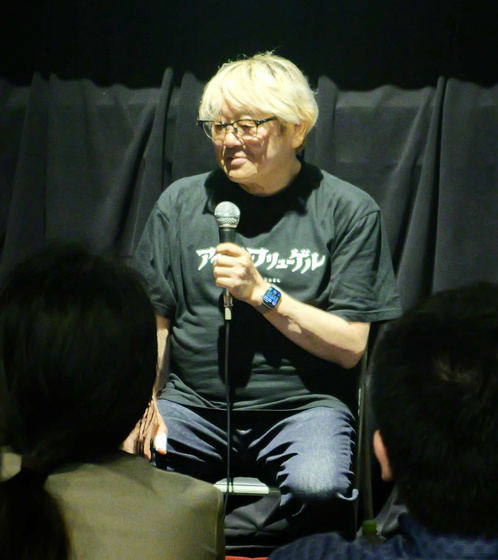
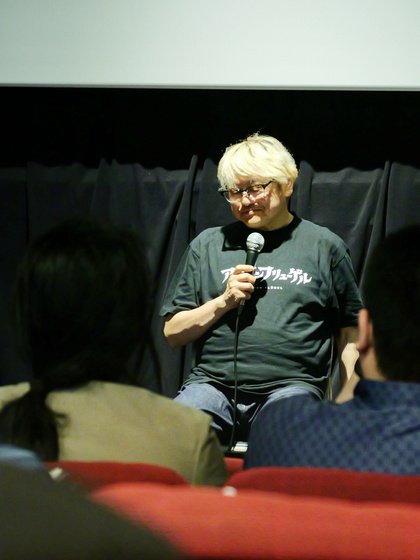
After working in cinematography and production management, Director Mizushima briefly moved into the game industry before returning to the anime industry. He directed works such as ' Shadow Skill ' and 'Lupin the Third: Walther P38,' and then directed ' Generator Gawl ' and ' Dai-Guard .' According to Director Mizushima, 'I was very lucky to become a director.'
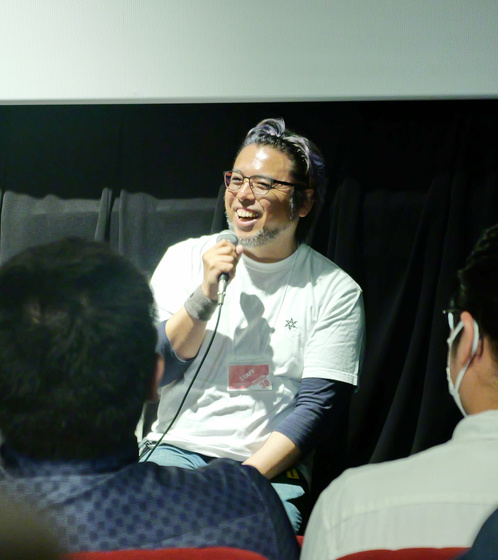
Director Kurokawa aspired to direct live-action films during his student days, but entered the industry through an animation production company, progressing from production assistant to director. He made his directorial debut with the OVA ' MURDER PRINCESS ' relatively early, within 5-6 years of joining the company. It was also revealed that the two directors met by chance at a theater in Kichijoji when Director Kurokawa was about to become a freelancer, and that's how he ended up greeting Director Mizushima.
Apparently, anime directors can be classified into two types: those who are former animators and are skilled at drawing, and those who moved into directing from production or cinematography. In the past, there were quite a few directors who were not skilled at drawing, and Director Mizushima and Director Kurokawa both fall into the latter category.
Furthermore, there are directors who are not from an animation background but are known for their 'skillful drawing,' and the late director Tatsuo Sato, who passed away in May 2026, was mentioned as an example of a 'non-animation director who draws unique and extremely skillful pictures.' Director Tatsuo Sato has published some of his storyboards on his X (formerly Twittr) account.
I'll just post a few of my favorite storyboards from episode 10 of Machikado and go to sleep. See ya! pic.twitter.com/B1JX3cAlCZ
— Tatsuo Sato (@seitenhyohyo) January 6, 2020
Furthermore, in recent years, there are apparently many directors who, while not having an animation background, are graduates of art universities and possess exceptional drawing skills.
The topic of discussion was the question, 'How do directors who don't draw the pictures approach acting?' For example, both directors pointed out that directors who come from an animation background tend to omit stage directions in storyboards. Stage directions are written information in storyboards that describes the characters' actions and so on, but directors who come from an animation background can explain the situation through the pictures themselves, so they often omit stage directions.
However, no matter how many pictures you draw, there's always a possibility that different animators, producers, and other viewers will interpret them differently. Therefore, carefully writing in stage directions, which are textual information, plays a crucial role in controlling the image and ensuring that no one who reads it misunderstands what they're seeing.
On the other hand, directors who are not animation directors themselves, naturally understand that their drawings won't necessarily become the final screen, so they accept that drawings are merely for conveying an image, and instead focus on writing detailed stage directions. Both directors commented that 'just because a drawing is beautiful doesn't mean it will make for an interesting storyboard.'
For example, in scenes where a character is smiling on the outside but crying inside, the superficial facial expressions depicted in the storyboard may not be enough to convey the character's true psychological state.
If stage directions are omitted at this point, an unsuspecting animator might proceed with the drawing based solely on the superficial 'smiling face,' which could lead to problems. To prevent such situations, it is essential for the director to clearly add stage directions stating 'this is the true psychology' in order to ensure that the character's performance is executed as intended.
According to Director Mizushima, when the animation director was in charge of storyboarding for the TV anime ' Shaman King ,' stage directions were omitted, so Director Mizushima himself added them afterward. According to both directors, a 'good storyboard' is 'a directorial script that presents a clear plan for the acting, without causing any discrepancies in interpretation or imagery no matter who reads it.'
Directors Mizushima and Kurokawa stated that because non-animation-focused directors cannot compete solely on the quality of their artwork, they incorporate realistic approaches and meticulous techniques, which is a key point.
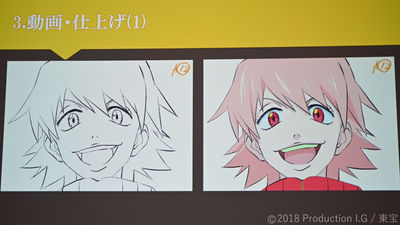
For example, there are apparently techniques involved in lip-syncing in animation. Typically, lip-syncing is based on combining three images: an open mouth, a half-closed mouth, and a closed mouth. However, by finely adjusting the timing of the mouth closing in each frame—whether the mouth closes the moment the dialogue ends or leaves a slight lingering sound—it's possible to express the character's emotions and the nuances of their speech.
In the anime ' D4DJ ,' for which Director Mizushima served as general director, in order to ensure that the actors and sound staff could understand the timing during voice recording, drawings were hastily added at the cutting stage to adjust the number of frames, and it is said that editing a single episode sometimes took up to 8 hours.
However, with the advancement of digitalization, the 'video editing' process, which prepares the video for delivery, now automatically organizes the footage to a clean timing. While this digitalization has made the work more efficient, it has also been pointed out that it can easily lead to a situation where actors simply move their mouths mechanically on set, resulting in younger directors losing opportunities to develop the skills to focus on lip-sync timing.
The event also included a question-and-answer session with the attendees.
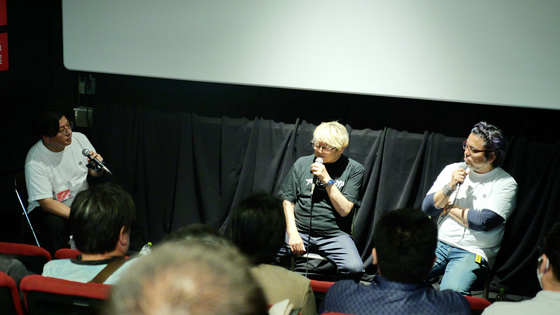
When asked whether the current trend of not being able to provide strict guidance might negatively impact the creation of interesting works, they replied, 'People who are overly sensitive to guidance tend to prioritize work over creativity, and often don't produce good work as creators. However, the people who form the core of creativity are inherently passionate, so there's probably no need to worry too much.' They also added that in recent years, new production styles have emerged where small groups of online creators start their own projects and receive support, and both directors said that interesting works that are in line with the times are constantly being produced.
On the other hand, there was also the harsh reality that if someone doesn't understand no matter how many times you explain it, you just have to accept it, and there were also observations that people's mental strength has weakened after the COVID-19 pandemic.
Regarding the way lines are drawn in storyboards, Mizushima said that 'rather than drawing with clean, single lines, leaving some ambiguous, hesitant lines gives animators room to imagine and broadens the range of interpretation when they look at the storyboards.' However, he added that these hesitant lines are often the result of drawing in haste rather than being intentional, and he revealed that when he reviewed past storyboards for the production of 'Expelled from Paradise: Resonance of the Heart,' he struggled to remember what he was trying to do when he drew them, which drew laughter from the audience.
Related Posts: