Google has announced 'Gemini for Science,' a collection of experimental features to help scientists use AI. This includes 'Science Skills,' a collection of AI agent skills integrating insights from over 30 leading life science databases and tools, and 'ERA,' an AI tool to support the creation of expert-level proof-of-concept software.
On May 20, 2026, Google announced ' Gemini for Science ,' designed to significantly expand the scale and precision of scientific inquiry.
New AI Tools for the Future of Science
https://blog.google/innovation-and-ai/technology/research/gemini-for-science-io-2026/
The scientific community is currently facing a paradox: 'As humanity's total knowledge expands rapidly, it is becoming increasingly difficult for individual scientists to grasp the whole picture.' Many scientific breakthroughs stem from finding creative connections between data, a process that can take weeks or even months if done manually. AI can be used to eliminate the problem of 'spending all day just sifting through vast amounts of data.' Google explains that AI can eliminate bottlenecks in scientific research and handle complex tasks, thereby multiplying the power of scientific research.
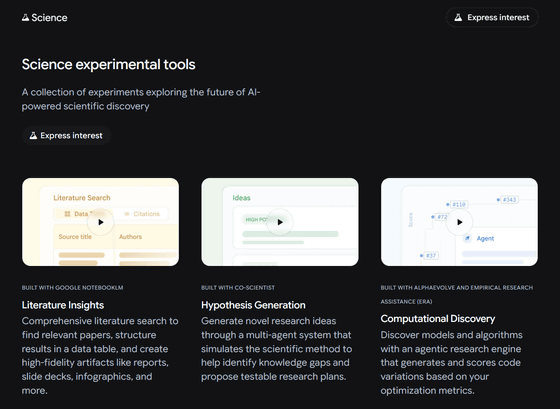
As an experimental tool for Gemini for Science, Google will release the following three main prototypes on Google Labs :
• Hypothesis generation: A function built on the foundation of Co-Scientist.
Generating new ideas is central to science, but reading and integrating the millions of papers published every year is impossible for humans alone. Hypothesis generation bridges this gap by simulating scientific methods. After defining research topics in collaboration with researchers, it hosts an 'idea tournament' with multiple AI agents to automatically generate, discuss, and evaluate hypotheses. To ensure absolute rigor, generated claims are thoroughly verified, and citations (sources) that can be clicked and referenced are always clearly indicated.
• Computational discovery: A function built on AlphaEvolve and ERA (Empirical Research Assistance).
Scientific progress is often limited by the number of hypotheses that can actually be tested through computational experiments using computers. Computational discovery, an autonomous research engine (agent-based research engine), solves this problem by generating and evaluating thousands of code variations in parallel. This allows for the smooth validation of new modeling methods in extremely complex fields such as solar power prediction and epidemiology, which would take months to validate manually.
• Literature insights: Built on Google NotebookLM
A deep understanding of scientific literature is an essential process in all research activities. Literature Insights searches vast amounts of scientific literature and organizes it in a comparative format in tables with customizable search attributes. Researchers can use the chat function to delve into detailed nuances based on their curated literature data (corpus). High-quality deliverables such as reports, slides, infographics, and audio and video summaries can also be easily generated. By utilizing Google Notebook LM, Literature Insights supports the integration of insights across multiple papers, the identification of untapped research areas, and the discovery of new opportunities.
The three tools mentioned above from Gemini for Science are available from the following page.
Experiments on the future of AI-driven science — Google Labs
https://labs.google/science/
Furthermore, as part of Gemini for Science, Google is offering a new 'Science Skills' suite. This is a specialized package that integrates insights from over 30 leading databases and tools in the life sciences, including UniProt , AlphaFold Database , AlphaGenome API , and InterPro . By leveraging Science Skills on agent-based platforms like Google Antigravity, researchers can perform complex, manual workflows such as structural bioinformatics and genome analysis, which previously took hours, in just minutes.
Google's research team, leveraging Science Skills, has already demonstrated this dramatic speed improvement. In initial tests, Google's team used Science Skills to complete complex analyses that would normally take hours in just minutes. As a result, they have successfully gained unprecedented new insights into the potential pathogenesis of a rare genetic disorder caused by mutations in the AK2 gene.
The following video features a Google research team discussing their experience using Science Skills to accelerate their research.
From Genetic Variant to Wet-lab: Accelerating the path from hypothesis to experiment - YouTube
Furthermore, Google also announced Empirical Research Assistance (ERA), an AI tool that assists with expert-level scientific coding. Given a scientific problem and criteria for success, ERA can search scientific literature, write code, explore solutions, combine multiple methods, and evaluate results. ERA considers thousands of options and uses a tree-search approach to optimize output code for a given goal. ERA has achieved expert-level performance in benchmark problems across a wide range of fields, including genomics, public health, satellite image analysis, neuroscience prediction, general time series forecasting benchmarks, and mathematics. Google says ERA 'has the potential to democratize access to expert-level computational modeling in the future and expand the capabilities of existing experts.'
Empirical Research Assistance (ERA): From Nature publication to catalyzing Computational Discovery
https://research.google/blog/empirical-research-assistance-era-from-nature-publication-to-catalyzing-computational-discovery/
ERA has also been published in the scientific journal Nature.
An AI system to help scientists write expert-level empirical software | Nature
https://www.nature.com/articles/s41586-026-10658-6
Please note that the ERA prototype is available through Google Labs' trusted tester program at the time of writing.
Ethan Morick, an AI researcher at the Wharton School of the University of Pennsylvania, who used Gemini for Science before its release, posted: 'I tried Gemini for Science a little before it went on sale. From my experience as a sociologist, it feels more focused on bioscience right now, but I think Google is a leading lab releasing full-fledged AI tools to accelerate science, and I expect them to improve rapidly in the near future.'
Got to play with a little of this before launch as well. My experience as a social scientist was that it was more bioscience focused right now, but I think Google has been the leading lab in releasing serious AI tools to accelerate science & expect to see them improve fast. https://t.co/1JPUsbdVJ5
— Ethan Mollick (@emollick) May 20, 2026
Related Posts: