The EFF criticized a bill that would mandate censorship software for 3D printers, arguing that it 'could destroy the open-source culture.'
The Electronic Frontier Foundation (EFF) has criticized the bill 'AB 2047,' currently under consideration in California, USA, arguing that it would not only mandate that all 3D printers be equipped with features to block the printing of guns and other dangerous objects, but could also criminalize users who disable these print-blocking features or use open-source alternative software.
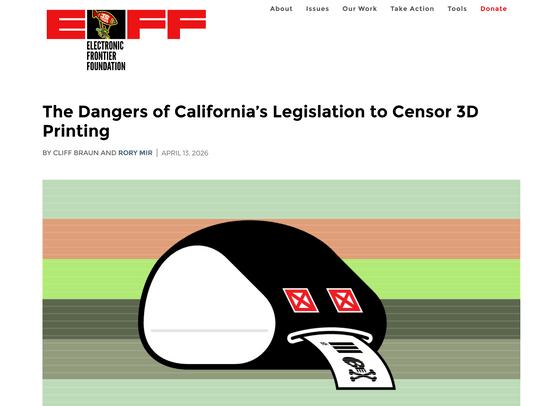
The Dangers of California's Legislation to Censor 3D Printing | Electronic Frontier Foundation
3D printers are used in a wide range of legitimate applications, including movie props, product prototypes, medical research, and the manufacture of repair parts. However, some California lawmakers are pushing for stricter regulations on 3D printers in general, citing concerns about 'ghost guns'—firearms that lack serial numbers and are difficult to trace.
3D printing for firearms is already rare and prohibited under existing laws. AB 2047 would further tighten regulations, not only blocking firearms manufacturing but also potentially depriving 3D printer owners of their right to freely control their equipment.
A particular concern is that even open-source 3D printer firmware could be deemed illegal. While users customizing firmware to suit their needs is an important part of 3D printing culture, AB 2047 could potentially target users for penalties as a way to circumvent print blocking features. Furthermore, it could allow 3D printer manufacturers to lock users into using proprietary software, parts, and consumables, potentially creating a situation similar to the forced purchase of proprietary ink for paper printers.
Manufacturers can use the print-blocking function as a pretext to restrict repairs and modifications, require purchases through their official store, and discontinu updates for older models to encourage replacement. 3D printers whose print-blocking function updates have stopped may be considered non-compliant with regulations, potentially making even resale difficult.
Furthermore, AB 2047 places a significant burden on emerging and small-scale manufacturers. They must implement print-blocking functionality, obtain state certification, and, in some cases, pay licensing fees for print-blocking software from external companies. While large manufacturers can absorb the costs of regulatory compliance, it creates a barrier to entry for smaller manufacturers. As a result, consumers will have fewer 3D printer options to choose from, and the influence of large manufacturers will increase.
This will also create a significant administrative burden for the California Department of Justice. Under AB 2047, the State Department of Justice will be responsible for creating technical standards for detecting firearm components, certifying algorithms for printing blocks, and maintaining a list of compatible 3D printers. Furthermore, they will need to continuously update the database of designs that will be blocked.
Even with all these efforts, those who manufacture firearms illegally are also breaking existing laws, so it is quite possible they will find ways to circumvent the printing block function, resulting in a cat-and-mouse game between circumvention and countermeasures. 'This could result in a bureaucratic system that is costly and manpower-intensive but ineffective,' the EFF pointed out.
Print blocking features can also lead to privacy violations. The mechanism by which 3D printers scan data before printing increases reliance on cloud connectivity and manufacturer-provided software. It cannot be ruled out that databases that initially focused on firearm parts could expand in the future to include copyrighted material, political expression, and other printed materials.
Far from enhancing safety, AB 2047 risks restricting repair, modification, research, and creative activities, undermining the grassroots innovation that has supported 3D printing. The EFF criticized AB 2047 as 'a bill that mandates technically impractical solutions to already illegal activities,' and concluded its article by arguing that 'California should reject AB 2047, and users and supporters in other regions need to pay attention to similar bills.'
Related Posts:






in Hardware, Posted by log1d_ts