Guinea worm disease, a parasite that crawls out of leg boils, is expected to become the second human infectious disease to be eradicated, with only 10 cases reported by 2025

Guinea worm disease is an infectious disease caused by ingesting water contaminated with the parasitic nematode Guinea worm. Over the course of about a year, blisters develop on the legs, from which adult worms emerge. A Guinea worm eradication program began in 1986, and the number of cases is expected to fall to just 10 by 2025. It is said to be the second disease to be eradicated by humanity, after smallpox .
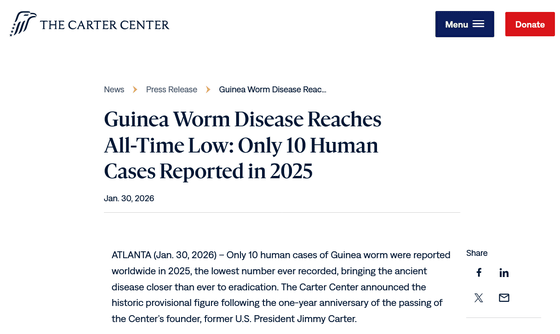
Guinea Worm Disease Reaches All-Time Low: Only 10 Human Cases Reported in 2025 - The Carter Center
https://www.cartercenter.org/news/guinea-worm-announcement/
Guinea worm on track to be 2nd eradicated human disease; only 10 cases in 2025 - Ars Technica
https://arstechnica.com/health/2026/02/guinea-worm-on-track-to-be-2nd-eradicated-human-disease-only-10-cases-in-2025/
Guinea worm disease is a type of NTD caused by parasitic and bacterial diseases, and is transmitted to humans by drinking water containing water fleas infected with Guinea worm larvae. WHO has implemented various initiatives to eradicate NTDs, and it has been reported that the number of reported cases of Guinea worm disease worldwide in 1985 was 3.5 million, but by 2015, only 22 cases were reported annually, marking 99.999% eradication.
What are NTDs, diseases caused by parasites and bacteria that infect more than 1 billion people, mainly in the poor? - GIGAZINE

The Carter Center , a nonprofit American non-profit organization, announced that the number of Guinea worm disease cases in 2025 was the lowest ever, at just 10. Since 15 cases of Guinea worm disease were reported in 2024, this represents a 33% decrease in annual cases. Please note that the tally is provisional at the time of writing; the tally is finalized at the Guinea Worm Disease Control Program meeting held each April.
In 2025, 10 human cases were confirmed in three countries: 4 in Chad, 4 in Ethiopia, and 2 in South Sudan. Complete eradication is believed to require eradication of epizootic cases, with 147 cases in Chad, 17 in Mali, 445 in Cameroon, 70 in Angola, 1 in Ethiopia, and 3 in South Sudan in 2025.
The Carter Center's Guinea Worm Eradication Program offers rewards to people who report Guinea worm disease in endemic areas. Reports are investigated and countermeasures include education on care, safe drinking water, and spraying water sources with larvicides. It is estimated that eradication programs have prevented 100 million cases since 1986.
'Our founder, former President Jimmy Carter , said he hoped to outlive the last Guinea worm,' said Carter Center CEO Paige Alexander. 'While his wish was not fulfilled, knowing that one year after his death there were only 10 human cases of Guinea worm disease would surely make him proud and remind us to keep working until we reach zero.'
Adam Weiss, Director of the Carter Center's Guinea Worm Eradication Program, stated, 'Guinea worm causes immeasurable suffering, not only to the individuals affected, but also to their families and communities. They are fighting a disease that we know how to prevent. And we have a unique opportunity to eradicate this disease. We are encouraged by the progress we have made this year, but zero is our only goal. That is why we are unwavering in our commitment to seeing this mission through.' He expressed his determination to continue working to eradicate Guinea worm disease.
The Carter Center has described Guinea worm disease as 'the second disease to be eradicated from humanity after smallpox,' 'the first parasitic disease in history to be eradicated,' and 'the first parasitic disease for which there is no cure or vaccine.'
Related Posts:

in Note, Posted by log1e_dh