Comparing the benchmark results of 'DaVinci Resolve Studio' with NVIDIA and AMD multi-GPU configurations looks like this
Puget Systems, a manufacturer of build-to-order PCs and workstations, conducted benchmark tests on the video editing software
DaVinci Resolve Studio v20 GPU Scaling Analysis | Puget Systems
https://www.pugetsystems.com/labs/articles/davinci-resolve-studio-v20-gpu-scaling-analysis/
This test used DaVinci Resolve Studio 20.0.1 and PugetBench for DaVinci Resolve version 1.2.0, a benchmarking tool from Puget Systems. PugetBench for DaVinci Resolve evaluates performance across a wide range of tasks, from codec processing to GPU effects and even the latest AI-based features. PugetBench's overall score includes tests that are CPU-bound and don't scale with multiple GPUs, making it ideal for assessing overall system balance. Note that multi-GPU support and many of the advanced AI tools are only available in the paid Studio version; the free version is limited to a single GPU.
The test platform is a system equipped with the AMD Ryzen Threadripper PRO 9975WX to minimize bottlenecks. This configuration has enough PCIe lanes to deliver top-class performance in DaVinci Resolve. The system is equipped with a total of 256GB of DDR5-4800 RDIMM memory, a 1600W power supply, and Windows 11 Pro. We tested both NVIDIA and AMD GPUs in configurations of one to three.
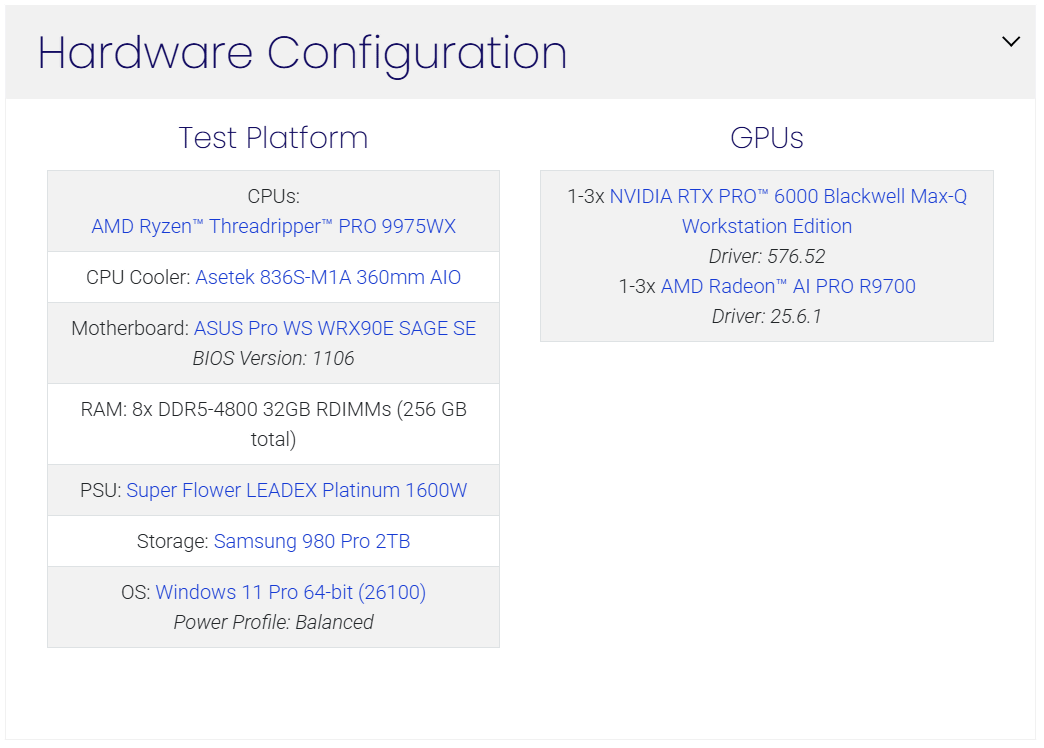
In addition, since the manufacturer's retail price is $8,500 (approximately 1.33 million yen) for the NVIDIA RTX PRO 6000 Blackwell Max-Q and $1,299 (approximately 200,000 yen) for the AMD Radeon AI PRO R9700, Puget Systems says, 'The two are not direct competitors.' However, it says that it is an excellent choice when comparing peak performance and cost performance.
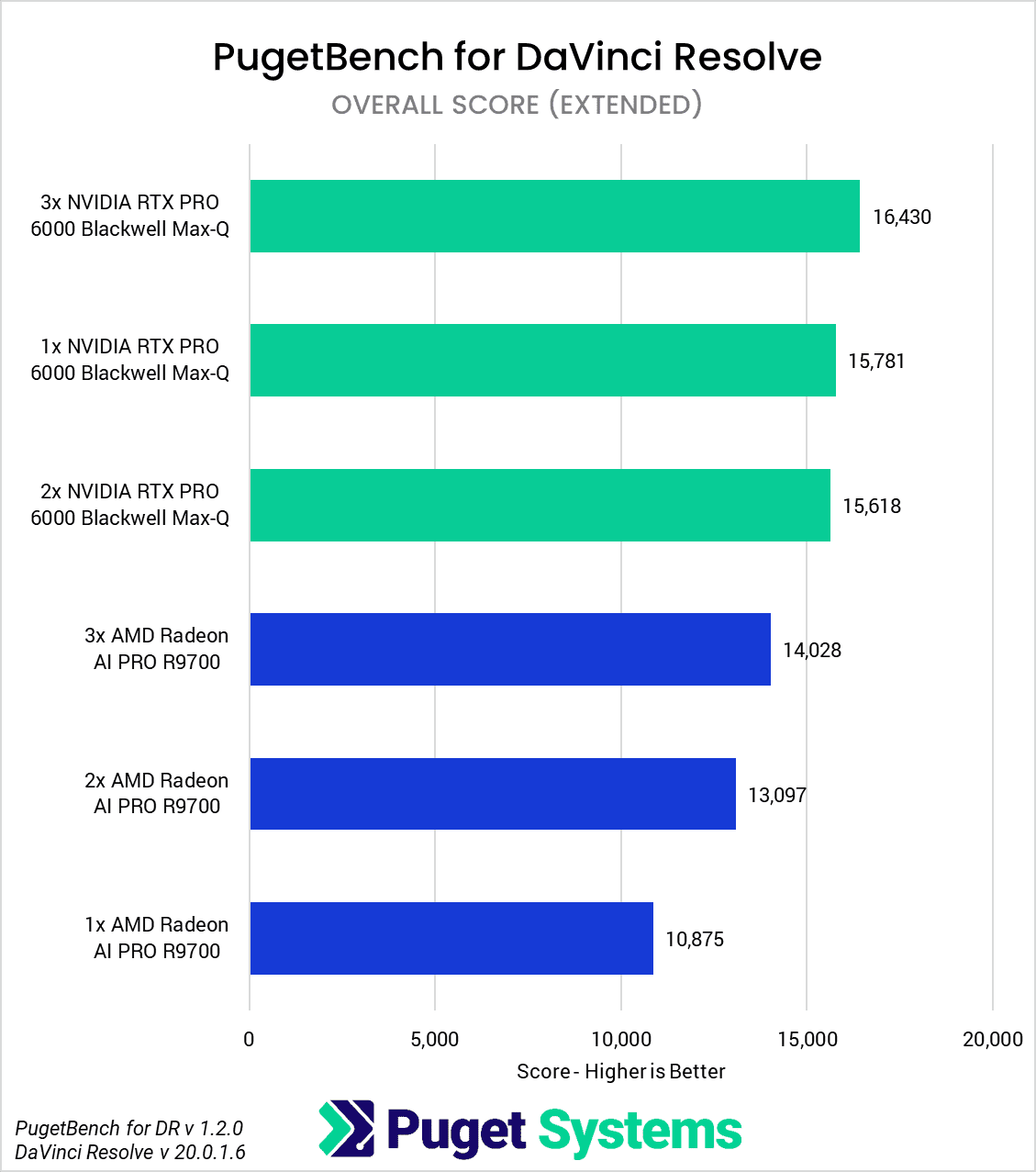
In the case of the NVIDIA RTX PRO 6000 Blackwell Max-Q, the score difference was within about 6% for all configurations from one to three cards, and no dramatic improvement was observed. On the other hand, the AMD Radeon AI PRO R9700 showed relatively good scaling, with a performance improvement of about 20% for a two-card configuration and about 30% for a three-card configuration. This suggests that whether or not multi-GPU is effective depends on where the bottleneck in the workflow is, Puget Systems argues.
When processing RAW codecs,
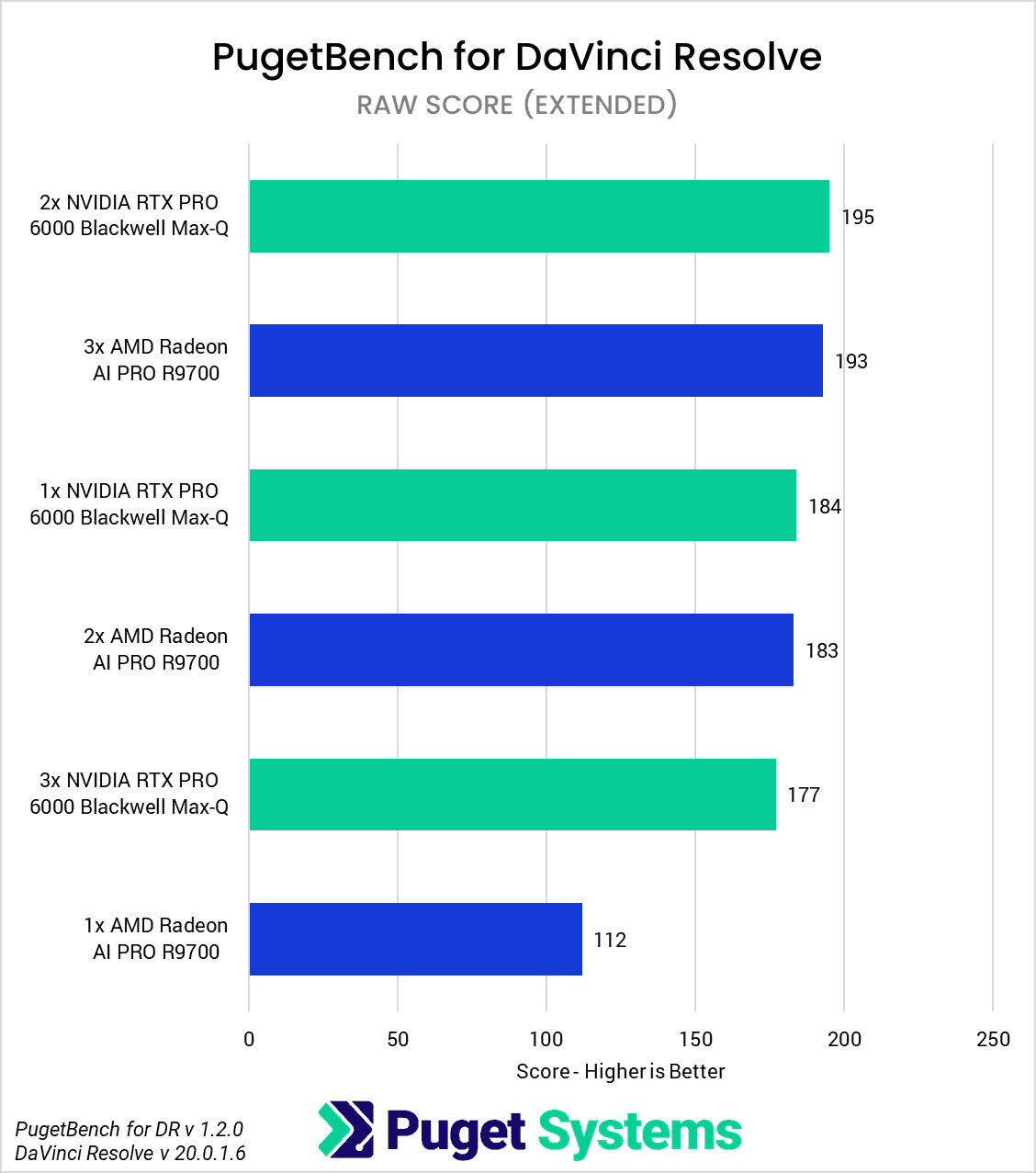
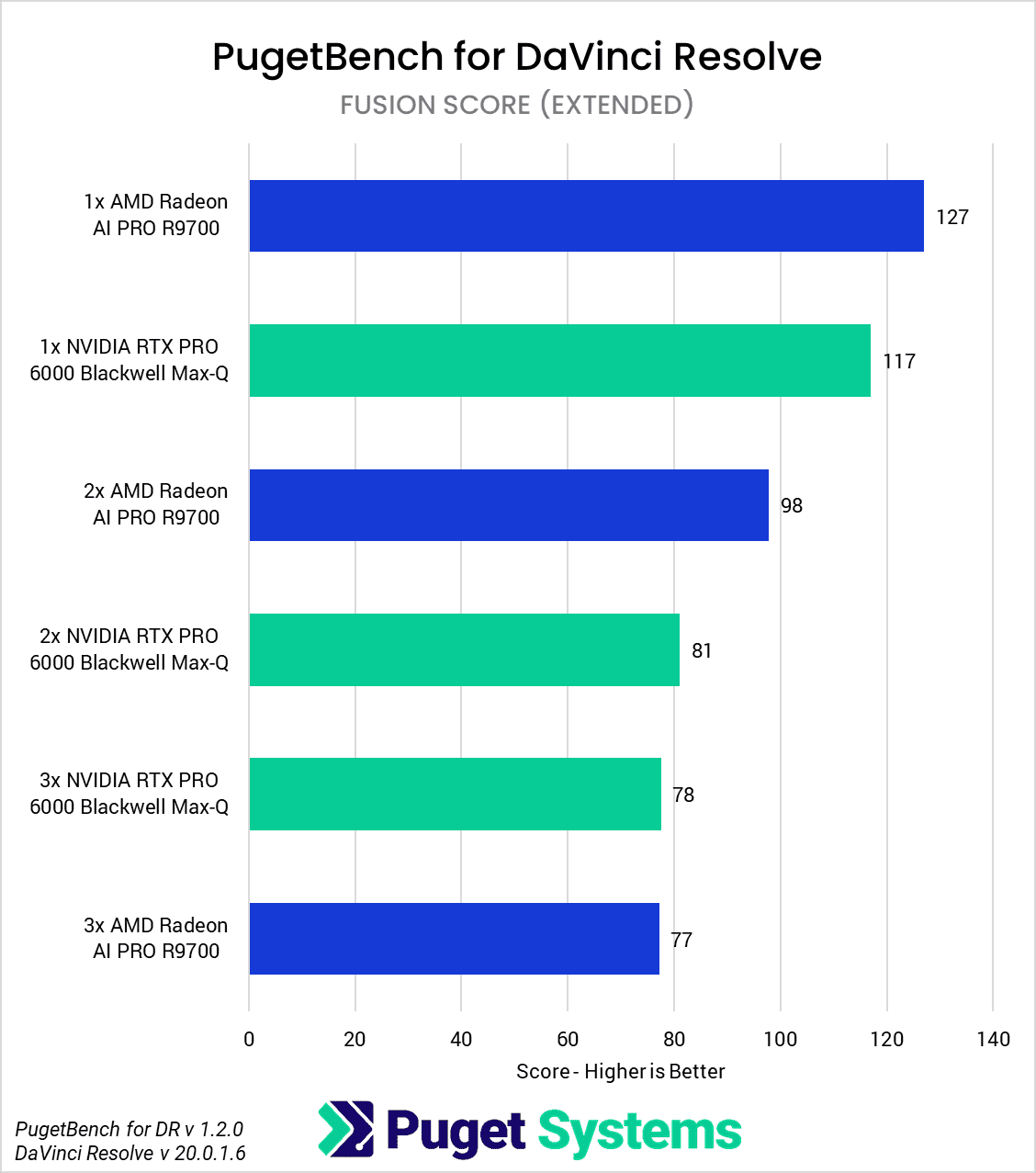
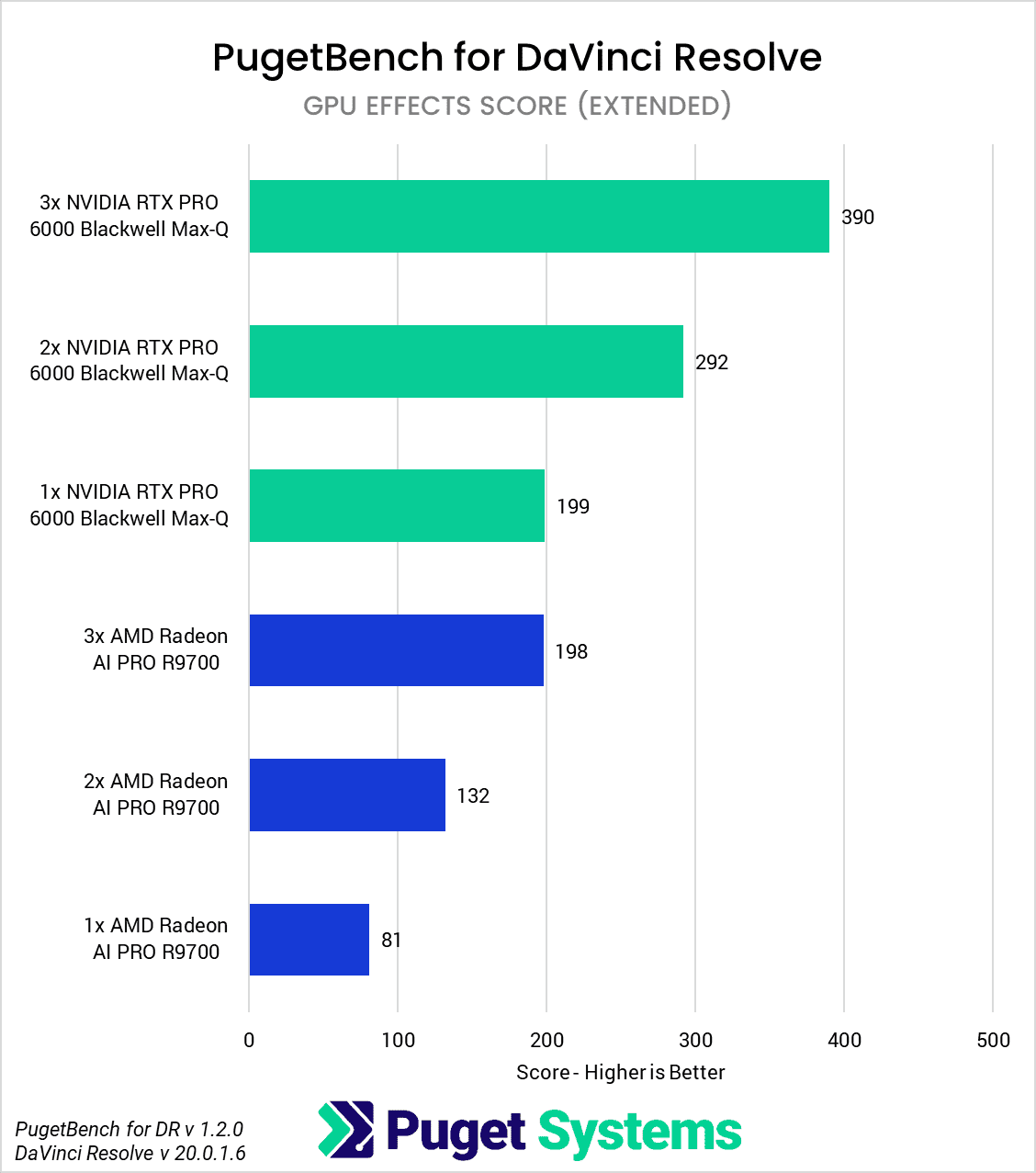
GPU effects such as OpenFX and noise reduction are typical tasks that can fully utilize the capabilities of multiple GPUs. NVIDIA saw an improvement of approximately 50% when increasing the number of NVIDIA RTX PRO 6000 Blackwell Max-Q cards from one to two, and from two to three. A triple-card configuration achieved nearly double the speed of a single-card configuration. AMD's performance was even more pronounced, with a 60% improvement in a dual-card configuration and an astounding 2.5x improvement in a triple-card configuration compared to a single card. While the performance of a triple-card configuration of AMD Radeon AI PRO R9700 cards is roughly equivalent to that of a single NVIDIA card, the fact that it costs less than half the price is a major attraction. However, it's important to note that VRAM cannot be shared and power consumption differs.
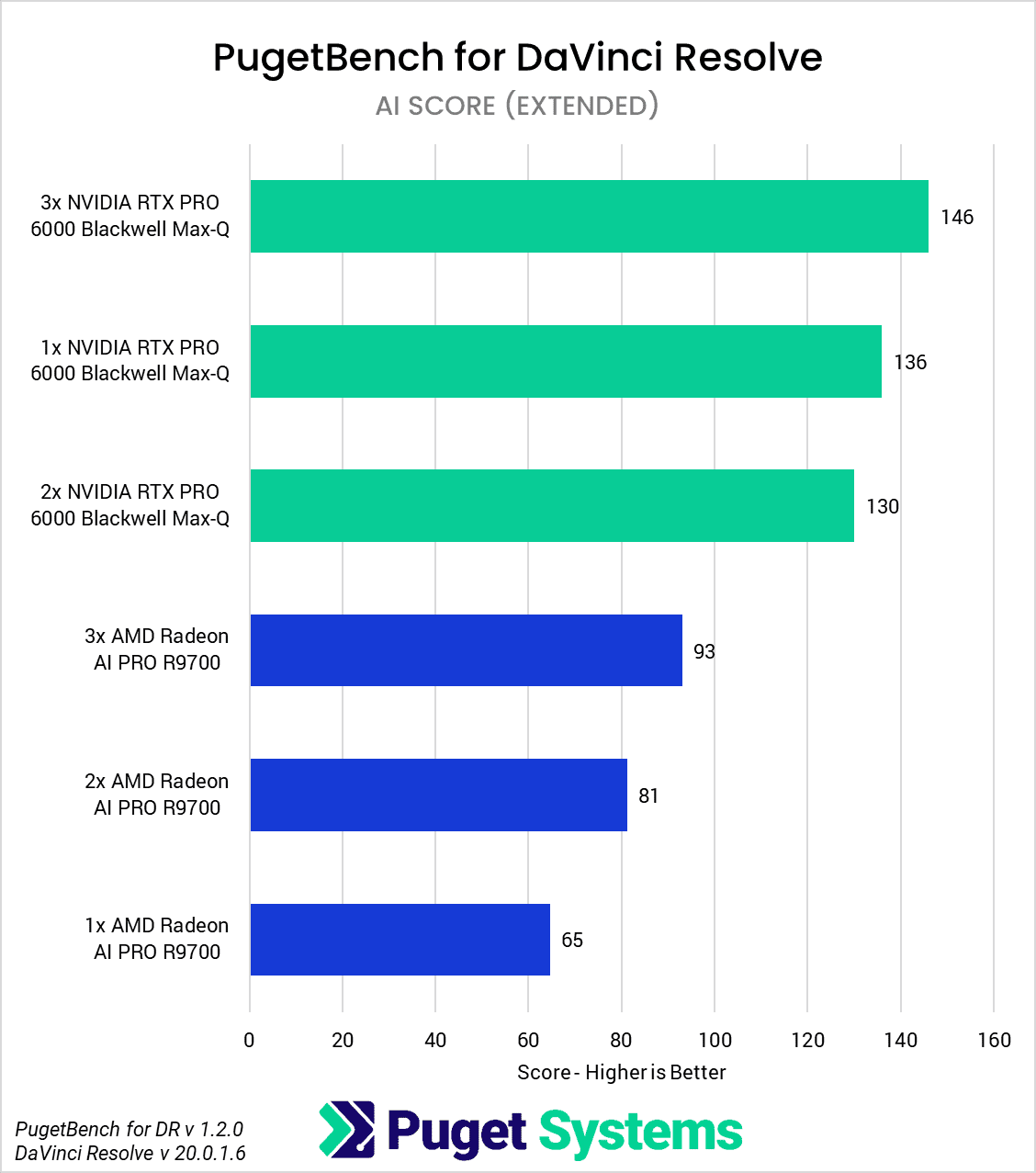
The AI function testing covered 15 different effects, but as with RAW processing, the NVIDIA RTX PRO 6000 Blackwell Max-Q showed little benefit from multiple GPUs. Puget Systems speculates that this is because many AI tasks still require significant CPU usage, resulting in a bottleneck that limits the GPU's full potential. Meanwhile, the AMD Radeon AI PRO R9700 saw an average improvement of 25% with a two-card configuration and 44% with a three-card configuration. In specific functions such as face refinement and depth mapping, both teams saw examples of scaling of approximately 60% with two cards and approximately 100% with three cards.
Puget Systems argues that the main areas where multi-GPUs can benefit DaVinci Resolve Studio are 'RAW codec processing,' 'GPU effects,' and 'some AI functions.' In environments that make heavy use of OpenFX and noise reduction, a multi-GPU configuration is a very effective upgrade option.
However, Puget Systems said that the performance improvement is not perfectly proportional and is heavily dependent on the CPU performance and specific tasks, so it is important to assess your own workflow. He also said that operating multiple boards brings with it challenges such as power consumption, heat dissipation, and securing physical space, so careful consideration is required when configuring a system.
Related Posts:

in Hardware, Posted by log1i_yk