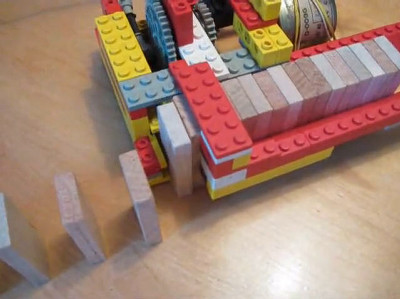
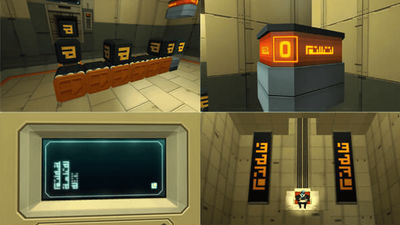
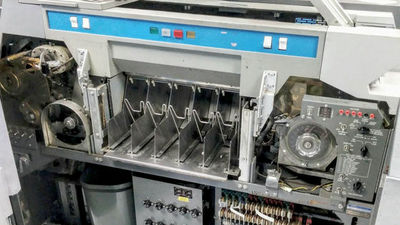
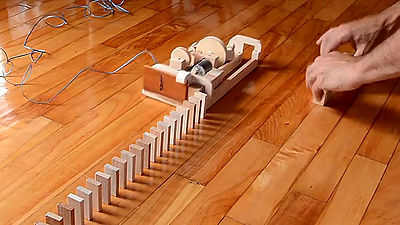
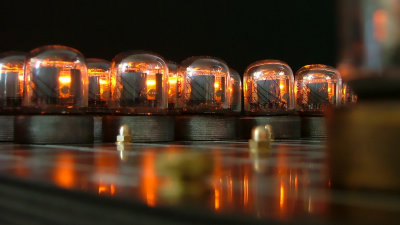
'Roons' is a DIY kit that you can assemble yourself and use to understand computer calculations.
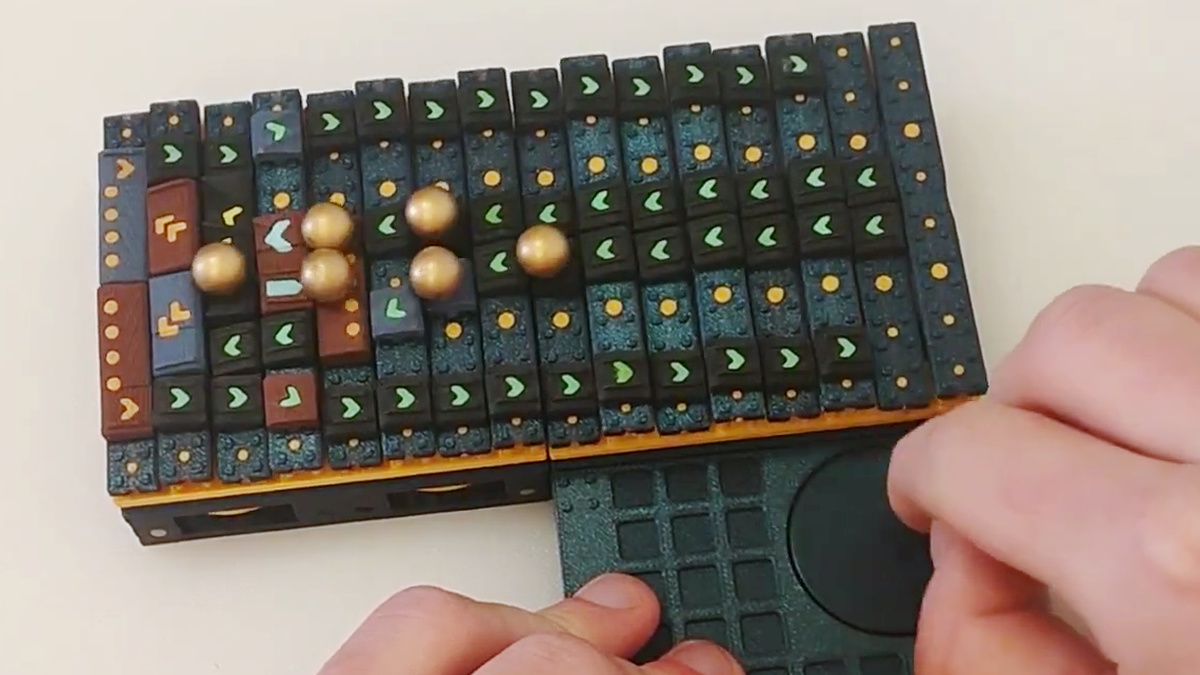
' Roons ' is a kit that allows you to build a real physical mechanical computer by combining small tile-like parts called 'roons.' By placing tiles on a bar that moves up and down and controlling the movement of the balls, you can form logic circuits and build various computer components such as adders, registers, and display devices. The design is small and modular, making it easy to assemble and modify, and the visibly operating system allows you to intuitively learn how computers work. It has attracted attention as an educational tool and a plaything for engineers, and is scheduled to be sold on Kickstarter in the future.
roons — technical overview – whomtech
'Roons' consists of alternating bars that move up and down, with contoured tiles called 'roons' placed on top of them. These tiles control the movement of the ball and hole, and represent the bit stream in a discrete way.
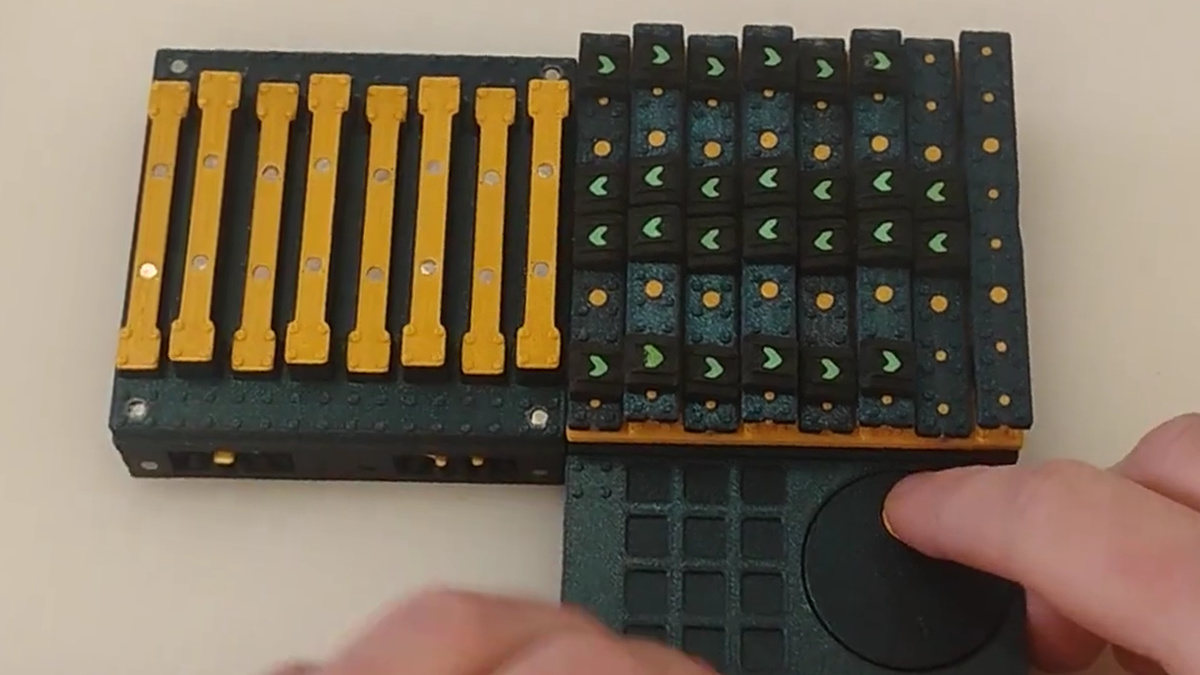
Each cell is composed of 'occupied or empty,' 'rising or descending,' and 'type of controlling roon,' and functions like
mechanical computer demo (roons) - YouTube
By implementing basic logic gates such as XOR gates in roons, Turing-complete computations are possible. Although roons exist for storing state, register-like functions can also be realized by circulating a bit stream in a loop structure. In addition to being Turing-complete, roons is designed to be small, fast, easy to edit, has save and load functions, and allows complex configurations with a small number of parts, in order to be a practical and fun kit.
With roons, you can configure adders, memory devices, processors, counters, timers, etc. In the following movie, you can see how 00111 + 01110 = 10101 (7 + 14 = 21) is executed.
binary adder (roons) - YouTube
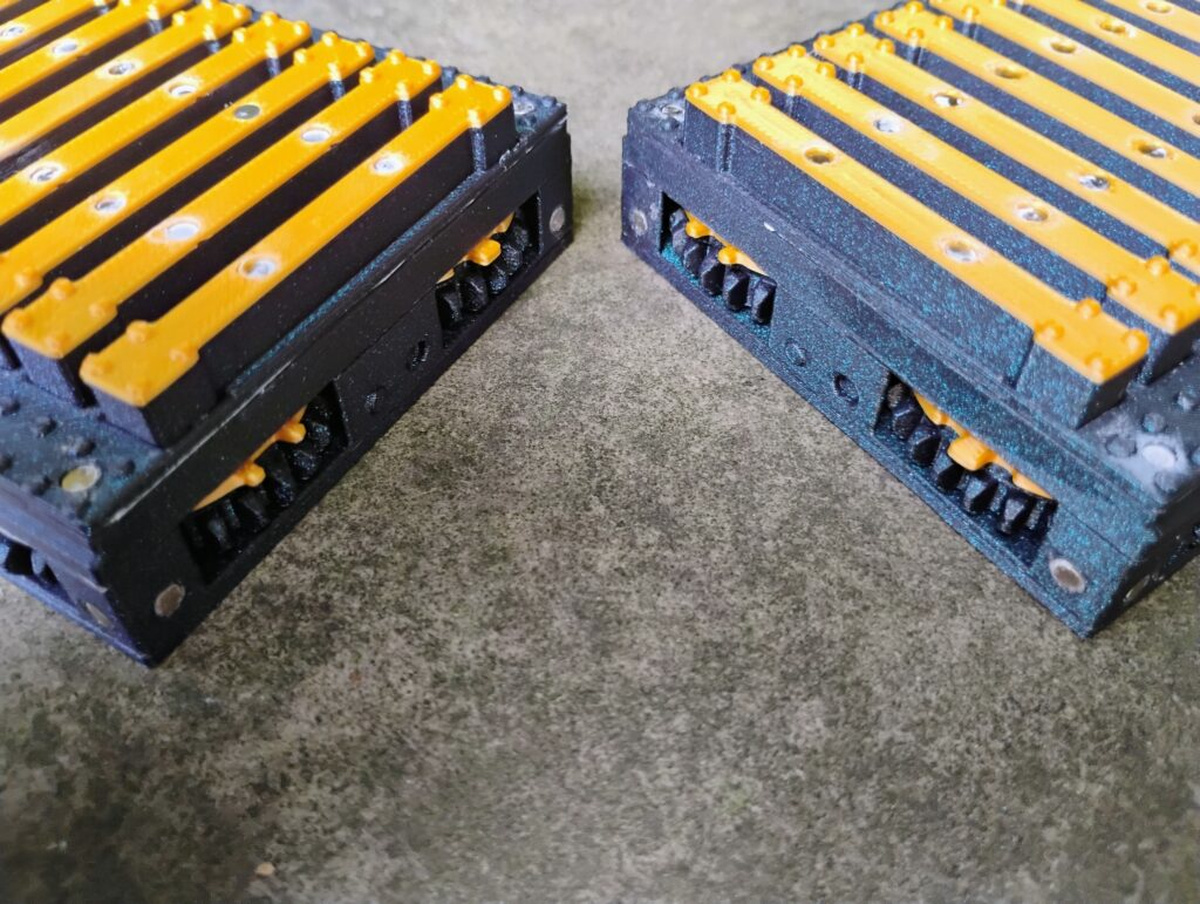
To make each unit replaceable and storable, the drive mechanism is designed to be partly housed inside the disk. The order of the bars within the disk can be changed, and they can also be moved between disks, making it easy to modify the pattern. If the working space is insufficient, the disks can be extended by placing them next to each other. The sides of each disk are equipped with magnets and a concave-convex structure, and are designed to precisely mesh with another disk rotated 180 degrees and rotate in the same direction. The gears have a structure called a 'phase baffle,' which prevents them from connecting unless they are perfectly synchronized.
Roons has peripherals such as an 'encapulator' that drives it and a 'bucket' that is the output destination. In addition, they are prototyping a seven-segment display, a numeric keypad, an alphanumeric display, a hard disk, and a motor for driving a large grid. By combining these, more advanced displays and input/output are possible.
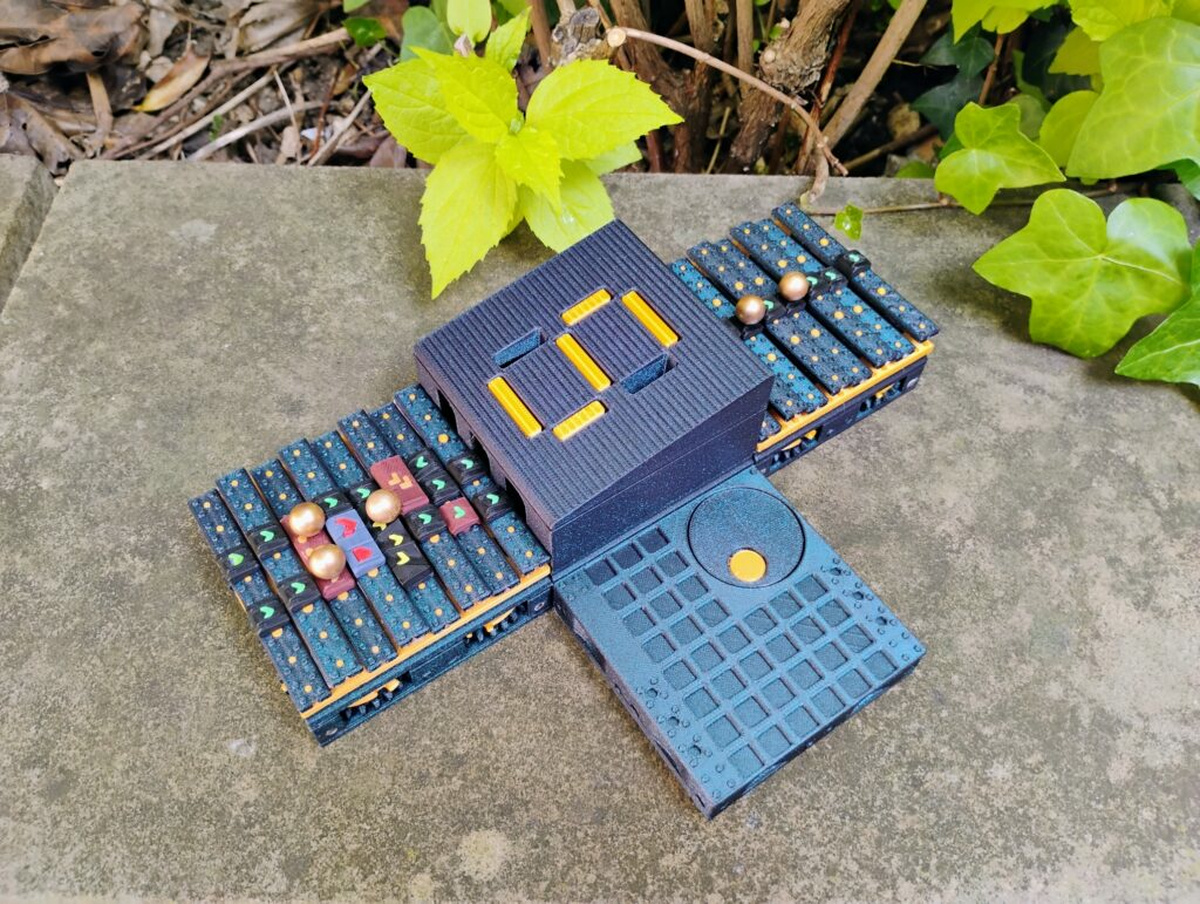
Many of the parts are 3D printed from PLA, with plans to use ABS injection molding in the future. To make the tiles magnetic, the company has cut and embedded copper-coated steel rods, and hand-glued neodymium magnets, thousands of which are attached to the wall.
At the time of writing, there were issues such as delays in the development of peripherals, lack of reliability of parts, difficulty in interoperability between parts, difficulty for new users to use, lack of tutorials and websites, and a large number of unfinished parts. 'Roons' is scheduled to launch a campaign on Kickstarter on May 21, 2025, and review kits are also being distributed in limited quantities.
In addition, a simulator that allows you to experience roons in your browser is available at the following link.
simulator (alpha) – whomtech
https://whomtech.com/whomtech/simulator-splash-page/
Related Posts: