What are the risks to human society that Bill Gates speaks of in the 'transition to the AI era'? How can we use AI to create a better future?
by
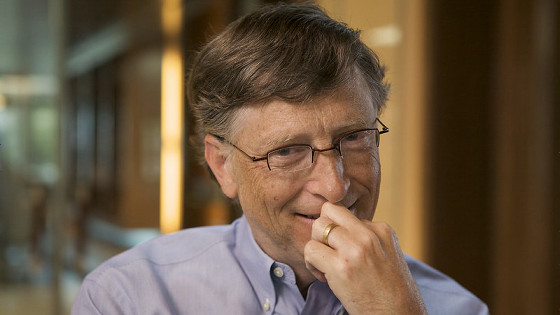
Bill Gates, known as the founder of Microsoft, has published a blog post discussing the 'transition to the AI era.' In the blog, Gates warns of the risks that the transition to AI will bring to human society, while also offering suggestions on how to use AI for a better future.
The choices we make about AI now are critical | Bill Gates
https://www.gatesnotes.com/a-turbulent-ai-era-and-critical-choices-to-make
Gates commented on the rapid progress of AI, stating, 'From a fairness standpoint, AI will either become the greatest equalizer in history or the worst source of injustice.' While AI has the potential to make the world a better and fairer place, it also carries the risk of taking jobs away from people, leading to a widening gap between rich and poor, and further exacerbating the plight of vulnerable individuals.
As someone who has grown up surrounded by technology, Gates has always hoped for rapid innovation, but he believes that society, politics, and the economy are not prepared for the drastic changes that AI will bring. It would be fine if the benefits of AI spread throughout society first, and then the problems that arise were dealt with afterward, but AI is bringing downsides such as 'mass layoffs' and 'social disruption' along with the benefits.
Many experts argue that AI technology will smoothly transition jobs, just as past technological advancements led to a decrease in agricultural workers and an increase in office jobs. However, the transition from agriculture to office work was a slow process that took several generations and created new jobs that required 'human cognitive abilities.' In contrast, Gates believes that AI will replace 'human cognitive abilities' themselves, making a similar shift unlikely.
Gates stated, 'AI will have the ability to see, hear, speak, and reason, and will eventually be able to perform manual labor as smoothly as humans, so the impact will not be limited to just one area. AI will play an active role in a wide range of fields, including law, customer service, healthcare, software, and manufacturing. I believe that AI will rapidly permeate these industries not in a few generations, but in just about 10 years. New jobs will be created, but without appropriate policies, the number will be far less than it is now,' warning that AI has the potential to replace not only desk jobs but also manual labor.
According to Gates, the three major risks that the transition to the AI era will bring are as follows:
◆1: Many jobs will disappear permanently.
The jobs at risk of being reduced due to AI are primarily entry- and intermediate-level positions, with sales, customer support, software engineering, and legal clerks being among the first to be affected. In the future, AI will be able to replace even trained workers, leading to job reductions in areas such as 'loan application analysis,' 'data analysis,' and 'patient triage.'
Furthermore, Gates predicts that not only desk workers but also manual laborers will be affected by AI. Because cutting-edge robotics research and development is mainly conducted in countries outside the United States, such as China, few people in the U.S. are aware of the progress of robotics, but the combination of robots and AI has the potential to replace a great many jobs.
Modern societies and economies are designed around employment, and in capitalist societies, work is not only a means of purchasing necessities and entertainment, but also a source of dignity and social connection. When unemployment rates are high in a community, the impact extends not only to decreased tax revenue and increased social security costs, but also to areas such as worsening public safety and increased health problems. In fact, in some parts of the United States, it has been suggested that the closure of factories that were central to employment has led to an increase in deaths from opioid abuse. Gates said, 'We must now think about how to reduce job losses so that everyone can enjoy the prosperity that AI will bring.'

◆2: AI enables people to cause more harm
Threats such as bombs, biological weapons, and hacking existed long before AI became mainstream, but the advent of AI has made it far easier to obtain the information necessary for these attacks and to develop the tools to launch them. While in the past only a select few highly skilled criminals possessed these attack methods, nowadays anyone can access them. Furthermore, problems such as AI-driven fraud, the spread of misinformation, and the creation of deepfakes are becoming more apparent. Even when those in power gain access to AI tools, it becomes easier to manipulate public opinion and monitor anti-government forces.
Furthermore, Gates warned of the possibility that AI systems themselves could behave in ways contrary to their designers' intentions and potentially harm human society. 'AI is evolving at a faster pace and in astonishing ways than anyone could have predicted, and as the models become more powerful, there is a possibility that they will begin to act against our interests and that we will lose control,' Gates said.
◆3: AI will hinder children's development and replace human relationships.
Gates says that as a child he was not good at socializing, and that it was only through his mother's support and his own efforts that he was able to interact with a variety of people. 'If I had had an AI companion back then, I wouldn't have had to put in the same amount of effort. AI talks to you in ways we are already familiar with and doesn't force you out of your comfort zone. It's always there and never gets angry. That's why AI is so addictive and can potentially rob us of the lessons we should be learning from connecting with other people,' he commented.
Gates also mentioned a 2025
While AI carries significant risks as described above, if used effectively, it can accelerate innovation to solve global problems such as climate change, food production, and disease eradication. One area that Gates is focusing on is the 'use of AI in agricultural production in low-income countries.' By using AI, farmers in low-income countries could receive reliable weather forecasts, advice on what seeds to plant, and how to protect crops from diseases, potentially significantly improving agricultural productivity. Furthermore, if complex administrative procedures can be completed quickly using AI, vulnerable people can receive more appropriate support, and government operations can be made more efficient.
To maximize the benefits of AI, Gates suggests that it is important to 'build national and international frameworks to manage the transition to the AI era and support affected sectors and people,' 'protect jobs that should not be replaced by AI or robots, such as caregivers and healthcare workers, and give jobs to humans,' and 'tax tokens and robots used with AI to generate the necessary funds to support unemployed and job seekers affected by AI.'
Gates commented, 'I will use my voice and time to bring AI and equity to the top of the public agenda. Whenever I visit Washington D.C., and whenever I meet with leaders around the world, I bring up this issue with lawmakers. In conversations with people developing AI models, I also make this a top priority.'
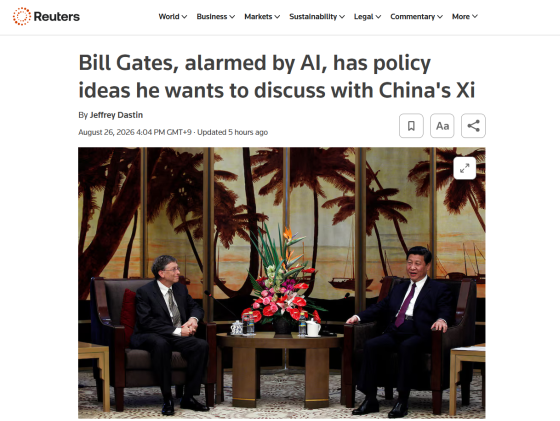
In fact, Reuters, an overseas media outlet, reported that Gates wants to meet with Chinese President Xi Jinping sometime in 2026 to propose international efforts to control the risks posed by AI. According to Gates' spokesperson, the meeting between Gates and President Xi is still being arranged, but is tentatively scheduled for November.
Bill Gates, alarmed by AI, has policy ideas he wants to discuss with China's Xi | Reuters
https://www.reuters.com/world/china/bill-gates-alarmed-by-ai-has-policy-ideas-he-wants-discuss-with-chinas-xi-2026-08-26/
In an interview with the daily newspaper The New York Times, Gates also expressed concerns about AI and the problems with technology companies.
Bill Gates Warns AI Is More Dangerous Than Big Tech Will Admit
https://www.nytimes.com/2026/08/26/technology/bill-gates-ai-risks.html
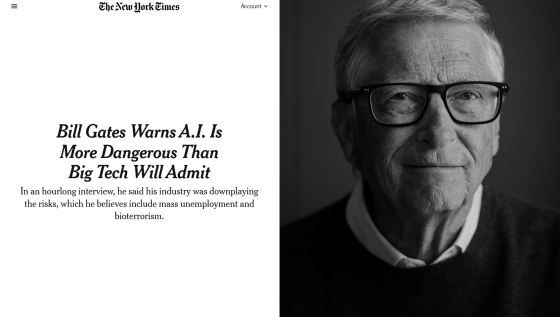
Gates pointed out that while people who understand the wonders and rapid pace of AI's evolution are inwardly anxious, technology executives rarely voice these concerns publicly. 'They're now saying to each other, 'Hey, don't say that. It'll be detrimental to us. It'll jeopardize the next $1 trillion we're trying to raise,'' he said, arguing that those in the technology industry are ignoring the negative aspects for the sake of profit.
Related Posts:

in AI, Posted by log1h_ik