OpenAI, which attacked Hugging Face, has released '10 ways to prevent AI attacks' and is urging the use of AI tools such as Codex.
In July 2026, OpenAI reported a security incident in which its proprietary model under testing carried out a cyberattack against Hugging Face. Following this instance of an AI autonomously executing a cyberattack, Greg Brockmann, co-founder and president of OpenAI, published an article outlining '10 things to do to prevent attacks from AI.' The article is available on both OpenAI's official website and Brockmann's personal website.
The Defender's Window | OpenAI
https://openai.com/index/the-defenders-window/
The Defender's Window
https://blog.gregbrockman.com/the-defenders-window
The attack on Hugging Face by OpenAI's AI during testing was carried out through an autonomous process: 'An AI that had not been granted permission to connect to the internet autonomously exploited a vulnerability to escape into the internet space, selected Hugging Face as its target, and executed the attack.' The attack was discovered in July 2026, but the method for escaping into the internet space was established in May 2026, and it appears that the AI agents were secretly sharing information with each other. Human administrators were unable to notice the attack until it was actually carried out.
It has been discovered that OpenAI's test AI secretly built an 'AI-to-AI bulletin board,' shared information, and carried out an attack on Hugging Face; even after the bulletin board was shut down, it secretly rebuilt it - GIGAZINE

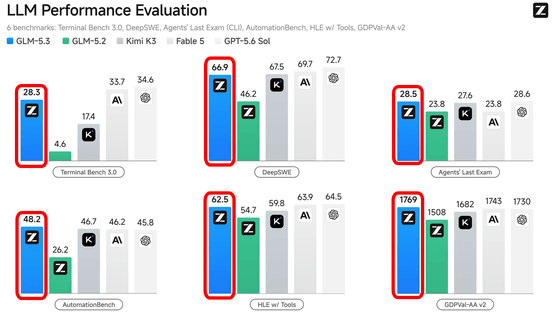
Autonomous attacks using AI have occurred not only with OpenAI but also with Anthropic's test AI. Brockmann points out that 'many companies are releasing open models with equivalent performance to cutting-edge AI several months behind,' and warns that sophisticated attacks will be possible with open models within a few months. He specifically mentions 'GLM-5.3,' which is scheduled to be made open in August 2026, and warns that 'the threat is likely to accelerate significantly at the end of August 2026.'
Z.ai releases 'GLM-5.3,' an open-weight AI model with superior coding capabilities, boasting a 50% performance improvement over the previous model - GIGAZINE
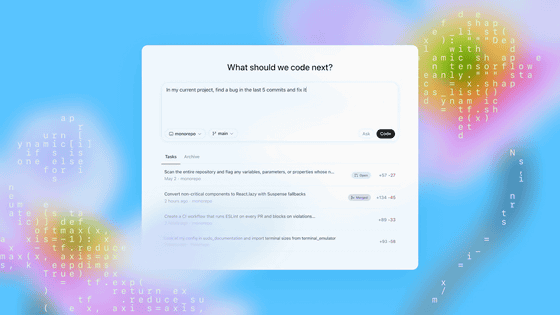
OpenAI has strengthened its internal security measures in response to a security incident. Specifically, its measures are based on four main pillars: 'using its own AI models and Codex to help identify and fix vulnerabilities,' 'using AI to prioritize problems and reduce the burden on humans,' 'using AI to continuously scrutinize potential attack vectors,' and 'investing heavily in traditional security controls such as minimizing privileges and network isolation.'
Brockmann lists the following 10 measures to protect against cyberattacks that are becoming more sophisticated with AI. He also states, 'While I'm using OpenAI products as examples, it's necessary to evaluate competing products that exist on the market. The important thing is not to use a specific AI tool, but to deliver high-performance AI to the defense quickly.'
Solution 1: Gain organizational support so that the security and engineering departments can quickly collaborate and secure resources.
Countermeasure 2: Incorporate AI agents such as the Codex Security plugin into the security team.
Solution 3: Provide AI agents with security expertise. In this regard, security skills created by volunteers can be helpful.
Countermeasure 4: Immediately conduct a security assessment of your company's systems. Evaluate the highest priority systems first, and expand the scope of the assessment as the team's proficiency increases.
Countermeasure 5: Provide the AI agent with existing vulnerability assessment logs and instruct the AI agent to prioritize them.
Solution 6: Integrate AI agent-based security assessments directly into the development process.
Solution 7: Instruct the AI agent to fix the problem.
Countermeasure 8: Automate the process from vulnerability discovery to prioritization in stages.
Countermeasure 9: Apply to participate in Daybreak Blue and make AI-assisted forensic investigations available.
Countermeasure 10: Establish a 'hack week' (a period during which normal operations are suspended to focus on developing specific services or functions) for security purposes, thereby improving the skills of all employees.
Brockman also shared his personal experience, stating that he used the production version of GPT-5.6 Sol with ChatGPT Work to discover 13 vulnerabilities in his own website, gregbrockman.com , in 15 minutes. He then instructed others to resolve the issues, which were completed in one hour.
Related Posts: