According to Google data, workers will not lose their jobs due to AI automation.
With several companies implementing large-scale
Google's AI & Economy ATLAS v1.0:Mapping Gemini Usage in the Economy
https://ai.google/static/documents/GoogleATLASv1.pdf
Despite AI hype, Google's data shows workers aren't automating themselves away - Ars Technica
https://arstechnica.com/ai/2026/07/despite-ai-hype-googles-data-shows-workers-arent-automating-themselves-away/
Google investigated 15 million anonymized AI interactions performed using the Gemini app, Google Search's AI mode, and the Gemini API. An initial review of the data suggests that while AI is being used to some extent across a wide range of occupations, its use is 'shallow, overwhelmingly collaborative, and limited in scope to end-to-end task automation.'
Google's research team created an automated classifier to categorize work-related AI interactions using the Bureau of Labor Statistics' Standard Occupational Classification and the O*NET Work Interaction Database . After human reviewers validated this automated classifier, it was determined to be a reliable indicator that accurately reflects 'how prompts entered into Gemini are used in actual work situations.'
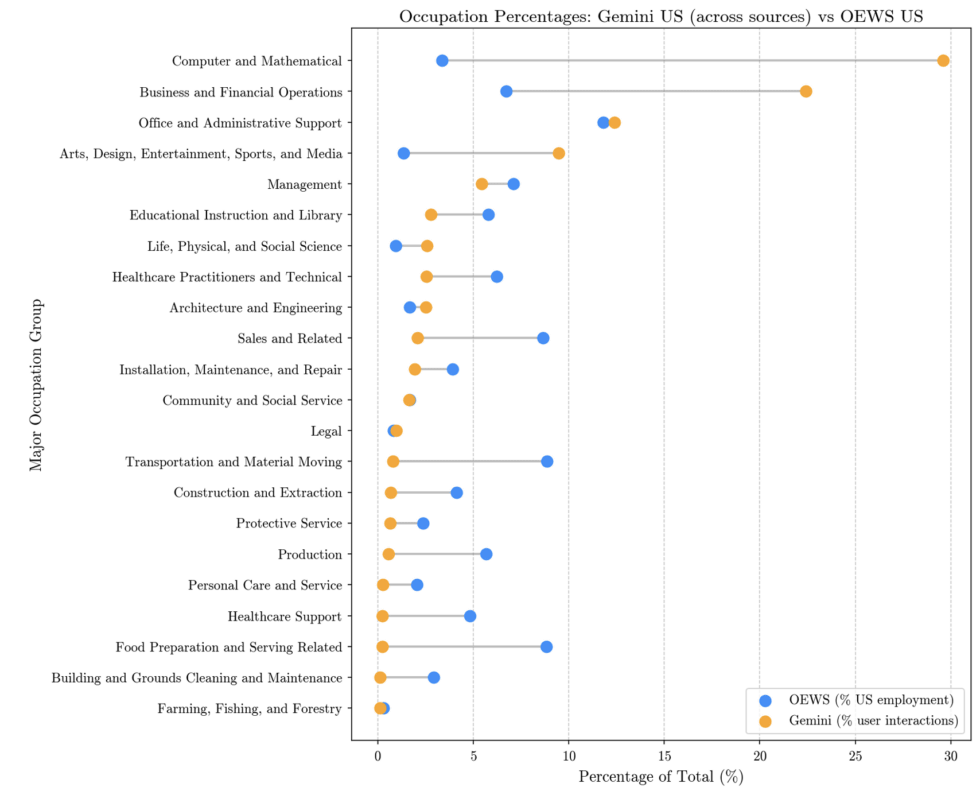
White-collar jobs in fields such as computers, finance, and arts and entertainment were found to have particularly high levels of Gemini usage compared to the overall adoption rate in the U.S. economy. Financial and market analysts, software developers, and system administrators were among the professions that used AI relatively frequently for work-related tasks, while sales representatives, transportation workers, and food preparation and service workers were significantly underestimated in terms of AI usage data.
In the graph below, the blue dots represent the 'percentage of that occupation in the entire United States,' while the orange dots represent the 'percentage of that occupation among Gemini users.' In other words, if the orange dots are to the right of the blue dots, it indicates that the occupation has a high rate of Gemini usage, and if the orange dots are to the left of the blue dots, it indicates that the occupation has a low rate of Gemini usage.
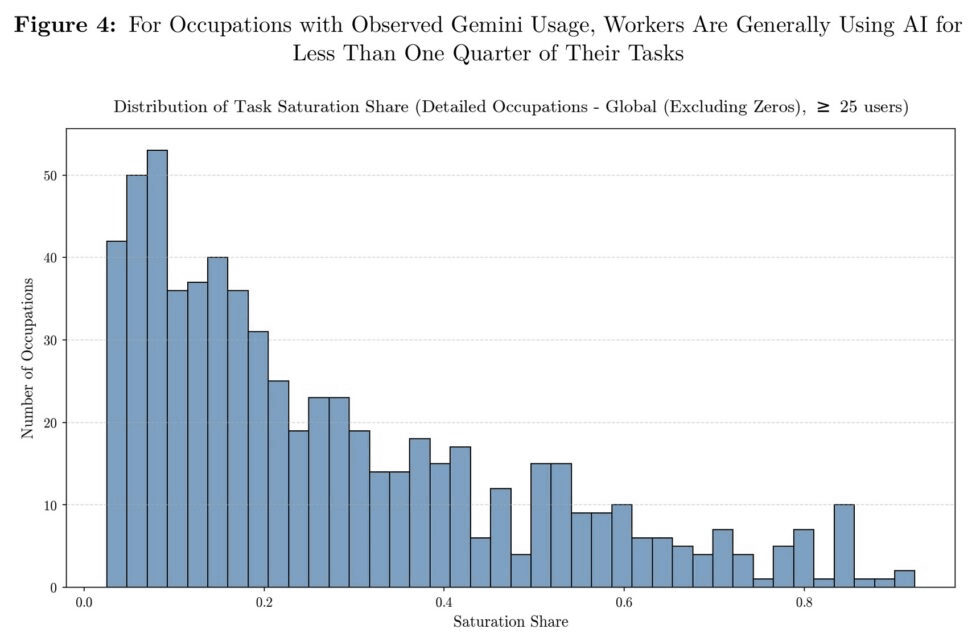
In many occupations (29%), none of the relevant work tasks reached a threshold for Gemini usage that could not be ignored, indicating that these occupations have so far been largely unaffected by the AI revolution. Furthermore, it was found that less than a quarter of the tracked tasks showed significantly higher Gemini usage. This suggests that the majority of these occupations are still performed by humans.
Only 3% of job roles regularly utilize Gemini in at least three-quarters of their work-related tasks. This category includes roles such as software quality assurance analysts and testers, HR specialists, and document management specialists, which were identified in this survey as the roles most significantly impacted by the use of AI.
The graph below shows the percentage of jobs in which AI (Gemini) is used on the horizontal axis, and the number of jobs corresponding to the AI usage rate on the vertical axis.
The research team commented on these results, stating, 'AI currently plays a primary role in complementing existing tasks,' and 'While AI appears useful for some tasks within a profession, it suggests that it is not currently being used to comprehensively perform tasks that humans currently do.'
In addition, cognitive tasks (primarily those involving thinking) accounted for 86% of the measured Gemini interactions. Furthermore, Gemini wasn't entirely useless in manual labor jobs; thousands of cases were reported where industrial machinery mechanics used Gemini to 'analyze test results and machine error messages.' Tens of thousands of cases were also reported where automotive mechanics used Gemini to 'test vehicle parts and systems, rewire wiring systems, and inspect parts for wear.' Interestingly, in these types of tasks, users tended to input photos rather than text into Gemini.
In terms of cognitive tasks, it seems that a large portion of Gemini's key tasks were related to 'drafting ideas' and 'researching and learning information.' The important point is that the cognitive tasks that workers entrusted to the AI did not require specialized knowledge, specifically things like 'rewriting documents into different languages.'
Google's research team has summarized their findings, suggesting that 'workers are not losing their sense of purpose because of AI.' Rather, they point out that workers are increasingly using AI to 'enhance their work by automating routine cognitive tasks, while simultaneously collaborating with AI on non-routine cognitive tasks.'
Related Posts:







in AI, Posted by logu_ii