Changing the type of light humans use could potentially save many insects.
Insects are extremely important organisms in ecosystems, and some are vital to
Optimized light sources reduce nocturnal insect attraction at railway stations - ScienceDirect
https://www.sciencedirect.com/science/article/pii/S0006320726002764
BALIN - LIB
https://leibniz-lib.de/en/research/projects/balin.html
Scientists Reveal The Simple Change That Could Save Millions of Insects : ScienceAlert
https://www.sciencealert.com/a-simple-lighting-swap-could-save-millions-of-insects
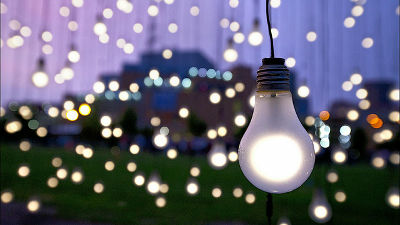
Previous studies have shown that insect populations have declined significantly in recent decades, with causes including habitat loss and environmental pollution due to human development, the spread of pathogens, invasion by alien species, and climate change. Artificial lighting used by humans at night to illuminate their surroundings is also considered one of the factors negatively impacting insect populations because it disrupts their natural behavior.
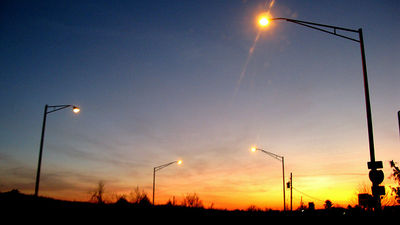
ScienceAlert, a science media outlet, states, 'More than 60% of invertebrates are nocturnal, so artificial light in their habitats affects their most active time of day. This is a widespread problem. Around the world, bright sodium lamps and LED lights constantly illuminate roads, sidewalks, railways, shopping streets, and almost every other part of the building environment, primarily in the name of public safety.'
Some estimates suggest that one-third of insects attracted to stationary artificial light sources, such as moths, die before dawn due to fatigue or predation. Additionally, the weta , a species of camel cricket found in New Zealand, avoids artificial light at night, rendering areas constantly lit unusable habitats.
Researchers at the Leibniz Institute for Biodiversity Change Analysis in Germany estimate that 'on summer nights in Germany, approximately one billion insects are affected by artificial light sources every night, and many die.' They point out that 'the global increase in light pollution and the brightness of the night sky in recent years pose a major threat to insect diversity and are becoming increasingly important for nature conservation both domestically and internationally.' Therefore, they conducted an experiment in the Westerwelland Nature Park in northeastern Germany to see if changing the 'type of artificial light' used by humans could save insect lives.
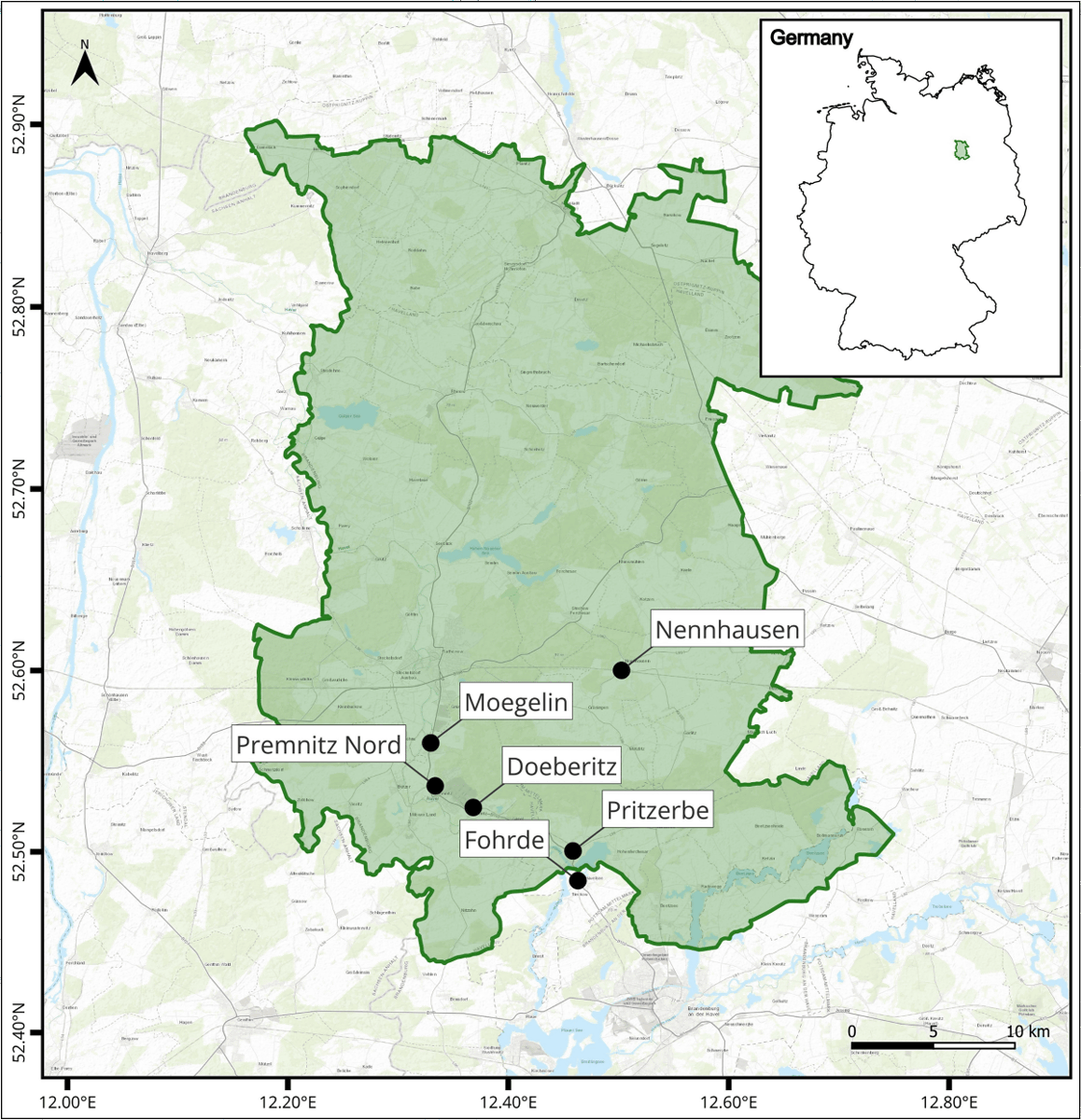
The research team focused on train stations that run through the Westerwelland Nature Park. These train stations are located within the nature park, but they are often lit up all night for the safety of passengers, which attracts insects. In the map below, the green area represents the Westerwelland Nature Park, and the black dots represent the train stations where the experiment took place.
The railway stations in question were all illuminated with 2000
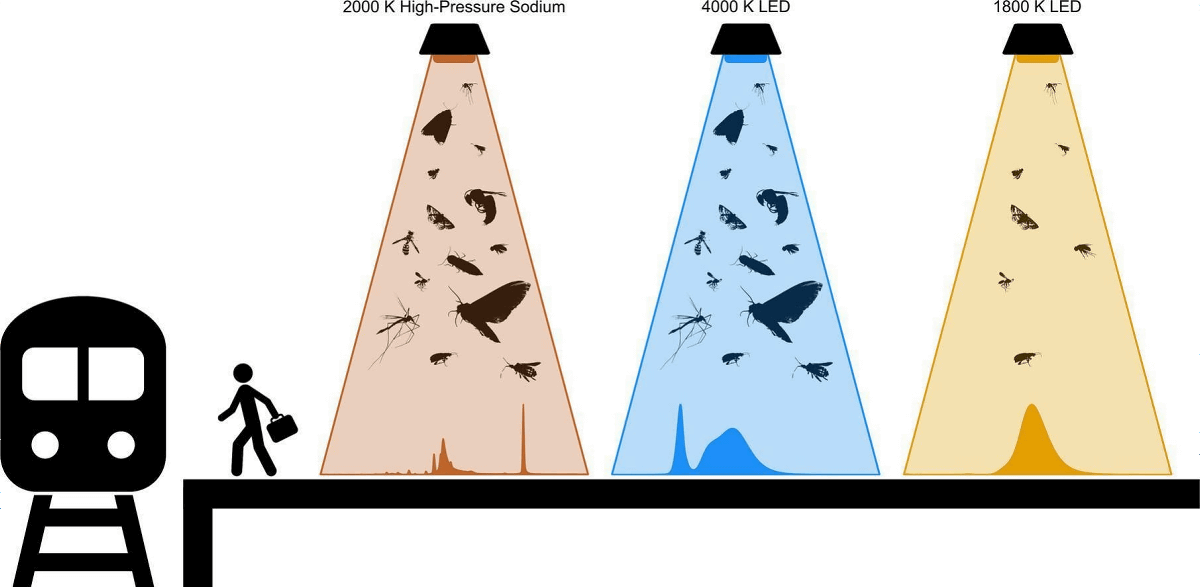
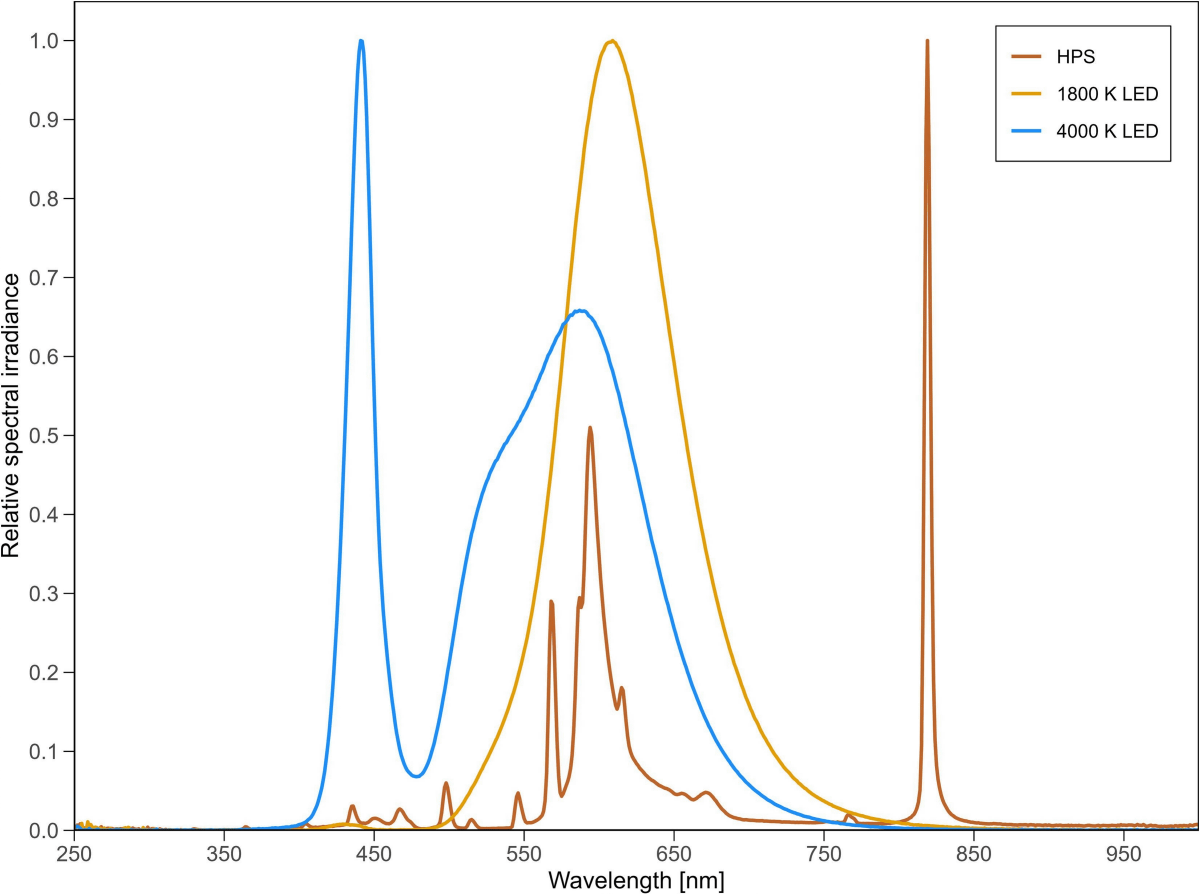
To investigate the differences caused by different types of artificial lighting, the research team replaced some of the lights at each railway station with cool white 4000K LED lights, some with amber-colored 1800K LED lights, and left the rest as the original 2000K HPS lamps. They also monitored adjacent areas that were not illuminated as control points and investigated insect activity outside the illuminated areas.
To measure the types and numbers of insects active in these regions, the research team set traps and collected samples from July to October 2023 and again from April to July 2024. These samples were then analyzed using AI-based image analysis and DNA metabarcoding .
Analysis of the data revealed that amber-colored 1800K LED lighting, which has a low blue light content, attracts significantly fewer types and numbers of insects compared to conventional warm white 2000K HPS lamps and cool white 4000K LED lighting. It was also confirmed that it attracts fewer valuable endangered species and legally protected species.
The graph below shows
Following the results of this experiment, all the lighting at the railway stations within the Westerwelland Nature Park has been replaced with 1800K LED lighting. Although this experiment was conducted at railway stations, similar insect protection effects can be expected from streetlights, garden lights, park lights, and shop lights.
However, since different insect species respond to light differently, the strategy of changing the lighting may not be equally effective for all insects. Also, because the samples collected in this study were limited to nocturnal and flying arthropods, the effects on diurnal species and ground-dwelling insects are not well understood.
However, this study suggests that optimizing the light sources of outdoor lighting could potentially reduce insect attraction and the resulting population decline, thereby mitigating environmental damage. ScienceAlert stated, 'Even just going to a home improvement store, for example, could be a good start to making our world a slightly more habitable place for insects.'
Related Posts:


in Free Member, Science, Creature, Posted by log1h_ik