Firefox 153 initially supports Vulkan video decoding on Linux, laying the groundwork for its use in NVIDIA and Arm environments.
Version 153 of Mozilla Firefox, scheduled for official release on July 22, 2026 (Japan time), will include initial support for hardware decoding of videos using Vulkan Video on Linux. This allows users to utilize GPU video decoding capabilities through a different route than the traditional Video Acceleration API (VA-API), and is expected to expand support particularly for NVIDIA GPUs and Arm-based Linux terminals.
Firefox Beta 153.0beta, See All New Features, Updates and Fixes
https://www.firefox.com/en-US/firefox/153.0beta/releasenotes/
Firefox 153 Available With Support For Vulkan Video Decoding, Experimental JPEG-XL - Phoronix
https://www.phoronix.com/news/Firefox-153-Downloads
The beta version of Firefox 153 was released on June 17, 2026, but not all of its features were finalized at that time. Mozilla updates the beta version three times a week, gradually incorporating features as development progresses, and also updating the release notes. Vulkan Video support was also incorporated into Firefox 153 through these updates during the beta period.
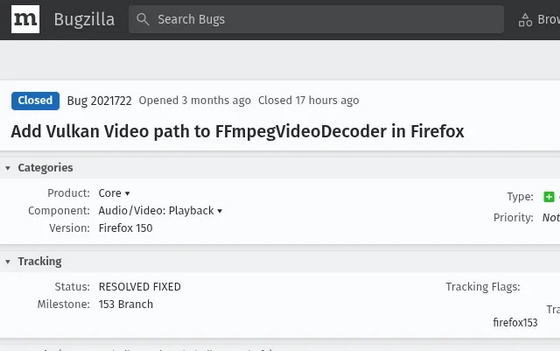
The fix for Vulkan Video support adds Vulkan-based processing to Firefox's video decoder, 'FFmpegVideoDecoder.'
Until now, the Linux version of Firefox has primarily used VA-API for hardware decoding of videos. However, NVIDIA's official drivers do not directly support VA-API, and using it requires external projects such as ' nvidia-vaapi-driver ' which handles NVDEC via VA-API. In addition, there are drivers that do not support VA-API, including those for embedded devices.
Vulkan Video is a mechanism for handling video encoding and decoding based on the Vulkan graphics API, and it is a cross-vendor and cross-platform interface that is less dependent on specific GPU manufacturers or operating systems. In Firefox 153, a route was added that uses FFmpeg's Vulkan API to decode video and passes the result to Firefox's rendering process via Linux's dma-buf .
Bugzilla reported in February 2022 that Firefox lacked Vulkan video decoding functionality, and this was implemented between March and June 2026.
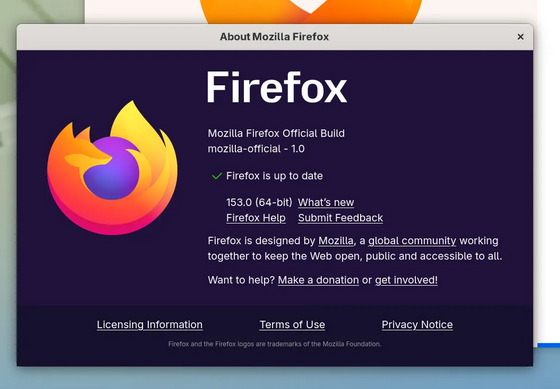
Subsequently, on July 20, 2026, the official Firefox 153 binary became available for download from Mozilla's distribution server, and it was confirmed that the Vulkan Video decoding implementation was included in the official version.
Firefox 153 also includes a mechanism for transferring video decoding results from the GPU to the screen rendering process. When the same GPU handles both video decoding and screen rendering, the decoded video is transferred directly without copying it whenever possible. On the other hand, when different GPUs handle these tasks, the video data is copied before being transferred.
To ensure this process runs correctly, a mechanism has been added to verify the video formats that both the decoder and the screen rendering side can handle, as well as a Vulkan-based synchronization function to synchronize processing timing. Additionally, the sandbox settings have been modified to allow the RDD (Remote Data Decoder) process, which performs video decoding, to access the necessary GPU drivers.
This update also addresses an issue where hardware video decoding was incorrectly disabled in AArch64 environments running Linux. Mozilla has modified the build configuration to recognize available GPU decoders in AArch64 and added hardware decoding tests for Linux.
However, the addition of a Vulkan Video processing path to Firefox 153 does not mean it will be automatically available in all Linux environments. Mozilla has indicated that it will enable Vulkan Video decoding in the Nightly version only for GPU and driver combinations that have been confirmed to work correctly, and will enable it as a standard feature in the future after further testing.

Therefore, although the Vulkan Video mechanism was introduced in Firefox 153, it has not yet reached the stage where it can be used as a standard feature in a wide range of environments at the time of writing. It can be said that Firefox 153 has only incorporated the necessary foundation for full-scale implementation in anticipation of future expansion of FFmpeg support and operational verification.
Related Posts:

in Software, Posted by log1i_yk