A study has shown that a treatment involving electrical stimulation of the brain has shown remarkable effects in treating depression in just 10 days.
The idea of 'electrical stimulation of the brain' might sound alarming, but this treatment method, which uses magnetism to stimulate the brain electrically, is actually being used to treat conditions such as Parkinson's disease, depression, and obsessive-compulsive disorder. A new clinical trial has shown that electrical stimulation of the brain can have a significant effect on treating
Intermittent Theta-Burst Stimulation and Depressive Symptoms in Major Depressive Disorder: A Randomized Clinical Trial | Medical Devices and Equipment | JAMA Network Open | JAMA Network
https://jamanetwork.com/journals/jamanetworkopen/fullarticle/2851350
Non-Invasive Brain Stimulation 'Significantly' Improves Depression in Just 10 Days, Trial Finds : ScienceAlert
https://www.sciencealert.com/non-invasive-brain-zapping-improves-depression-in-just-10-days-trial-finds
Transcranial magnetic stimulation (TMS) is a treatment method that involves applying a coil device that continuously generates pulsed magnetic fields to the patient's head, allowing the magnetic field to reach inside the skull, and stimulating brain nerve cells with the resulting electric current. TMS is said to provide rapid therapeutic effects in patients with depression who do not respond to standard treatments.
Transcranial magnetic stimulation (TMS) targets the dorsolateral prefrontal cortex (DLPFC) , a region involved in executive functions such as working memory, cognitive flexibility, planning, inhibition, and abstract reasoning. Analysis of brain blood flow and oxygen metabolism has shown that in many patients with depression, activity in the left anterior DLPFC is decreased, while activity in the right anterior DLPFC is increased.
TMS is said to regulate brain networks by activating the left DLPFC, which is suppressed in the brains of depressed patients, or by suppressing the right DLPFC, which is excessively excited. There are also several TMS techniques, including 'rTMS (repetitive transcranial magnetic stimulation),' which stimulates regularly at a frequency of 10 times per second (10 Hz), and 'iTBS (intermittent theta burst stimulation),' which stimulates irregularly at a high frequency of 50 times per second (50 Hz).
A research team led by researchers at the University of the Arctic (University of Tromsø) conducted a clinical trial to investigate the effects of once-daily iTBS on patients with depression. While iTBS is already used to treat depression, this clinical trial included a control group that believed they had received iTBS but had not, allowing for a more accurate measurement of the therapeutic effect.
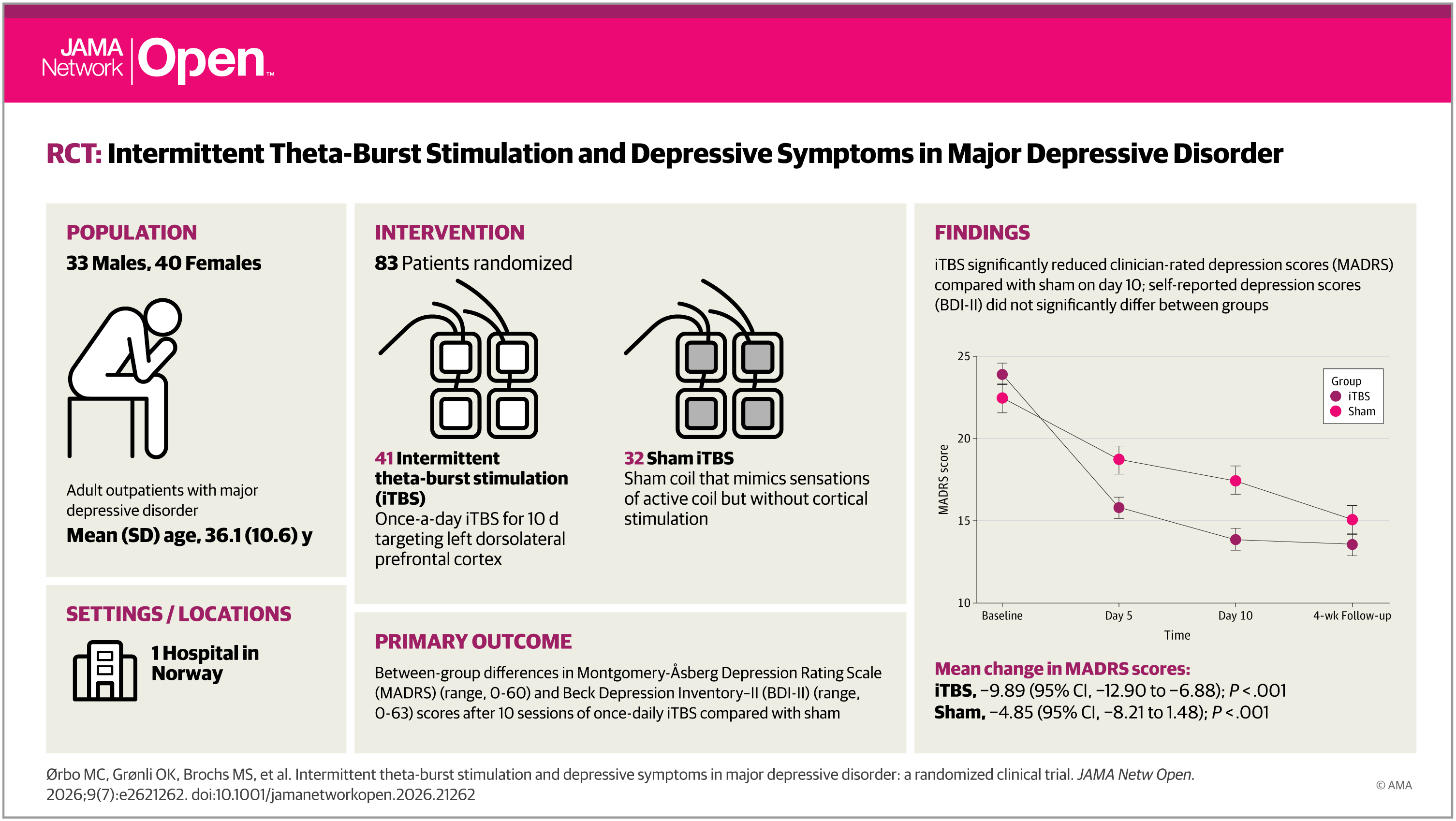
The experiment involved 73 patients aged 22 to 65 with depression. Of these, 41 received treatment with a standard iTBS device, while the remaining 32 wore a 'fake device' that looked identical but did not emit a magnetic field that reached the brain. The fake device had a different winding pattern for the coil that generated the magnetic field, and the magnetic field was weakened by internal shielding, but the pressure felt on the head and the knocking sound were the same as those experienced during actual iTBS treatment.
After 5-day and 10-day treatments, subjects who received genuine iTBS treatment showed significantly improved depression scores based on clinician consultations compared to the control group. However, there was little difference in self-reported symptoms.
Furthermore, a follow-up survey conducted four weeks after the start of treatment showed that the clinical depression scores of the experimental group that received genuine iTBS treatment remained stable, and the control group also showed a similar level of improvement on average.
The graph below shows depression scores on the vertical axis and time elapsed since the start of the experiment on the horizontal axis. The dark red line represents the iTBS treatment group, and the pink line represents the control group using a sham device. Ten days after the start of treatment, the control group clearly had higher depression scores, but it can be seen that the improvement in scores had converged after four weeks.
The research team explained their findings by stating, 'The significant reduction in symptoms in the sham stimulation group is consistent with previous evidence that sham TMS is not physiologically inactive and that nonspecific factors such as expectation, sensation, and situational influence may contribute to symptom improvement.' ScienceAlert, a science media outlet, commented, 'While the factors behind this improvement are not clear, the psychological reassurance of receiving treatment may have had a positive effect on the subjects.'
Related Posts:




in Science, Posted by log1h_ik