Some argue that it was iPhones, not ATMs, that reduced the number of bank tellers.

When considering whether AI will take away human jobs, the example of 'ATMs were thought to take away the jobs of bank tellers, but in reality, the number of teller jobs did not decrease' is often cited. However, writer David Ochs points out that it was not ATMs that significantly reduced the number of bank teller jobs, but rather the iPhone and the mobile banking that spread as a result.
Why ATMs didn't kill bank teller jobs, but the iPhone did
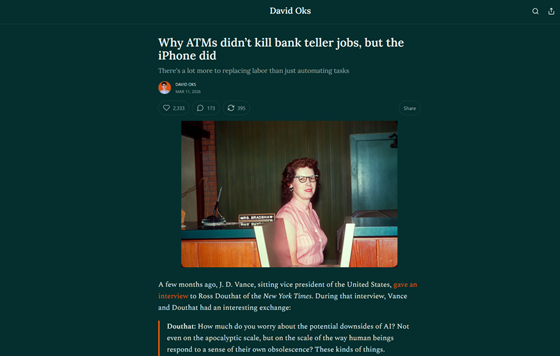
U.S. Vice President J.D. Vance addressed concerns about job losses due to AI by saying, 'ATMs were predicted to put bank tellers out of a job, but in reality, the number of tellers increased, and their jobs just changed a little.' Ox took up this point and acknowledged that the statement that 'ATMs did not lead to massive job losses for bank tellers' is correct.
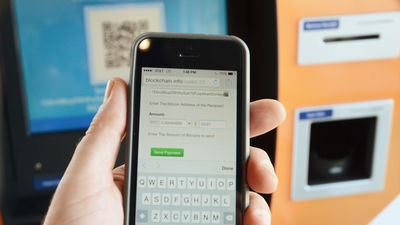
Ox points out that the reason ATMs did not lead to widespread unemployment among bank tellers is that they only replaced a portion of the work performed at bank branches. At the time, bank tellers were the core of banking operations, handling cash and checks at branches, while ATMs were a technology that handled only a part of that work, such as cash withdrawals.
ATMs became practical in the 1970s, and in 1977, Citibank, a major American bank at the time, embarked on a large-scale deployment. In the early days of ATMs, many customers still preferred human tellers, but the processing cost for banks per transaction via ATM was 27 cents (approximately 70 yen at the time), which was significantly cheaper than the $1.07 (approximately 290 yen at the time) per transaction with a human teller. Furthermore, because ATMs could be used even outside of business hours, they spread rapidly, and the number of ATMs per million Americans increased from approximately 31 in 1975 to 1,135 in 2000.
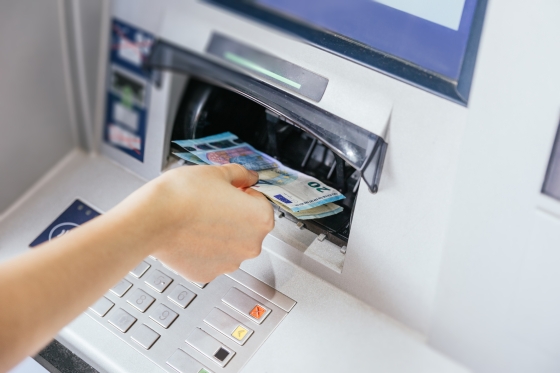
After ATMs became widespread, the number of tellers per urban branch decreased from 21 to about 13. However, according to economist David Autor, the introduction of ATMs lowered the cost of operating branches, and coupled with deregulation, the number of urban branches increased by more than 40% between 1988 and 2004. As a result, even though the number of tellers per branch decreased, the total number of tellers employed during this period actually increased. Furthermore, Ochs explains that with the reduction in routine cash handling tasks, bank tellers took on the role of informing customers about credit cards, loans, and investment products.
In short, ATMs replaced some of the work of bank tellers, but the practice of providing customer service at bank branches remained. This is why the total employment of bank tellers did not decrease immediately after the widespread adoption of ATMs.
However, Ox points out that Vance's explanation that 'the number of bank tellers has increased since the introduction of ATMs' might have been true around 2000-2005, but is no longer valid. In fact, the number of full-time bank tellers in the United States has decreased from 332,000 in 2010 to 235,000 in 2016, and to 164,000 in 2022.
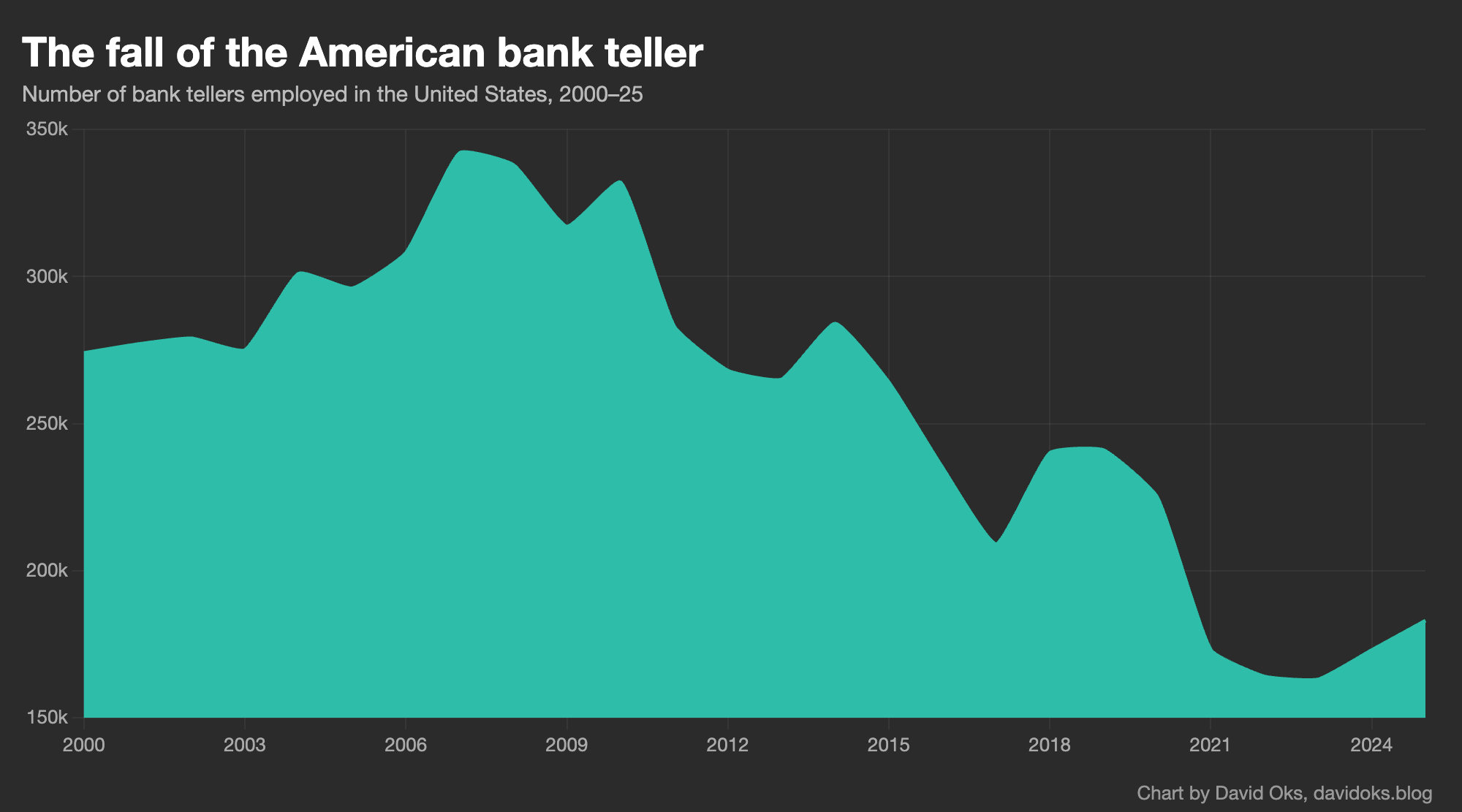
Ochs believes this decline isn't a delayed effect of the introduction of ATMs, but rather a result of the proliferation of smartphones and mobile banking, symbolized by Apple's iPhone released in 2007. The ability to check balances and deposit checks through banking apps, along with the widespread adoption of card payments and Apple Pay, has reduced the need for customers to visit bank branches and speak to tellers.
These changes are also reflected in the number of branches. The number of branches per capita for commercial banks in the United States peaked in 2009 and has since declined by approximately 30%. Bank of America, a major American bank, has also closed about 40% of its branches between 2008 and 2025, and in an interview with CNBC , the company's CEO said, 'The iPhone has made it possible for customers to carry a bank branch in their pocket.'

ATMs were a technology that automated some tasks while still relying on physical banking services, meaning that bank tellers still had to deal with customers at their branches, and there was room to reassign them to other roles. In contrast, mobile banking shifted the entry point for banking services such as balance checks, deposits, and payments from branches to smartphones, reducing the very reason for having tellers. From this, Ochs concludes, 'Technology has greatly reduced the work of bank tellers. However, it was the iPhone, not the ATM, that did it.'
Ox applies the analogy between ATMs and iPhones to the discussion of job losses due to AI. If AI is simply treated as a 'remote worker' that replaces human employees in existing tasks, the entry points and procedures for the work will remain designed for humans. In that case, the impact on employment is likely to be limited, just as ATMs have streamlined some bank branch operations.
Ochs argues that the bigger change will occur not when human jobs are directly replaced by AI, but when existing work procedures themselves are 'restructured with AI in mind.'
Related Posts:




in Note, Posted by log1b_ok