The identity of the famous 'Green Boots' body on Everest has been confirmed through DNA testing, and a recovery mission is planned.

by Maxwelljo40
DNA testing has confirmed that the body found in the 'Green Boots' cave at an altitude of 8,500m, a landmark that climbers ascending Everest from the north side must pass through, belongs to Dorje Morup, a member of the Indian-Tibetan Border Police (ITBP) climbing team. Indian authorities are reportedly considering a mission to recover Morup's body.
Mount Everest, a climber known only as 'Green Boots', and the mission to solve a 30-year mystery | Mount Everest | The Guardian
Mystery identity of 'Green Boots' climber - who became a macabre landmark frozen in ice after dying on Everest - is finally solved after DNA test | Daily Mail Online
https://www.dailymail.com/news/article-15943905/Mystery-identity-Green-Boots-climber-macabre-landmark-frozen-ice-dying-Everest-finally-solved-DNA-test.html
The 'green boots' were first captured on video in May 1996 by documentary filmmaker Matt Dickinson, and were shown in his documentary 'Summit Fever,' which followed actor and mountaineer Brian Blessed. In the documentary, they are referred to as 'an unidentified body of Indian origin.'
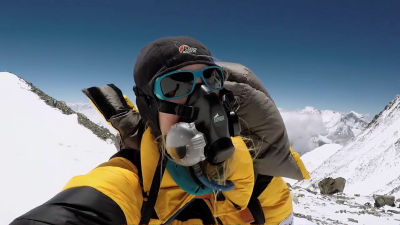
As its name suggests, the body, nicknamed 'Green Boots' because it was wearing green hiking boots, was found inside a cave at an altitude of 8,500 meters on Mount Everest. It was a kind of landmark, as it was always visible when taking the route along the northeast ridge of Everest.
In 2006, British climber David Sharp also perished in the same cave. Several climbers passed Sharp during their ascent and descent, and some, like Mark Inglis, tried to help, but their rescue was unsuccessful. It is thought that some climbers mistook Sharp for the famous 'Green Boots' and did not recognize him as a significant landmark. Sharp's body was found missing in 2007, and the 'Green Boots' were moved to a less conspicuous location in 2014.
The identity of 'Green Boots' remained unknown for 30 years, with leading candidates being Tsewang Parjol, an ITBP member who summited at the same time as the mass Everest disaster in May 1996, or Lance Naik Dorje Morp, also an ITBP member.
ITBP divided its approximately 16 members into three teams, and on May 10, 1996, the first team of six began their ascent to the summit of Everest via the North Ridge route. However, due to bad weather and frostbite, three members returned to base camp, and three members—Parjol, Morup, and Subedar Tsewang Samanla—continued their climb to the summit. The three reported their successful ascent by radio around 6:30 PM. Of the team, Samanla, who was considered the leader, remained on the summit for a long time to pray, while the other two descended first.
Although not a member of ITBP, P.M. Das, who served as a senior deputy leader of an ITBP team, published a report in the Himalaya Journal in 1997 titled 'Indians' Ascent of Mount Everest via the North Ridge Route.'
HJ/53/7 THE INDIAN ASCENT OF QOMOLUNGMA BY THE NORTH RIDGE
https://www.himalayanclub.org/hj/53/7/the-indian-ascent-of-qomolungma-by-the-north-ridge/
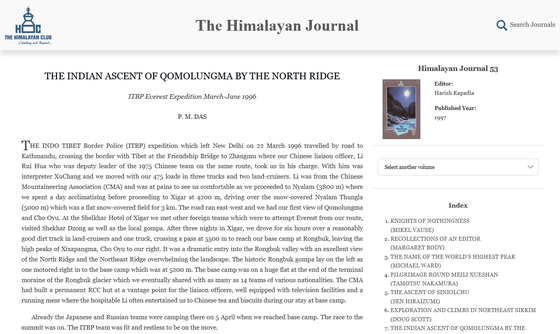
According to the report, radio communication with the summit area was lost around 7 PM due to a storm, and around 7:30 PM, two headlamps were spotted descending in the darkness. At 6 AM the following day, May 11th, a report was received that the group that had reached the summit had not returned to Camp 6 at an altitude of 8320m.
According to Mr. Das, on the 11th, he was able to contact members of the Fukuoka team from Japan, who were at Camp 6 aiming to reach the summit via the same North Ridge route as the ITBP team, via base camp. He learned that team member Morupp was slowly descending between the First Step and Second Step, that Morupp refused to put on gloves because his hands were frostbitten, and that he was unable to remove the carabiner at the anchor point, so the Fukuoka team attached the carabiner to the next fixed rope.
Furthermore, it was reported that Samanla had already died when the Fukuoka team reached the summit, and his body was lying on the second step. At that time, the whereabouts of Parjol were unknown, but later information was obtained from Sherpas that he, like Morupp, was between the first and second steps and in critical condition.
After reaching the summit, the Fukuoka team encountered team member Morupp again below the First Step and proceeded their descent assuming they could return to Camp 6. However, Morupp died on the afternoon of the 11th, and the team that arrived later found his body near Camp 6. The body of team member Parjol was not found, and Das speculates that he may have accidentally fallen down the east face of Everest (Kangshun face).
However, this report by Mr. Das, who was part of the team, was not given much weight, and for a long time it was believed that team member Parjol was the one wearing the 'Green Boots.' Now, DNA testing has confirmed that team member Morupp is indeed the one wearing the 'Green Boots.'
ITBP is reportedly considering conducting body recovery missions through a bidding process. According to the documents, the contracted company is scheduled to recover the bodies and transport them to Delhi by October 2026. Tsiring Jambu Sherpa, who has recovered five bodies from Everest so far, said, 'This will be the most technically challenging operation ever attempted. The risks are twice as high as normal climbing.'
India eyes 'high risk' Mount Everest mission to recover frozen body of climber 'Green Boots' after 30 years - CBS News
Incidentally, John Krakauer, the author who survived the Everest disaster and wrote 'Into the Sky: Why the Everest Disaster Happened,' writes that the Fukuoka team noticed the ITBP members but did not offer any help. In reality, the Fukuoka team was unaware that there were missing members from the ITBP team, and initially mistook the team they encountered along the way for the Taiwanese team. Furthermore, as Das's report states, they were cooperating with the ITBP team, and Das also wrote that 'the Fukuoka team was cooperative.'
Amazon.co.jp: To the Sky: Why the Everest Tragedy Happened (Bunshun Bunko Ku 11-1): Jon Krakauer, Masahiko Kaizu: Book
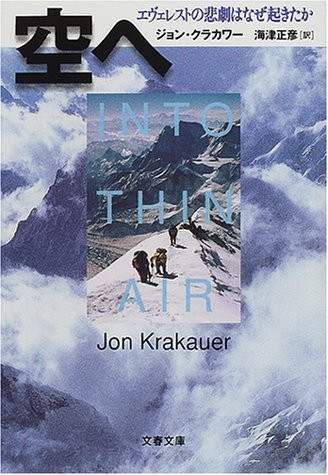
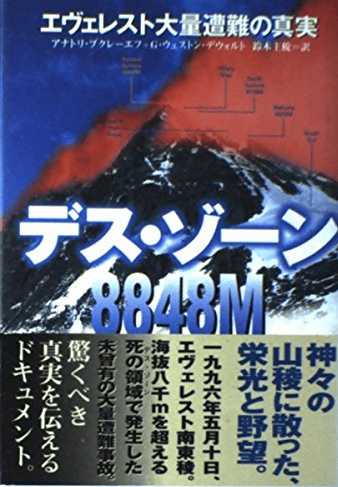
Furthermore, Krakauer takes a somewhat critical view of the actions of his guide, Anatoly Boukreev, in the Everest disaster in which he himself was involved. Since Boukreev, a participant in the disaster, has written his own book, 'Death Zone 8848M: The Truth About the Everest Disaster,' it might be best to read both books to understand what happened.
Related Posts:

in Note, Posted by logc_nt