Exercising together as a family for 45 minutes may improve cognitive function in both parents and children in the short term.

A 45-minute exercise session involving parents and children together has been shown to lower postprandial insulin levels in parents and potentially improve performance on certain cognitive tasks in both parents and children in the short term. Scarlett Fountain and Kara Dorling, researchers at Nottingham Trent University, discuss the benefits and ease of continuing family exercise.
Family-Based Tag Rugby: Acute Effects on Risk Factors for Cardiometabolic Disease and Cognition and Factors Affecting Family Enjoyment and Feasibility | Healthcare
https://www.mdpi.com/2227-9032/13/24/3186
How a 45-minute family exercise session could boost thinking skills | The Conversation
https://theconversation.com/how-a-45-minute-family-exercise-session-could-boost-thinking-skills-284400
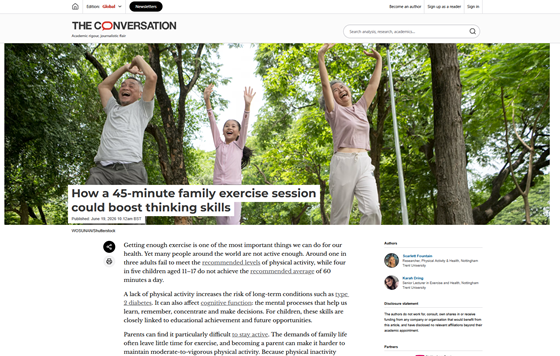
Parents often find it difficult to find time for exercise due to household chores and childcare, and children tend to be less active in the evenings and on weekends when they spend time with their parents. Therefore, exercise programs that only target children have difficulty addressing the lack of exercise among parents.
Fountain and his colleagues focused on tag rugby , a non-contact version of rugby where players are tackled if their tag, attached to their waist, is taken by an opponent, as a 'family-unit exercise' that allows parents and children to exercise together. Fountain and his colleagues believe that tag rugby is a fun exercise that can be easily enjoyed by participants of different ages and can be easily adapted for families.
The experiment conducted by Fountain et al. involved 16 families, consisting of 27 children and 20 parents. Participants experienced days of 45 minutes of family tag rugby followed by 45 minutes of sitting and resting, with approximately 7 days between the two conditions.
The 45-minute tag rugby session consisted of a 5-minute warm-up, 15 minutes of basic drills, 20 minutes of short matches, and a 5-minute cool-down. After the exercise and rest, Fountain et al. provided each participant with a lunch consisting of a chicken or cheese sandwich, baked crisps, and an apple, with a balanced amount of carbohydrates. Post-meal blood glucose, insulin levels, and triglycerides were measured. In addition, cognitive function was assessed using several tasks.

The results showed that parents had lower postprandial insulin levels after playing tag rugby compared to when they rested for 45 minutes. While blood insulin levels 30 minutes and 120 minutes after lunch were lower under the exercise condition than under the rest condition, no difference was observed in blood glucose or triglycerides. Insulin is a hormone that lowers blood glucose levels by allowing cells to take in sugar from the blood. If insulin levels are lower without a significant difference in blood glucose levels after eating the same meal, it may indicate that the body is able to process glucose with less insulin.
Regarding cognitive function, both parents and children showed short-term improvements in some tasks. In children, performance improved immediately after exercise in three items of the Sternberg task, which measures working memory, but worsened 45 minutes after exercise compared to the resting condition, indicating that the improvement was not sustained. However, in parents, improvement was observed immediately after exercise in the Stroop task , which measures the ability to process information and suppress unnecessary information.
Fountain and his colleagues explain that tag rugby involves a continuous sequence of actions such as running, passing, observing the opponent's position, reacting to teammates, and deciding on the next move, so the fact that it uses both the body and the mind may have contributed to cognitive function.
Fountain and his team gathered participating families to hear their impressions, and then conducted separate interviews with parents and children. They found that families perceived tag rugby as an activity they could 'participate in together,' that was 'fun,' and that was 'so easy to get into that you forget you're exercising.' They also noted that parents tended to prefer basic drills such as passing and moving, while children preferred activities with more freedom and less intense competition, such as small-scale matches.
'Tag rugby is perceived as an activity that families can easily participate in together, and it provides clues for thinking about future family exercise programs,' Fountain and his colleagues said.
Related Posts:








in Science, Posted by log1b_ok