Drinking unsweetened, highly carbonated water may reduce fatigue and improve concentration during esports.
When thinking about what to drink during long gaming sessions, energy drinks and coffee often come to mind, but it turns out that 'highly carbonated water' may also be effective. A joint study by the University of Tsukuba and Asahi Soft Drinks showed that drinking unsweetened highly carbonated water during esports matches resulted in less fatigue, increased enjoyment, and fewer fouls compared to drinking plain water.
Sparkling water consumption mitigates cognitive fatigue during prolonged esports play - ScienceDirect
Drinking highly carbonated water reduces cognitive fatigue caused by esports | Medical & Health - TSUKUBA JOURNAL
https://www.tsukuba.ac.jp/journal/medicine-health/20260220140000.html
Fumion Takahashi and his colleagues at the University of Tsukuba focused on the fact that prolonged esports play is prone to causing cognitive fatigue accompanied by a decline in executive function. In esports, maintaining high levels of functions such as attention, judgment, and inhibition is directly linked to winning or losing, but there is a problem in that players tend to rely on caffeinated beverages and sugary drinks to combat fatigue. Therefore, Takahashi and his colleagues investigated what effect highly carbonated water, which contains neither sugar nor caffeine, has on prolonged play.
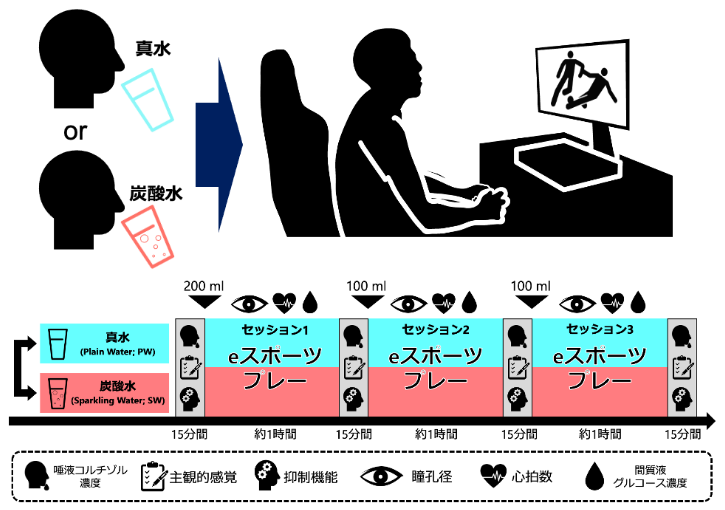
Takahashi et al.'s experiment was conducted with 14 ordinary, non-professional game players. Participants took part in the experiment twice on different days, experiencing both conditions: 'playing a virtual soccer game for a total of 3 hours while drinking plain water' and 'playing a virtual soccer game for a total of 3 hours while drinking highly carbonated water.'
The order in which participants drank their beverages was changed for each participant. One participant played while drinking plain water on the first day and highly carbonated water on the second day, while another participant played while drinking highly carbonated water on the first day and plain water on the second day.
In addition, during play, the subjects' pupil diameter, heart rate, and glucose concentration in the subcutaneous tissue fluid were continuously measured. Furthermore, they were asked to self-assess their fatigue and enjoyment every hour, and they underwent a flanker task in which they had to classify symbols displayed on a computer screen, ignoring those at the ends (flankers) and focusing only on the symbols and numbers displayed in the center. Salivary cortisol levels, which increase when stressed, were also measured.
The results showed that under the condition of playing while drinking plain water, subjective fatigue increased significantly over time, whereas when playing while drinking highly carbonated water, the increase in subjective fatigue was smaller. Conversely, the enjoyment score was higher when playing while drinking highly carbonated water, and the University of Tsukuba explained this result by saying that 'highly carbonated water suppresses the onset of fatigue and enhances enjoyment.'
In terms of cognitive function, the study found that drinking highly carbonated water resulted in a smaller decline in performance on the flanker task. Takahashi et al. suggest that this result indicates that highly carbonated water may be helpful in maintaining judgment and attention during prolonged play.
Furthermore, according to Takahashi et al., pupil dilation, which is considered one of the signs of cognitive fatigue, progressed under the condition of plain water, but was suppressed under the condition of highly carbonated water. In addition, a correlation was observed between the decrease in pupil dilation and the decline in performance on the flanker task, indicating that changes in pupil size can serve as an objective indicator of cognitive fatigue.
Furthermore, while there were differences in fatigue levels and cognitive function when participants drank highly carbonated water, there were no significant differences in heart rate, interstitial fluid glucose concentration, or salivary cortisol concentration. Takahashi et al. believe that these results suggest that the stimulation from carbonation itself, rather than the effects of sugar or caffeine, may be involved in reducing cognitive fatigue.
There were differences in in-game behavior between players using highly carbonated water and those using plain water. While there were no significant differences in goals scored, goals conceded, shots taken, passes, or interceptions, the number of fouls decreased under the highly carbonated water condition. Takahashi et al. interpret these results as 'highly carbonated water supporting the maintenance of executive function and fair play behavior.'
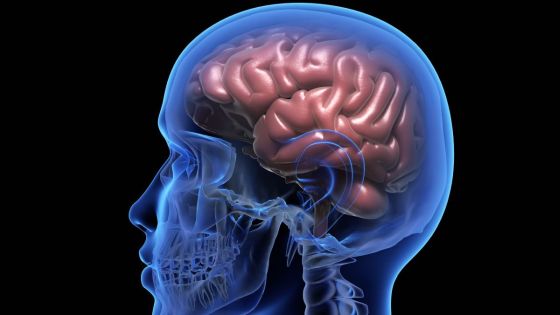
Takahashi et al. suggest that the stimulation from highly carbonated water may increase activity in the brainstem and prefrontal cortex through sensory pathways in the throat, potentially influencing alertness and the maintenance of judgment. However, this study did not directly investigate the mechanism itself. Furthermore, the comparison was only with plain water, and it was not verified how effective it is compared to coffee or energy drinks, so further research is needed to confirm the effects of highly carbonated water.
Related Posts: