Anthropic has published the results of its analysis of 'Who is using Claude Code and for what purposes?'
Anthropic has published an analysis of who is using the AI-powered coding assistant '
Agentic coding and persistent returns to expertise \ Anthropic
https://www.anthropic.com/research/claude-code-expertise
Our latest economic research introduces a framework for tracking Claude Code as it scales.
— Anthropic (@AnthropicAI) June 16, 2026
Who is using Claude Code, and what are they using it for? How is the value of tasks changing? And how much does domain expertise shape whether a session succeeds? https://t.co/IjjwQvrESo
According to Anthropic, agent-based coding is rapidly gaining popularity, with the percentage of GitHub projects contributed by coding agents more than doubling between the second half of 2025 and the first half of 2026. As of June 2026, Claude Code users spend an average of 20 hours per week on Claude Code.
Anthropic used Clio , an automated analysis tool that allows for the analysis of actual language model usage while protecting privacy, to analyze approximately 400,000 Claude Code sessions from approximately 235,000 users from October 2025 to April 2026.
First, in an analysis of who uses Claude Code, Anthropic states that they were able to successfully infer occupations in approximately 70% of sessions, with 'Computer and Mathematics-related occupations,' which cover most software-related jobs, being the largest group as expected. The next largest was 'Business and Finance,' followed by 'Arts, Design, and Media,' 'Management,' and 'Life Sciences, Physical Sciences, and Social Sciences.' The fastest-growing non-software-related occupations analyzed were management, sales, and legal-related jobs.
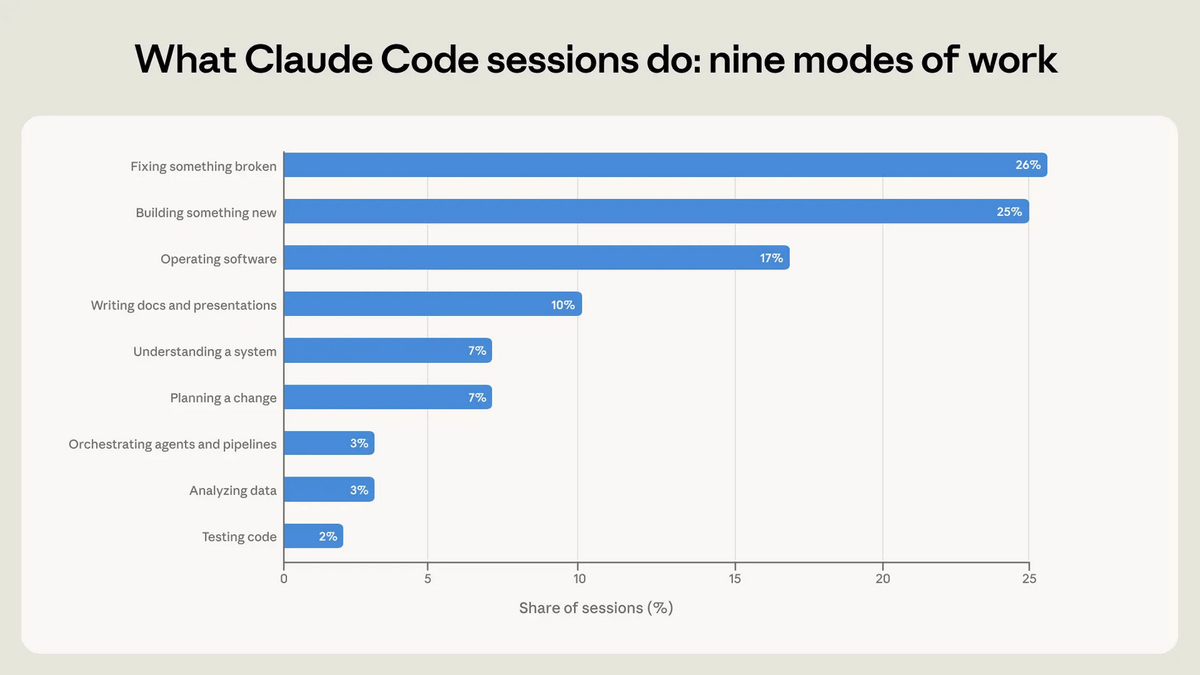
The following graph shows how people use Claude Code. More than half of the tasks were coding-related, with 26% modifying code and 25% writing code. Other common uses included software operation (17%) and writing documentation and presentations (10%).
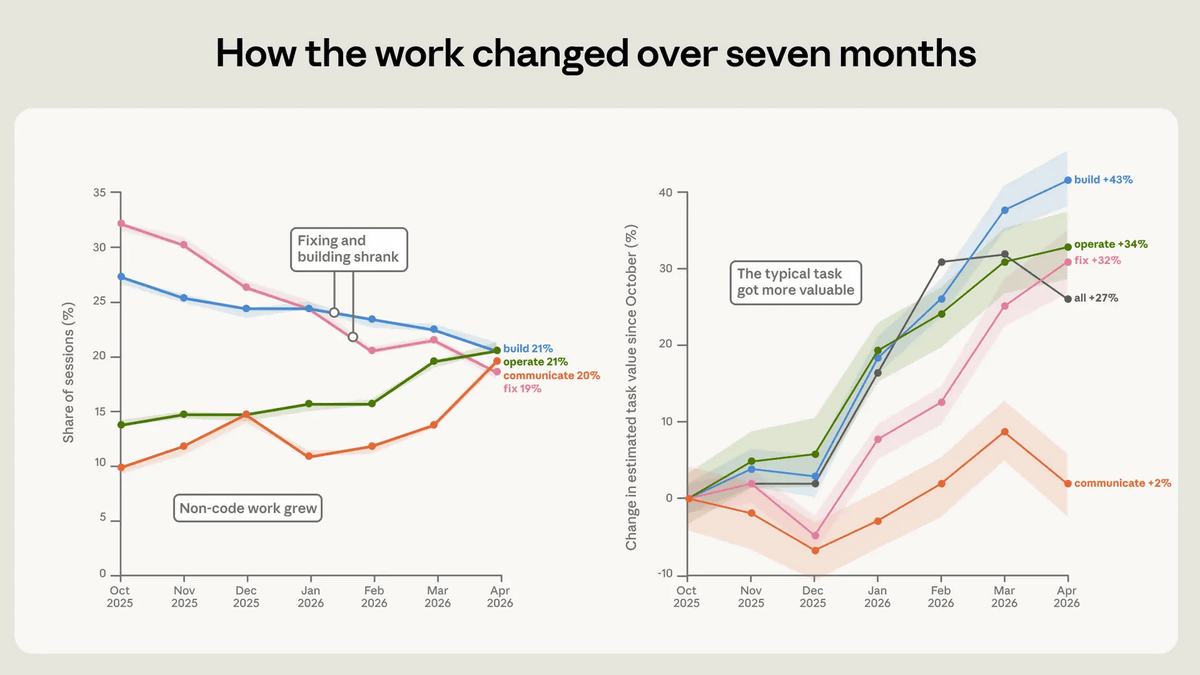
The image on the left below shows a graph illustrating the types of work performed using Claude Code over time. The most striking change is the decrease in the percentage of code modifications from 33% in October 2025 to 19% in April 2026. On the other hand, software operation, data analysis, and documentation creation have increased. The image on the right shows a graph illustrating the change in the economic value of each session, with the estimated value of the average session increasing by 27% between October 2025 and April 2026.
As AI rapidly develops and demonstrates advanced coding capabilities, it is often argued that the most important skill that AI cannot replace is '
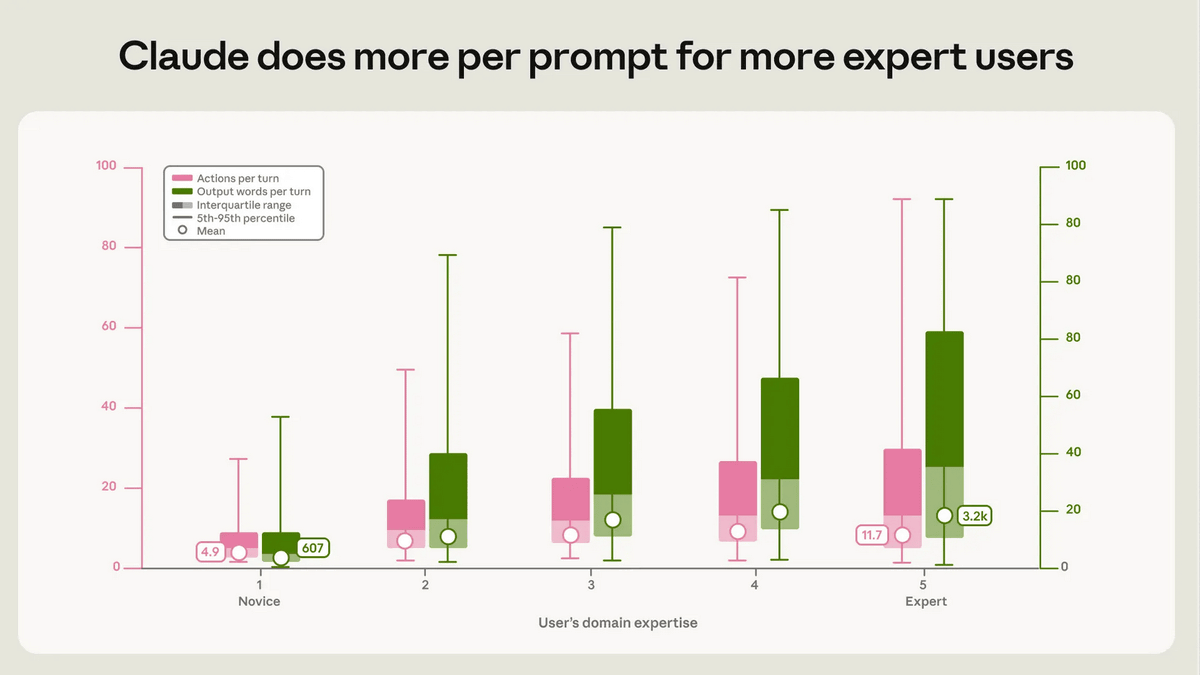
The following graph shows how a Claude Code session changes at each of five levels of user expertise. In a typical beginner session (level 1), approximately 5 actions and about 600 words of output are generated per prompt. In contrast, in an expert session (level 5), twice as many actions are generated, and the output is five times greater, at approximately 3200 words. In other words, the more experienced a user is, the more they can elicit autonomous activity from Claude Code.
Furthermore, Anthropic's success metrics showed that the higher the level of expertise participants demonstrated in a session, the more likely the session was to be successful. In beginner sessions, the strictest criterion of 'success' was about 15%, and 'partial success' was 77%, while in sessions with intermediate or higher expertise, 'success' was 28-33%, and 'partial success' was 91-92%, showing a significant difference. In addition, sessions detected as 'failures' (not even partially successful) accounted for 19% of beginner-level sessions, compared to 5-7% of other users. Anthropic analyzed this, stating, 'The less experienced the user, the more likely they are to give up if they struggle to achieve the desired results. Part of the value of expertise seems to lie in its ability to guide agents in the right direction.'
Anthropic summarizes the report, concluding: 'The results of this report provide new insights into how agent-based coding amplifies certain knowledge and skills while substituting others. In code-generating sessions, the success rate for major occupations was roughly the same as that for software-related occupations. With the advent of coding agents, a coding background appears to be less important for programming success than before, and the level of industry expertise has a more pronounced impact on session success. If the success rate of coding sessions by non-software-related users continues to increase, it may indicate that software development is becoming a part of the daily work across all fields, rather than being the product of a single occupation. These changes will alter who benefits from agent-based coding and to what extent, and will also affect what is most valuable in the labor market.'
Related Posts:






in AI, Posted by log1e_dh