Experiment successfully created a 'mini-universe' for measuring time without using a clock.

A research team at the University of Birmingham in the UK conducted an experiment using cold atoms to measure the passage of time without relying on clocks. This research explored the possibility that time is not something given from the outside, but rather arises from internal changes in a closed quantum system.
Testing the problem of time with cold atoms | Phys. Rev. Research
Scientist creates 'mini‑universe' to measure time without a clock
https://phys.org/news/2026-06-scientist-miniuniverse-clock.html
In the experiment, 24,000 rubidium-87 atoms were cooled to extremely low temperatures, creating a special state called a Bose-Einstein condensate . This collection of atoms is almost completely isolated from the outside world and was treated as a small 'mini-universe' in the study.
A research team led by Professor Giovanni Barontini of the University of Birmingham divided this mini-universe into two regions with a thin wall of light, designating the observer side as the 'bright region' and the unobserved side as the 'dark region,' allowing atoms to travel between them.
In the bright regions, the atomic cloud expands and contracts. The research team describes the moment it begins to expand as similar to the ' Big Bang ,' and the moment it contracts back as similar to the ' Big Crunch .'
The following diagram shows the time evolution of a miniature universe made of cold atoms. A thin barrier of light separates the observable bright regions from the unobservable dark regions, and the atomic cloud expands and contracts repeatedly as it moves.
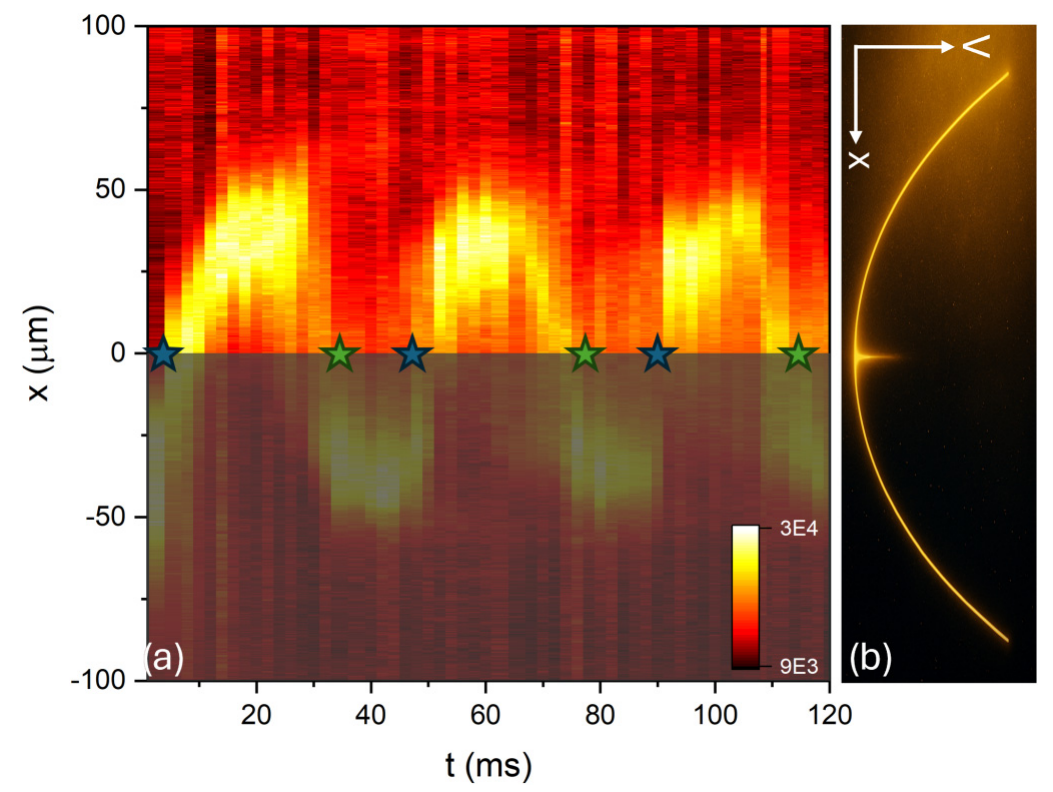
Furthermore, the research team determined the sequence of events solely from internal changes in the bright areas, without using an external clock. The clue they used was entropy, which represents the degree of atomic dispersion.
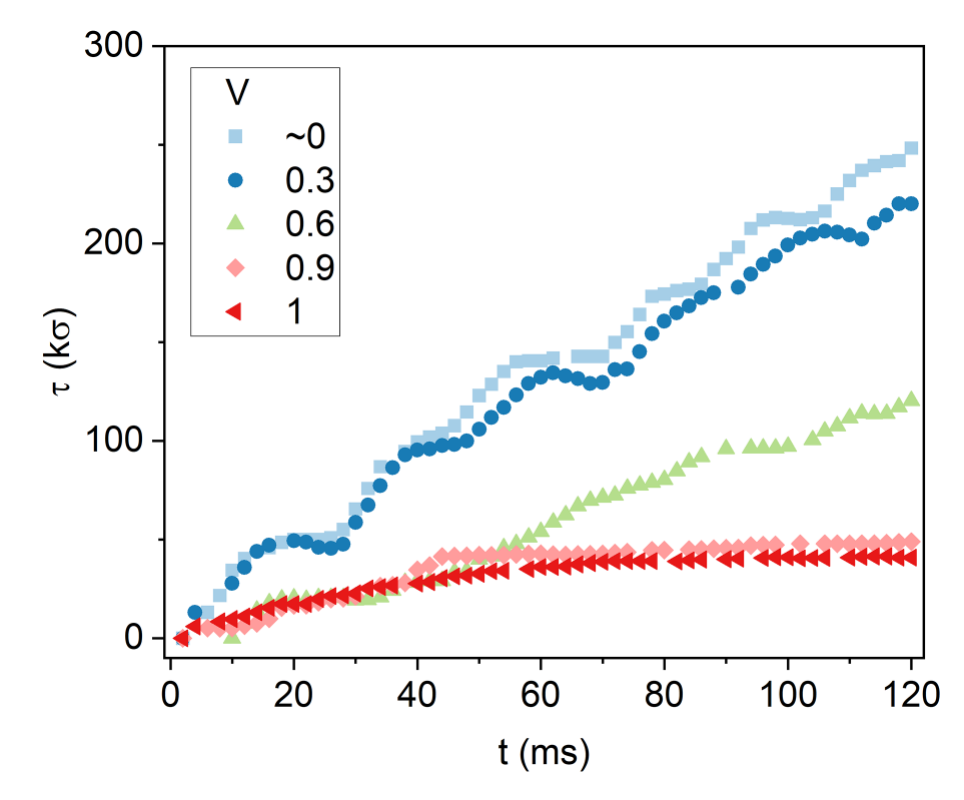
When atoms move between bright and dark regions, their entropy also changes. The research team defined 'entropy time' from this change, treating it as time progresses when entropy changes and stops when the change stops.
The graph below shows how entropy time (vertical axis), defined within the mini-universe, progresses relative to an external laboratory clock (horizontal axis). The greater the entropy exchange, the faster internal time progresses; conversely, the smaller the exchange, the slower it progresses.
Furthermore, the study derived the Schrödinger equation , which normally uses external time, by using entropy time. The results of this calculation reportedly reproduced the extent of the atomic cloud observed in experiments well.
The experimental results showed that the changes in the bright region, which repeatedly expands and contracts according to entropy time, can be arranged in a natural order. By raising the light barrier to suppress atomic movement, the exchange of entropy decreased, and the flow of internal time also slowed down.
The research team states that these results provide a clue to verifying in the laboratory the idea that the flow of time arises from changes in entropy. They also argue that using cold atoms could potentially allow us to investigate time-related issues in the Big Bang, Big Crunch, and quantum cosmology in a controlled environment.
Related Posts:







in Science, Posted by log1i_yk