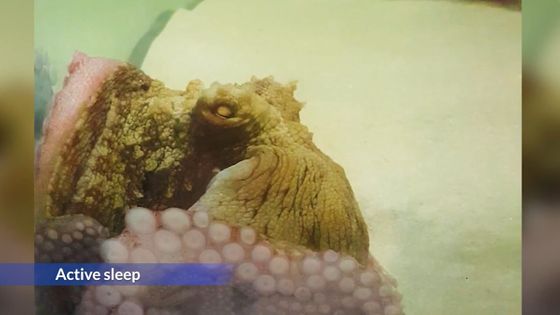
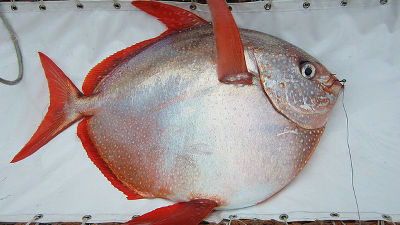
Human sleep consists of two types: REM sleep and non-REM sleep. However, it has been discovered that fish have four different types of sleep.

Mammals, including humans, cycle through two sleep stages: REM sleep and non-REM sleep. A study investigating whether fish also have sleep stages revealed that the zebrafish has four sleep stages.
Eye movement kinematics reveal novel circadian organization of sleep substates | Nature Communications
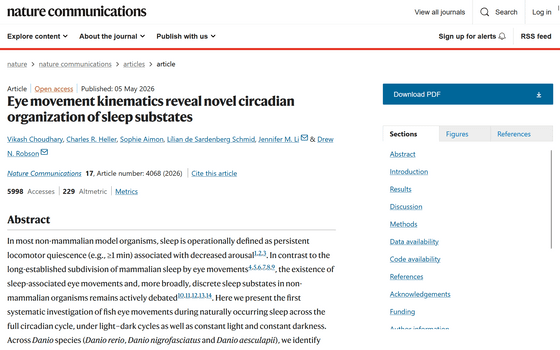
Fish reveal four distinct sleep states, including three with eye movements
REM sleep stands for 'rapid eye movement sleep,' and as the name suggests, it refers to a state in which the eyes move rapidly during sleep.
Previous studies have reported that fish exhibit eye movements while motionless, but no research had investigated whether the eyes move during natural sleep. Researchers at the Max Planck Institute for Biological Cybernetics in Germany have now discovered the first complex sleep movements in fish.
The researchers focused on zebrafish. Because zebrafish larvae have transparent heads, they were able to easily record brain activity using a special microscope.
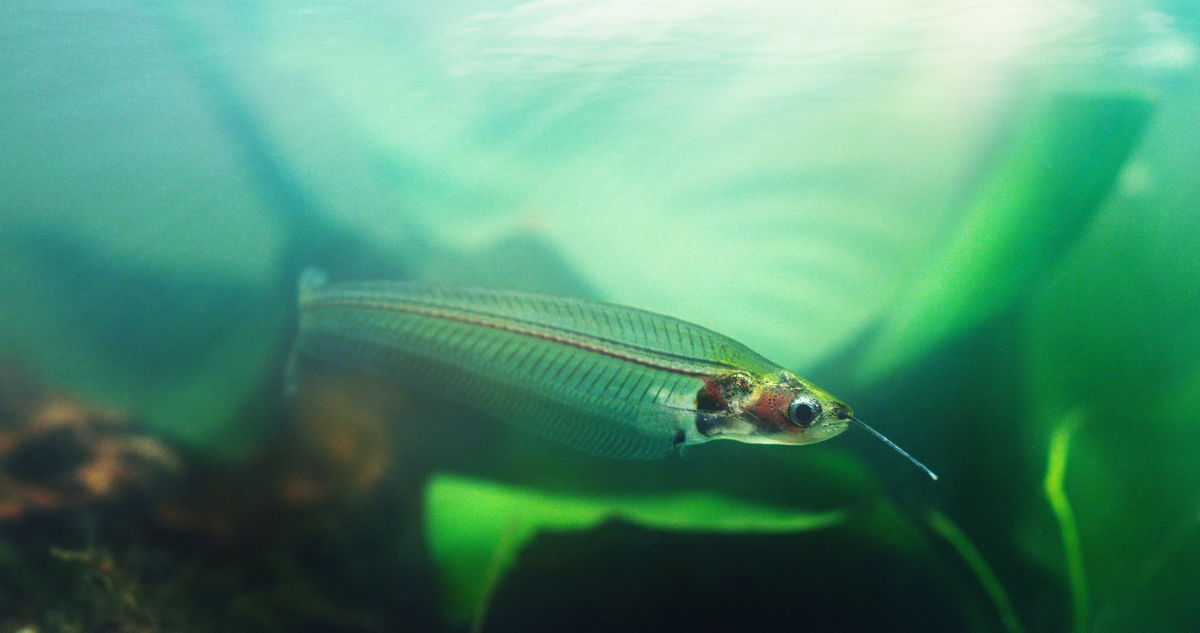
By combining brain activity recordings with behavioral observations, researchers discovered that the zebrafish's behavior followed each individual's circadian rhythm. After a period of activity, the zebrafish entered a period of inactivity lasting several minutes, similar to most teleost fish, during which their responsiveness to stimuli decreased.
This inactivity can be divided into several states. One state is one without noticeable eye movement and mainly occurs at night. The remaining states involve eye movement, and three types of these have been observed. One peaks at night, and another increases as morning approaches.
Most notably, the most frequently observed state of inactivity accompanied by eye movement, known as 'QEM-1,' occurred almost exclusively during the daytime. Researchers point out that this is 'remarkable' because fish in QEM-1 are very difficult to wake up and are vulnerable to predators.
During the sleep phase of QEM-1, overall brain activity was significantly reduced, confirming that QEM-1 is a 'sleep state similar to a nap.'

by Azul
While it was discovered that there are four different sleep stages, this raised new questions about the role each stage plays. The researchers stated, 'We are very interested in the role each sleep stage plays. Sleep is crucial for many processes, from memory revitalization to waste removal, but we still don't fully understand why it's necessary or how it's organized temporally. Zebrafish, with their transparent brains, should provide a powerful tool to unravel these mysteries.'
Researchers are now looking to further investigate neural activity during nighttime sleep to deepen their understanding of the mechanisms and functions of different sleep states.
Related Posts: