When the 'appearance' of a word evokes an image of its meaning, the brain can process that word more quickly and accurately.
In English, the 26 letters of the alphabet are used to form various words, and some words have shapes that evoke meaning, such as the vertical lines on both ends of 'bed' resembling bedposts, or the entire word 'loop' resembling a kind of loop. David Siddu, an assistant professor of psychology at Carleton University in Canada, has published research showing that 'when the appearance of a word is similar to its meaning, the human brain can process that word more quickly and accurately.'
The word “bed” looks like a bed: Orthographic iconicity in English - ScienceDirect
When words look like their meaning, we process them faster, new research reveals
https://theconversation.com/when-words-look-like-their-meaning-we-process-them-faster-new-research-reveals-282228
While some kanji characters, such as '山' (mountain) and '手' (hand), are pictographs derived from the shape of an object, English words like 'bed' and 'loop' also have shapes that evoke meaning. Some words, like 'blizzard,' have a more ambiguous association with meaning, such as the zigzag appearance that gives a sense of chaos.
This phenomenon, where the appearance or sound of a word evokes its meaning, is called ' iconicity, ' and has generally been studied in cases where sounds evoke meaning, such as 'meow' (the sound a cat makes) or 'teeny' (something small). In his new research, Sidhu investigated the iconographicity of 'visual features' in English words.
In the study, participants were asked to rate over 3,000 words on a scale of 1 to 7, judging how closely the letter shapes resembled their meanings. Psycholinguistic research often involves having participants rate certain aspects of words (such as how specific or positive they are) and using the results to understand how people process those words.
Sidhu points out that a notable point is the degree of agreement among the participants. Among the words that were rated as having a similar shape to their meaning were 'bed,' 'bubble,' 'look,' 'wiggle,' 'hoop,' and 'puppy.'
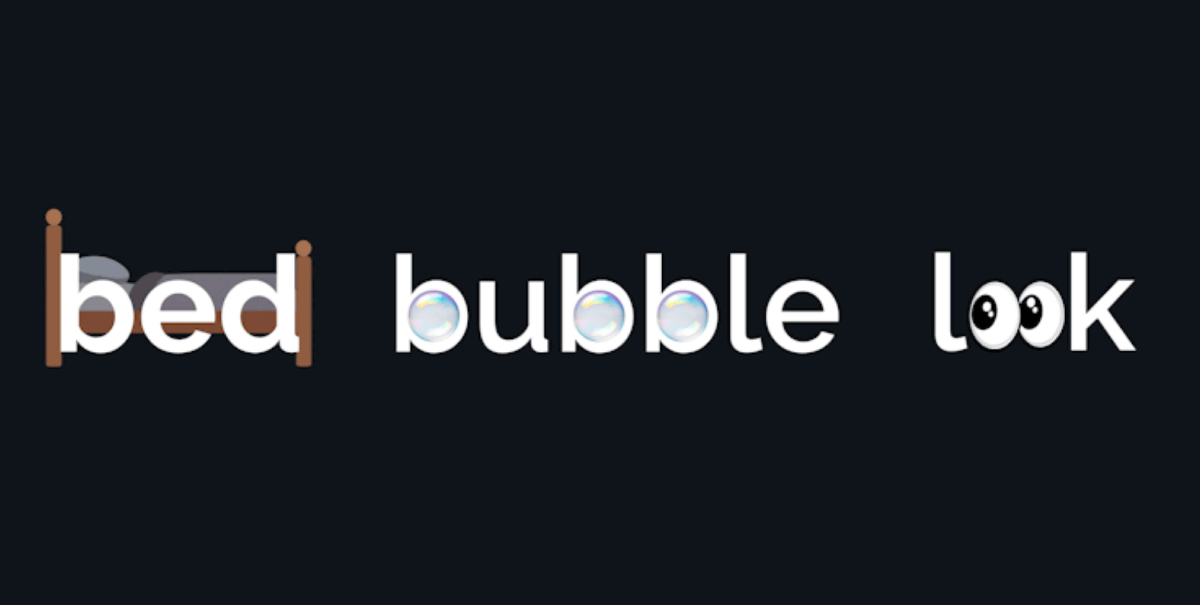
There are some explanations for why these words were so well-received. For example, 'puppy' looks as if it has legs and a tail, and the two lowercase 'g's in the middle of 'wiggle' give the impression that something is swaying.
The words that received high ratings tended to include round letters such as 'O', 'G', and 'C' in words describing round objects, and angular letters such as 'W', 'Z', and 'X' in words describing pointed objects. Additionally, words describing small objects received higher ratings the fewer letters they had.
Sidhu then conducted an analysis using three databases containing information on how quickly people can process individual words. This data was obtained from a task in which participants were presented with a string of letters and asked to identify as quickly as possible whether they were real or fictional words.
The analysis revealed that in all three databases, 'people process words with similar meanings more quickly and accurately.' This correlation was confirmed even after considering factors such as word commonality and length.
Sidhu stated, 'There is a growing recognition that language is more than just words and their meanings, and that all elements, such as tone of voice, gestures, and eye contact, are involved in language. Now, we can say that another subtle clue, the 'shape of letters,' has been added to that.'
Related Posts:



in Science, Posted by log1h_ik