What is 'Dick Over,' the technique that obscures web pages and forces users to perform pointless actions?
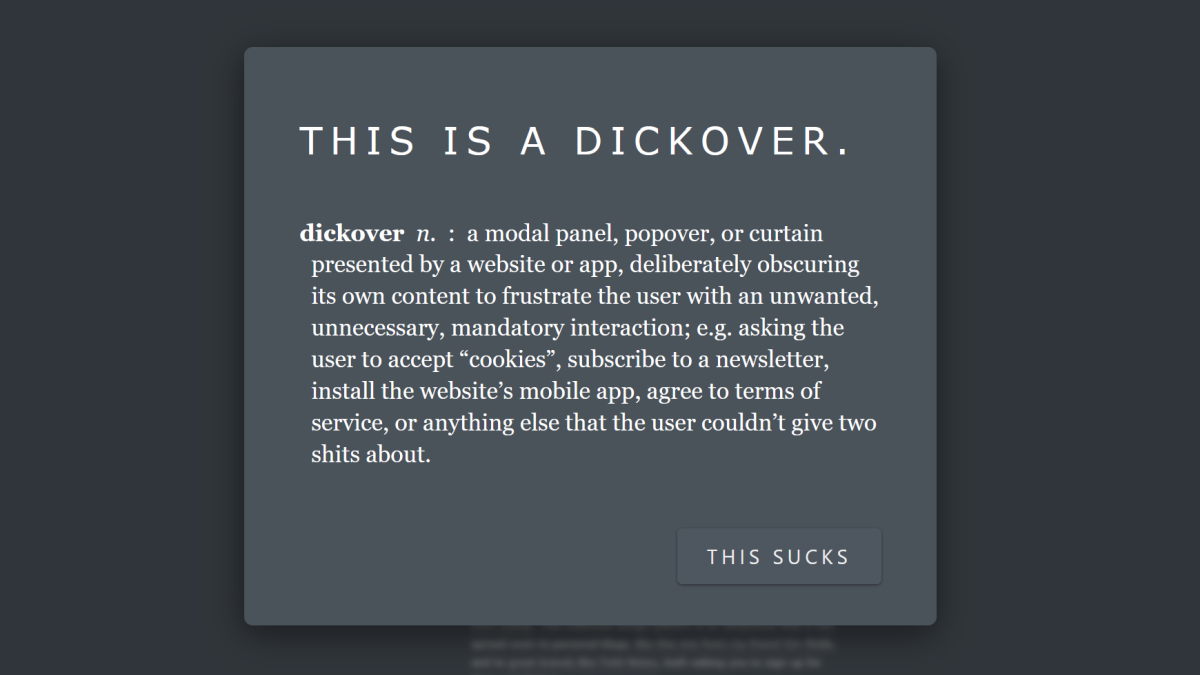
When you open an article on a website, the screen may be covered with prompts asking for cookie consent, newsletter subscriptions, or app installations before the main text is visible. John Gruber, the operator of the technology blog 'Daring Fireball' and the inventor of
What Is a Dickover? - Daring Fireball
https://daringfireball.net/2026/05/what_is_a_dickover
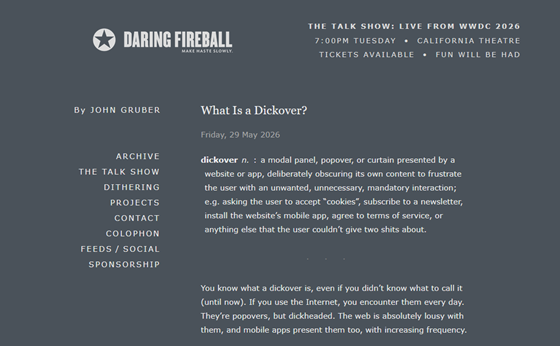
According to Gruber, a 'dickover' is a modal window , popover , or curtain-like display where a website or app intentionally hides its own content, forcing users to take unnecessary and coerced actions. For example, Gruber dismisses accepting cookies, signing up for newsletters, installing mobile apps, and agreeing to terms of service as 'completely useless to users.'
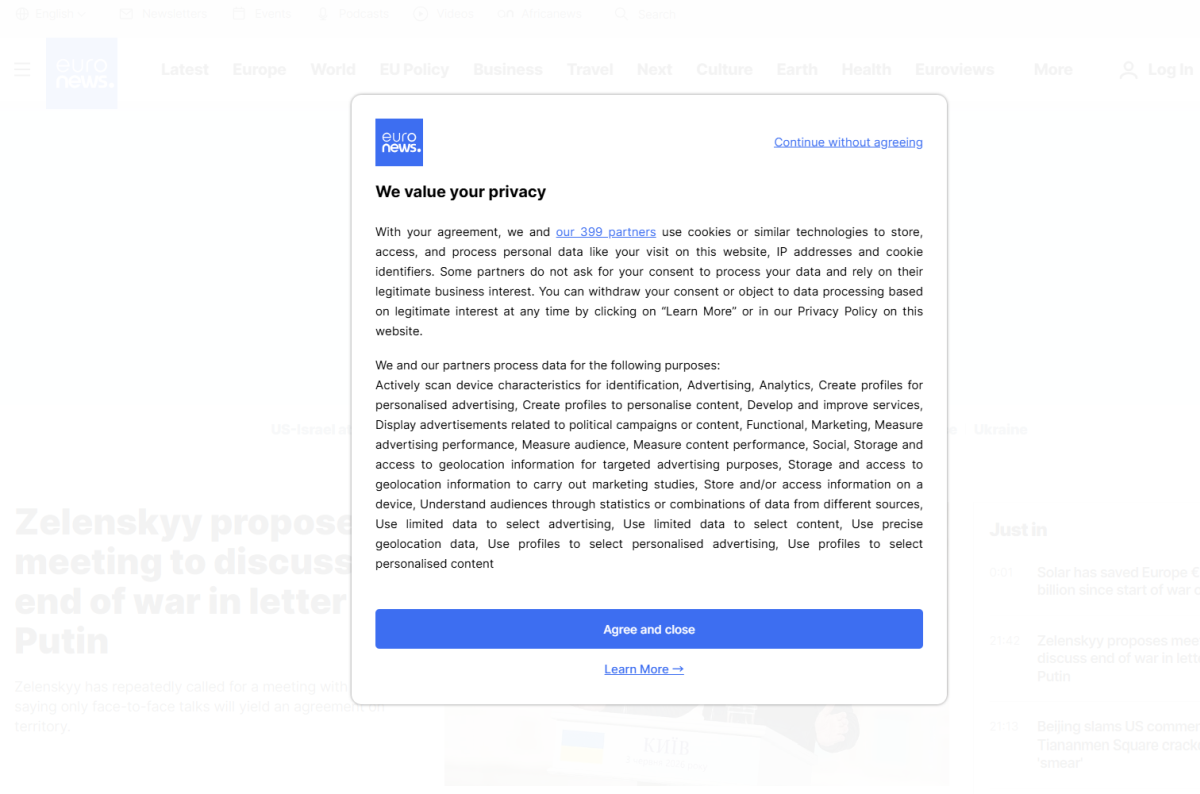
Gruber criticized the Dickover, calling it 'a popover in form, but a crappy popover that gets in the way of the user,' and cited ' Euronews ' and ' Galup ' as examples of sites where Dickovers appear. He also mentioned that Dickovers have spread to personal blogs and well-known brands, and that they are appearing in various places to ask users to sign up for newsletters.
One particularly egregious example cited is the homepage of all blogs hosted on Substack. Gruber explains that Substack's Dickover is not just a panel, but a curtain-like display that covers the entire screen, giving the impression that nothing can be read unless you subscribe to the blog's email newsletter. Furthermore, Gruber considers this to be malicious because the button to close Substack's Dickover is a small text link rather than a large, button-like UI element.
When I actually accessed the homepage of a blog hosted on Substack, at least on the page I checked, a clickover prompting newsletter registration appeared as shown below. However, the clickover could be closed not only by clicking the small text link that said 'No thanks,' but also by clicking the '×' button in the upper right corner, so the displayed content and the UI for closing it may differ depending on the environment and the blog being accessed.

Gruber also criticized the practice of displaying Dickover in front of articles, saying, 'It's like sending a newsletter by email and then not letting the reader read the content in the email, only including a link to a webpage.' He added, 'Webpages should be displayed as webpages. Emails should be displayed as emails. There's no reason why we should have to explain this.'
Even more despicable are websites that display a ticker after the reader has started reading and is scrolling. It's not something a website should take for granted that readers will pay attention to an article, story, or product page. Gruber criticizes that interrupting a reader while they are reading by displaying a ticker is 'no different from snatching a book or magazine from a reader's hands and demanding something else.'
However, Gruber cites 'unnecessary' as a key element in defining a 'dickover,' and states that not all 'modal blockers' that appear in the foreground of a page, making it difficult to interact with the content behind them, qualify as dickovers. For example, granting cookies or subscribing to an email newsletter are unnecessary actions for using the content, but signing up for or logging into a paywall, as shown below, are necessary actions for using the content. Therefore, Gruber states that even if a paywall signup or login screen can be annoying, it does not constitute a dickover.

The Dickover issue has also been discussed on the social news site Hacker News , with some pointing out that 'developers and administrators may not realize how bad the experience is for new users because it doesn't appear on their site since users have already given cookie consent, etc.' and others sharing their experiences , such as 'the Dickover appeared right before the purchase process, and when I closed it, the payment screen disappeared as well.'
Related Posts:


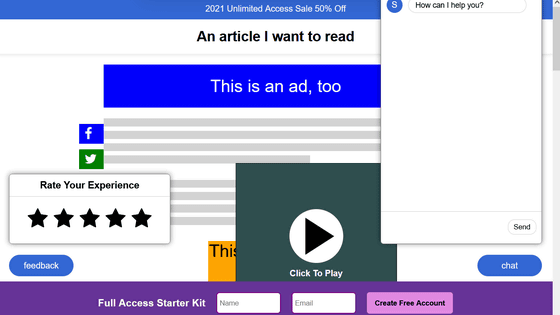





in Design, Posted by log1b_ok