Fitness tracking app Strava is now charging for developer API access to combat AI-driven data scraping.

An Update To Our Developer Program | Community
https://communityhub.strava.com/insider-journal-9/an-update-to-our-developer-program-13428
Strava Launches MCP Connector, Allowing Athletes to Sync Training History to Claude
https://press.strava.com/en-gb/articles/strava-launches-mcp-connector
Strava updated its community blog on June 1, 2026, announcing changes to its developer program. According to Strava, the number of Strava API users has increased from 185,000 in 2025 to 241,000 as of June 2026. On the other hand, Strava points out that automated access for the purpose of training AI models and collecting data has surged in recent years, with some users scraping the platform to obtain training data, abusing the API through intermediate layers, and providing zero-code AI tools that generate apps that overload the API. According to Strava, the number of developer applications to the Strava API has increased by 448% since the beginning of 2026, and the increase in scraping, along with violations of the terms of service by some API intermediaries, is degrading the platform's performance, such as causing long waiting times for developer application approvals.
Strava states that it has needed to review its terms of use for developer APIs to address issues such as AI-induced misuse of the Strava API and to protect user information and maintain the integrity of the platform.
To address performance degradation due to a significant increase in access, two new developer tiers, 'Standard' and 'Extended Access,' have been introduced. All applications created with the existing Strava API automatically receive Standard tier access and can upgrade their access level for up to 10 users without approval. To access the API as a Standard developer, a monthly subscription of $11.99 (approximately 1900 yen) will be required starting June 30, 2026. Additionally, apps with more than 10,000 users that have received Strava's approval can use the API as an Extended Access tier without a subscription.
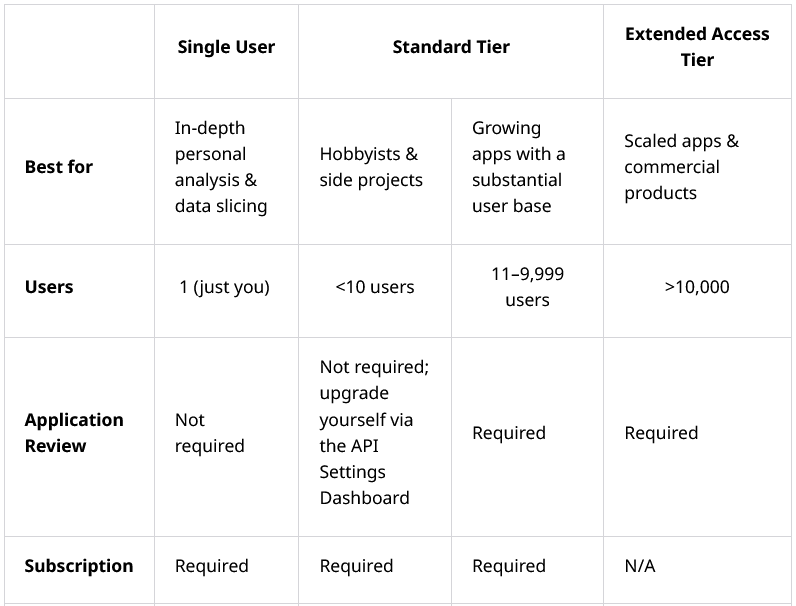
Strava explains that by making access to some APIs, which was previously available for free, a benefit of their paid membership program, they can minimize the impact on developers actually building apps while curbing use for the purpose of large-scale data collection. This change is for developers using the Strava API; general Strava users can continue to use it for free, and there will be no impact on features such as integration with wearable devices and other devices.
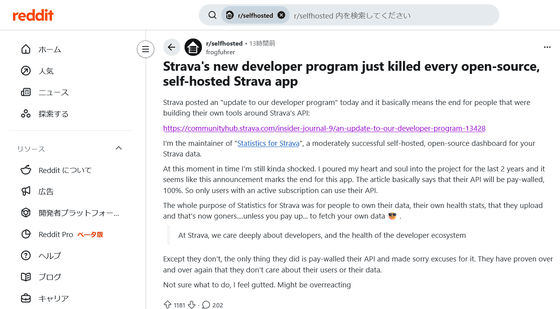
Strava has explained the API changes as being 'to improve platform performance,' but some in the developer community are protesting. One Reddit user, in a post titled 'Destroys all open-source, self-hosted Strava apps,' pointed out that 'Strava's announcement essentially means the end for people who have been developing their own tools using the Strava API. Strava says it 'cares about the health of developers and the ecosystem,' but in reality, with a fully paid API, you can't even get the data you need without paying,' and this has garnered a lot of support.
In addition, Strava also unveiled a new 'MCP Connector' for developers during this announcement. 'MCP (Model Context Protocol)' is a common standard for connecting AI assistants with external services, allowing compatible AI tools to access Strava activity data with the user's permission.
Previously, analyzing Strava data using an AI assistant required exporting the data and loading it into the AI chat. With Strava's MCP Connector, users can query their Strava data through compatible AI tools such as Anthropic's AI, Claude, and obtain detailed training analysis by asking questions and seeking advice in natural language.
Ryan Dixon, Vice President of Partnerships & Developer Relations at Strava, said, 'Athletes have been telling us they want more ways to analyze their training data. For years, they've been using spreadsheets, exports, and third-party scripts to do that. MCP Connector is a major change in our subscription service, giving athletes a tool to record and analyze their data much more efficiently and securely, while keeping them in control.'
Related Posts: