A study suggests that by analyzing subtle smartphone movements with AI, it's possible to predict smoking urges up to five minutes in advance.
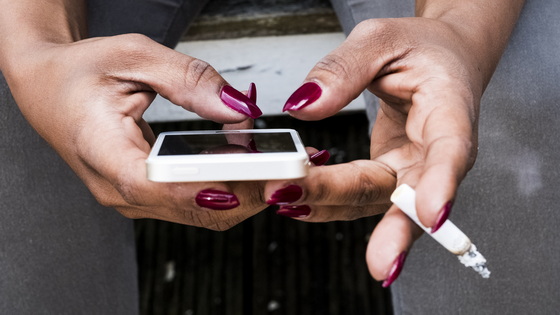
A study has shown that by using sensors built into smartphones to collect data on subtle movements during daily life, it's possible to predict smoking cravings and signs of relapse after quitting. These findings could lead to personalized smoking cessation apps and immediate interventions.
Smartphone movement data can reliably predict smoking lapses and cravings to enable timely smoking cessation support | Scientific Reports
https://www.nature.com/articles/s41598-026-49611-y
Smartphone data predict smoking cravings and lapses, with potential to treat addiction and other conditions
https://medicalxpress.com/news/2026-05-smartphone-cravings-lapses-potential-addiction.html
The experiment was conducted by a research team from Manchester Metropolitan University and the University of Lancashire. The participants were 17 smokers, and data was collected over a period of three and a half months using a smartphone app.
For the first two weeks, participants recorded each cigarette they smoked by pressing a button in the app. For the following three months, they reported on relapses after quitting and their craving for cigarettes on a five-point scale. The smartphone continuously recorded data from the accelerometer, gyroscope, magnetometer, light sensor, time, and GPS. The predictive model primarily used motion data obtained from the accelerometer, gyroscope, and magnetometer.

The results showed that the deep learning model '1D-CNN-BiLSTM' predicted smoking behavior within 5 minutes with 85% accuracy using only smartphone movements. The accuracy when using conventional factors such as time was 63%, demonstrating that even minute movement data has high predictive power.
For the three months following smoking cessation, the 1D-CNN-BiLSTM predicted smoking cravings and relapse with 78% accuracy. The fact that it was able to make predictions even when trained on data from other smokers suggests that subtle patterns of behavior related to smoking may not be unique to individual smokers.
The research team believes this technology could be applied to smoking cessation support apps. For example, they envision using it to display a photo of a race finish line to someone who wants to quit smoking for health reasons, or a family photo to someone who wants to quit for their family's sake, just before a strong urge to smoke arises.
A key feature of this study is that it collected unrestricted real-life data from smartphones that people use every day, rather than from laboratory settings or wearable sensors. GPS was not used in the model due to the sensitivity of location information and the bias in acquisition conditions. On the other hand, the research team states that the study was limited to participants in the UK, and further verification is needed to determine whether the same performance can be obtained in groups with different cultures, lifestyles, and physical functions. The fact that the recording of smoking and cravings relies on self-reporting is also cited as a limitation.
Researchers point out that analyzing subtle movements could potentially extend to predicting behaviors and health conditions other than smoking, such as overeating, insomnia, mental health issues, and eating disorders.
Related Posts: