Who wins and who loses in 'prediction markets' that bet on real-world events? Evidence from major prediction market Polymarket.

Prediction markets, which use all sorts of real-world events as betting subjects—from election results and the possibility of war breaking out to whether celebrities will attend events—are gaining popularity worldwide. A study investigating Polymarket, the largest prediction market, revealed just how many people are winning or losing at predictions.
Chances are you're going to lose money on Polymarket. Here's why. - Washington Post
Who Wins and Who Loses In Prediction Markets? Evidence from Polymarket by Pat Akey, Vincent Grégoire, Nicolas Harvie, Charles Martineau :: SSRN
https://papers.ssrn.com/sol3/papers.cfm?abstract_id=6443103
vgregoire/polymarket-users · Datasets at Hugging Face
https://huggingface.co/datasets/vgregoire/polymarket-users
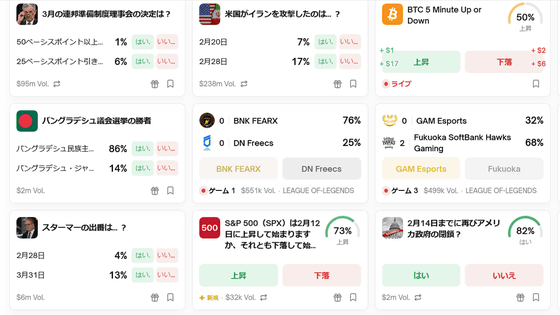
Polymarket is a platform where users bet on topics that can be predicted with a 'Yes/No' answer. Each topic is traded like a stock, and the price of each stock fluctuates between $0.00 and $1.00, with this price determined by market predictions. If the 'Yes' stock for a particular topic is trading at $0.65, it means the market estimates the probability of that event occurring to be approximately 65%.
This stock pays you $1 if the result is correct, and $0 if it's incorrect. If you buy the 'Yes' stock for $0.65 and the result is 'Yes,' you receive $1, making a profit of $0.35. The price is constantly fluctuating, you can buy and sell even before the result is known, and you can sell the stock at any convenient point.
However, most users aren't very good at predicting the future, and very few actually manage to make money from it.
A study conducted by financial researcher Pat Akey and colleagues at the European Institute for Corporate Governance found that of the 2,469,589 people surveyed, only about 30%, or 764,988 people, were able to make money. Furthermore, of those, 1,200 people, a mere 0.05% of the total, monopolized more than half of the total profits.
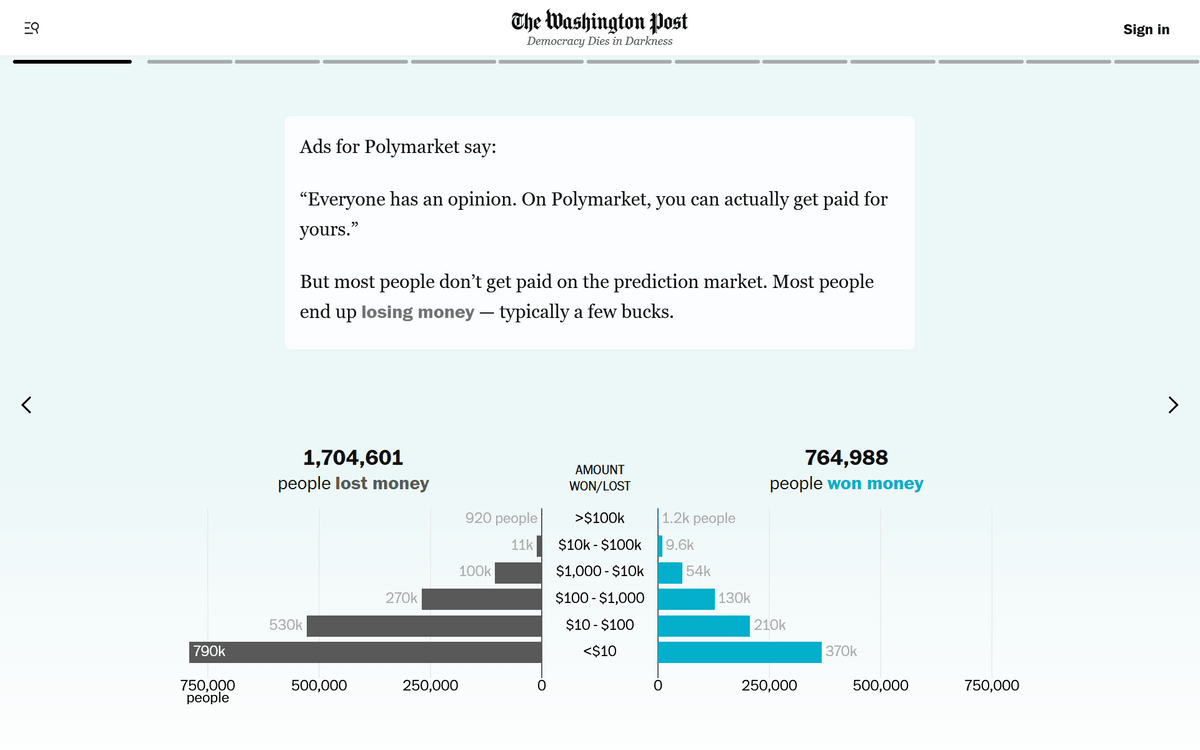
Most of the 1,200 individuals are 'professional' traders who have made thousands of trades in the past year and a half. These traders are very skilled at choosing what to bet on and win so frequently that it is statistically unlikely to be mere luck, leading Akey and his colleagues to speculate that they may have possessed expertise, meticulous research, or inside information.
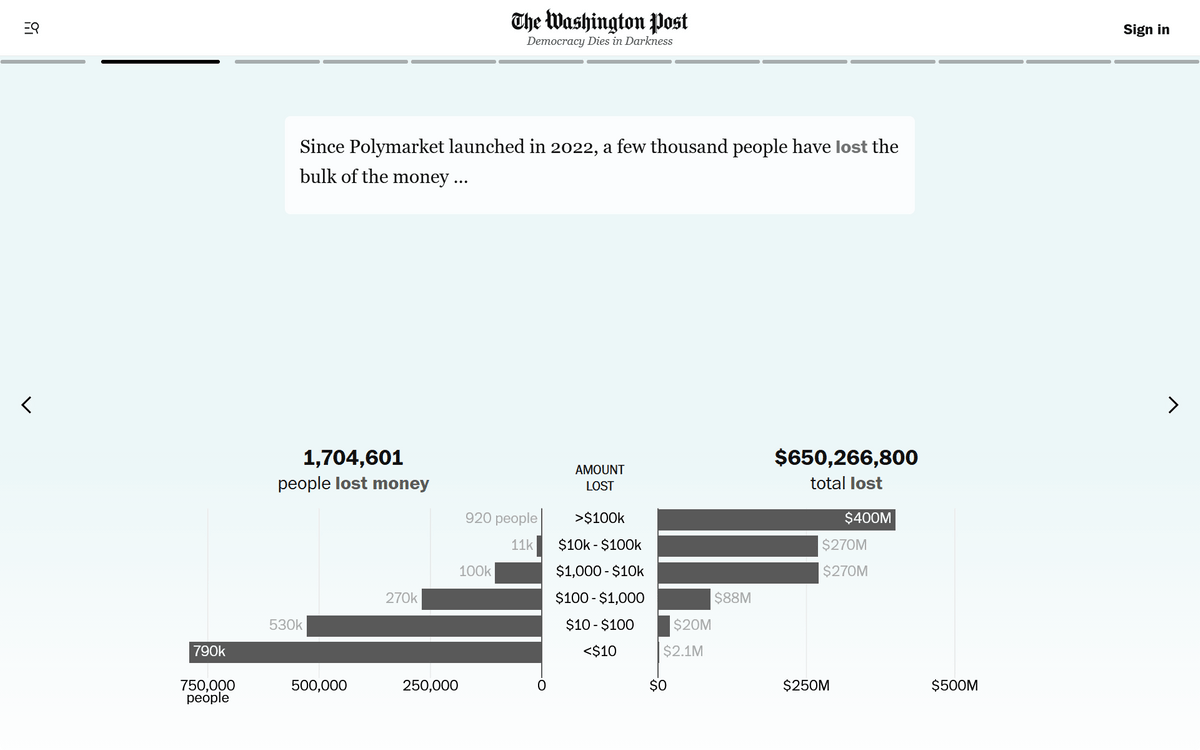
1,704,601 people lost money, and the total loss amounted to $650,266,800 (approximately 103.4 billion yen).
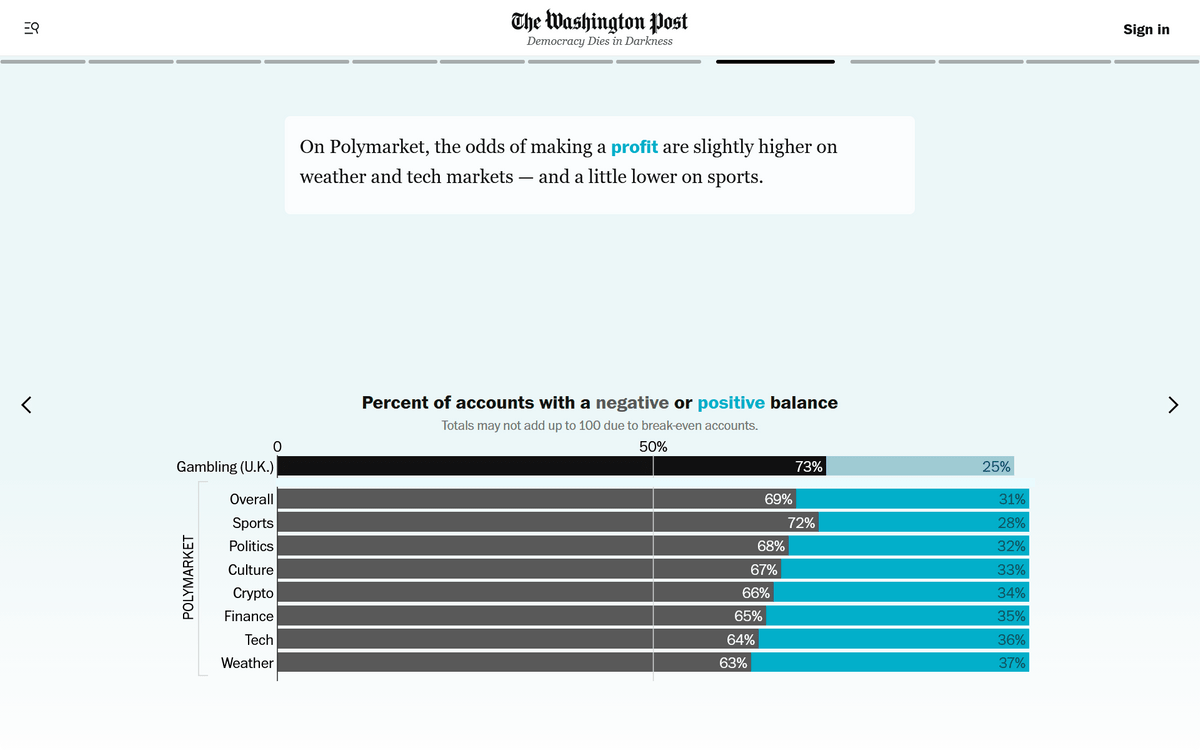
The percentage of accounts that have made a profit is roughly the same as in traditional gambling. Polymarket users tend to be weaker in sports betting, but more successful in weather and technology-related betting. However, over 99.9% of users are making healthy bets, and losses are minimal.
Akey and his colleagues conclude that 'getting involved in prediction markets means competing with highly skilled players who have consistently been winning.'
Related Posts:






in Web Service, Posted by log1p_kr