Anthropic's sales manager explains how they use Claude in their work.

Travis Bryant, who is in charge of sales and market development for the mid-market in the US at AI company Anthropic, explains in the official Claude blog how he is using the AI agent 'Claude Cowork' to carry out his sales activities.
How an Anthropic sales leader uses Claude Cowork to run a 4,000-account book | Claude
The mid-market refers to companies that are larger than startups but not yet large corporations. Mr. Bryant is responsible for 4,000 clients, which are divided into technology companies and industrial sectors such as finance, healthcare, retail, and manufacturing.
According to Bryant, the sales manager's job is to make decisions such as 'where to invest the team's time' and 'how to communicate quarterly outlooks to management.' However, in reality, he said that a lot of time was spent gathering data from multiple sources and recalculating baselines every time the numbers were updated.
To reduce this workload, Bryant began entrusting data collection and formatting to Claude Cowork. Claude Cowork is an AI agent for PC operation developed based on Claude Code, which can view, edit, create, and move files within folders that the user has granted access to. The basic functions of Claude Cowork are covered in the following article.
Anthropic announces 'Cowork,' an AI for PC operation that can automate everything from creating to deleting files - GIGAZINE
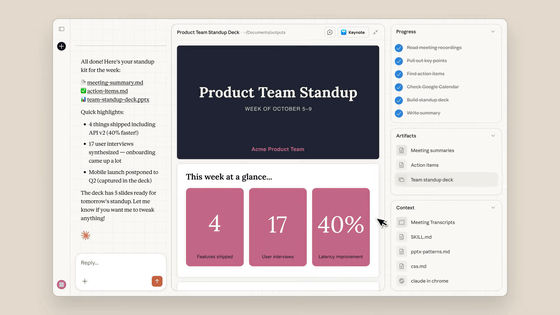
Mr. Bryant's work is divided into three parts: 'preparing for daily client meetings,' 'weekly sales forecast reports,' and 'creating quarterly responsibilities and prospect lists.' For his daily tasks, he has Claude Cowork check his Google Calendar every morning, and if a meeting room is not already scheduled for an external meeting, it is automatically booked. Furthermore, before client meetings, he has them retrieve spending data from BigQuery, import deal progress from Salesforce, and create pre-meeting materials. Mr. Bryant claims that these small efficiencies save him approximately 90 minutes of time.
Additionally, every Friday, Claude Cowork prepares a sales forecast report. First, Claude Cowork retrieves opportunity records and submitted sales forecasts from the Salesforce Forecast tab, and token usage from BigQuery. He then gathers relevant information from internal documents. Based on this information, he creates a one-page report summarizing overall metrics, key opportunities, areas where the outlook is improving and worsening, and forecasts gathered from each sales manager. This report is shared internally before the sales forecast meeting held the following Monday. Bryant explains that this Friday report preparation saves them approximately three hours per week.

The biggest project Bryant used Claude Cowork on was scoring customers across the entire mid-market, allowing sales representatives to determine which companies to prioritize. Each sales representative has a group of companies they are responsible for, and each customer needs to be scored to determine their priority within their assigned area. In the environment before implementing Claude Cowork, this scoring process involved multiple departments and took hundreds of hours in total.
To carry out this scoring process at Claude Cowork, Bryant collaborated with Claude to create two sets of evaluation criteria: one for technology companies and one for industrial sectors. For technology companies, five items were set: 'How likely are there to use Claude's agent functions?', 'Is there room to change internal operations?', 'How proactive are they in adopting AI?', 'Is there room for additional revenue compared to existing spending?', and 'Is it a good fit for the industry?'. On the other hand, for industrial sectors such as finance, healthcare, retail, and manufacturing, the evaluation criteria included 'the proportion of knowledge workers whose work primarily involves handling knowledge and information' and 'how much the company mentions its commitment to AI on its job postings.' Bryant explained that 'law firms tend to have a high proportion of knowledge workers, while manufacturing companies tend to have a lower proportion because they have many employees working on the factory floor.'
After inputting a list of 4,000 customers and evaluation criteria into Claude Cowork, it completed the task of 'examining each customer individually, scoring them based on web information, Salesforce data, and BigQuery data, and then writing down the reasons for those scores' overnight.
Furthermore, Bryant asked Claude Cowork to create an interactive dashboard based on the scoring results. The dashboard will allow sales representatives to select their area of responsibility, and their clients will be displayed in descending order of score. Each client will have justification for each evaluation criterion, and hovering over a client's name will display use cases and comparable examples that could be used in proposals to prospects.
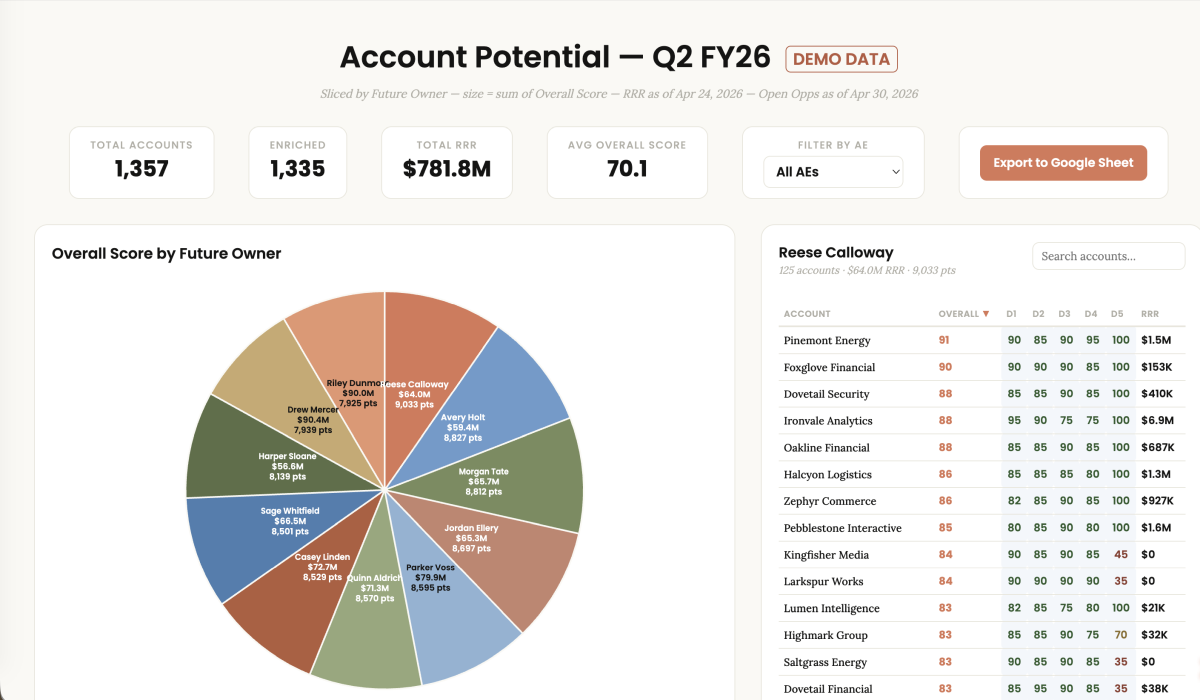
Bryant communicated the scoring criteria to Claude, who then tested it in a portion of his assigned area. He reviewed the results and made adjustments, such as 'I think the weight of this evaluation criterion is a little too high, so we should lower it,' before expanding it to other areas of responsibility.
Using the same scoring method, Claude Cowork can also be used to estimate the size of sales opportunities across the entire market, conduct customer research, and compare compensation levels. Bryant explains, 'Claude Cowork has allowed me to reclaim my time as sales manager and dedicate that time to strategy and customer relationships.'
Related Posts:







in AI, Posted by log1b_ok