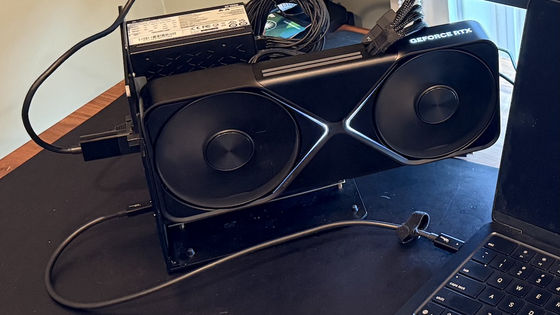
Installing the desktop GPU 'RTX 5090' into a MacBook Air with an M4 chipset.
RTX 5090 + M4 MacBook Air: Can it Game? | Scott's Blog
https://scottjg.com/posts/2026-05-05-egpu-mac-gaming/
RTX 5090 and M4 MacBook Air: Can It Game? | Hacker News
https://news.ycombinator.com/item?id=48137145
Goldman asked ChatGPT, 'Do you think it's possible to pass through an eGPU to a Linux VM running on an M4-equipped MacBook Air? It's not supported at the moment, but if I were a software developer, would I be able to make it work?' The response he received was, 'No. It's not possible at the moment, at least in a practical sense, and even if it were possible, it would be at a very deep research level and would be limited to areas with almost no practical use.'
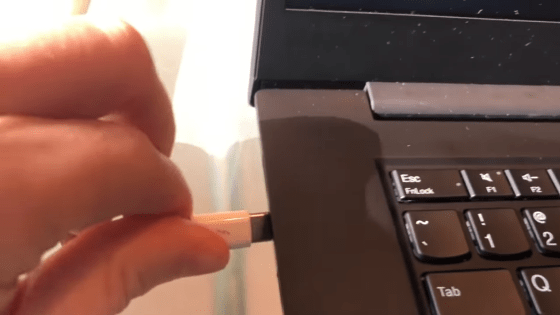
Despite ChatGPT's advice, Goldman physically connected his RTX 5090 to his M4-equipped MacBook Air using an eGPU enclosure . Because Thunderbolt tunnels PCIe through a USB-C cable, the Mac recognizes Thunderbolt devices as PCIe devices, not USB devices. Thunderbolt 4 allows the use of four PCIe lanes at up to 40Gbps, although there is a slight performance degradation due to the tunnel connection. Since USB4 also includes the same PCIe tunnel connection as an optional feature, Goldman explained that 'this feature can be used even with USB4 ports that do not support Thunderbolt.'
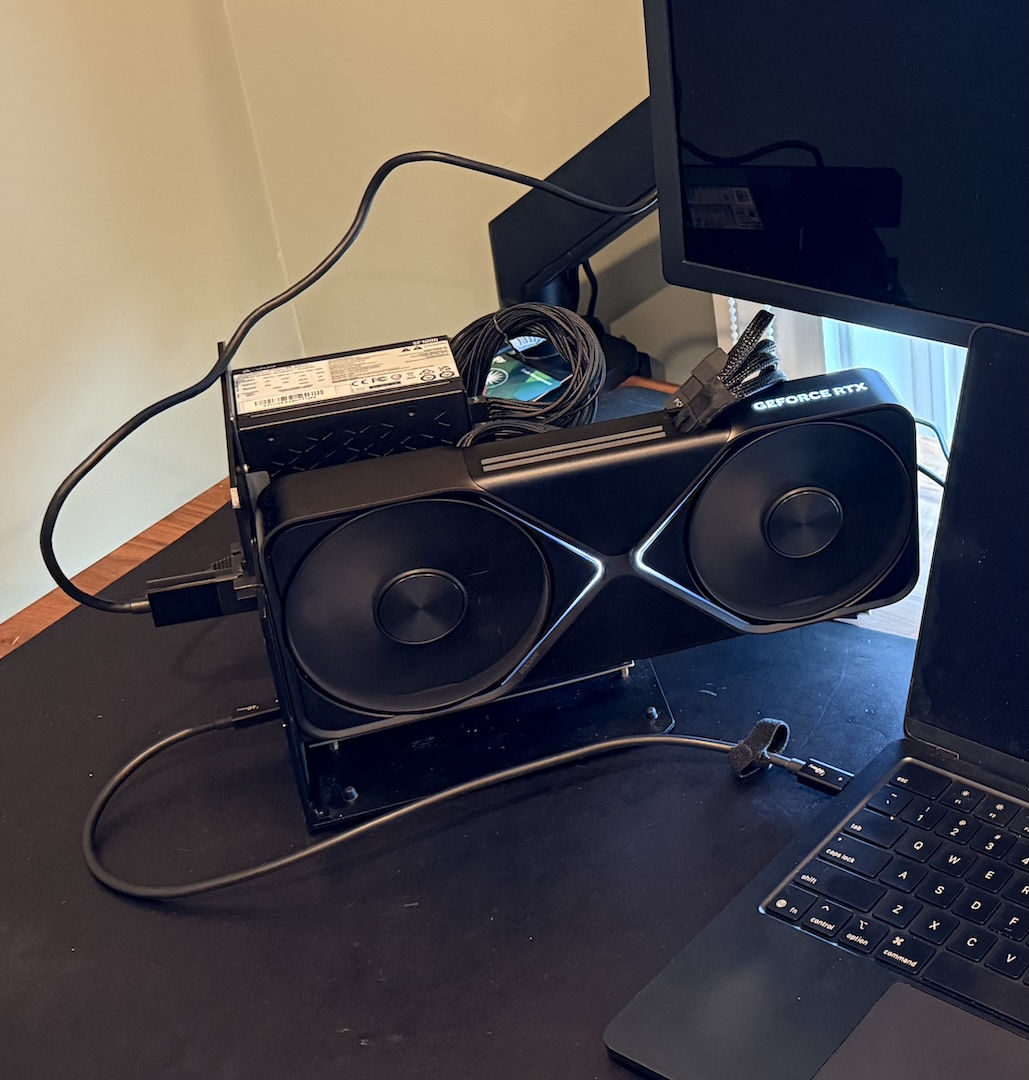
The first problem after connecting is that macOS does not have drivers for NVIDIA or AMD GPUs for Macs with Apple Silicon. However,
However, it is possible to run Linux using a 64-bit ARM virtual machine on macOS. Since macOS supports Thunderbolt devices and Linux supports NVIDIA GPUs, Goldman thought, 'Let's combine these and pass through the GPU to the Linux virtual machine.'
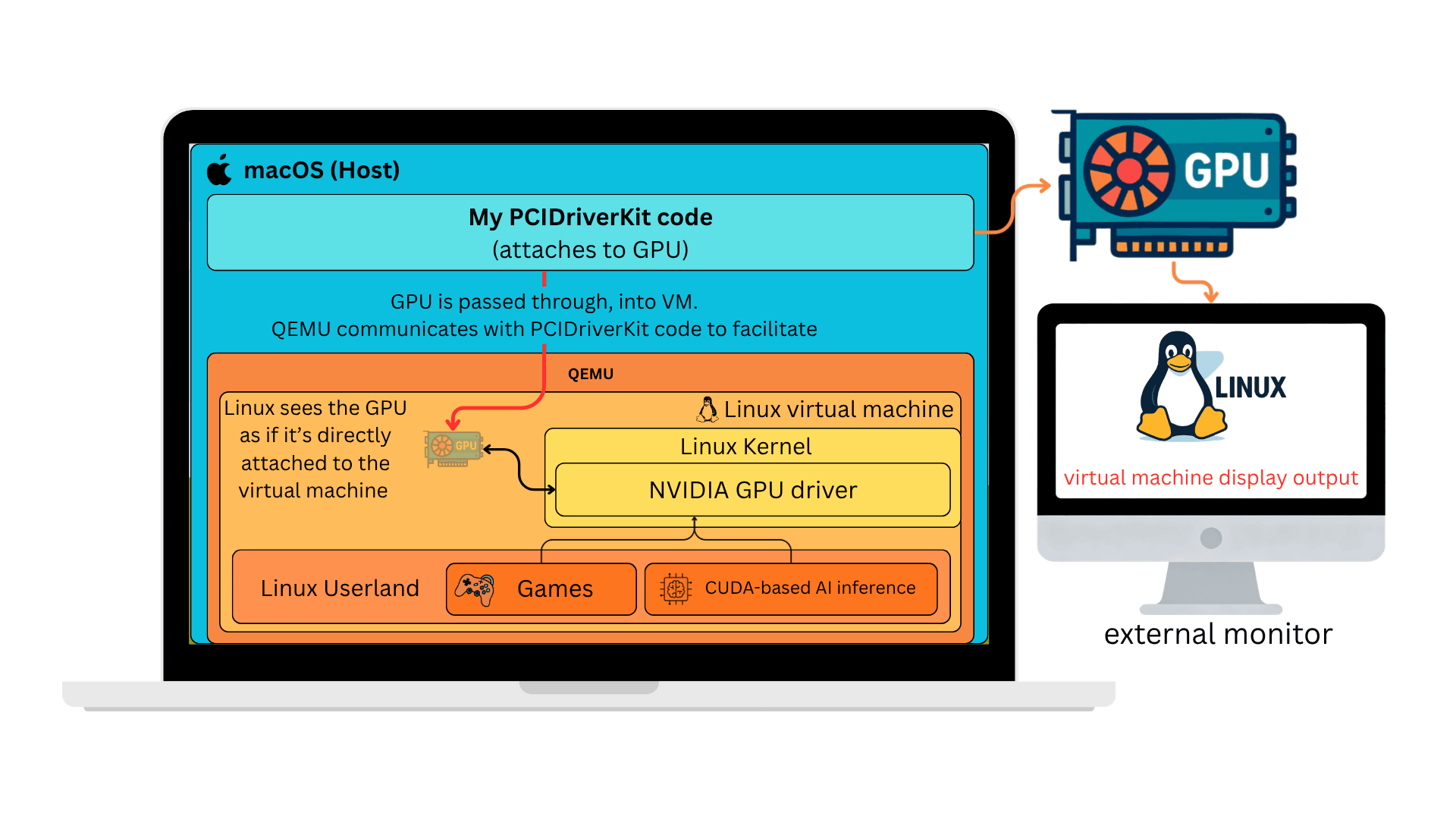
In simple terms, this task involved 'simply placing the GPU in a Linux virtual machine.' Since the virtual machine uses the same architecture (arm64) as the host Mac, the performance should have been equivalent. However, achieving this required 'designing PCI passthrough on macOS.'
Now that the connection is successful, the question is, 'Will connecting an RTX 5090 to a MacBook Air improve gaming performance?' Goldman uses
The following is a comparison of CPU performance measurements taken with Geekbench 6 on an M4-based MacBook Air connected to an RTX 5090, compared to other Macs. The 'M4 MacBook Air (Linux VM + FEX)' at the bottom is the environment built by Mr. Goldman.
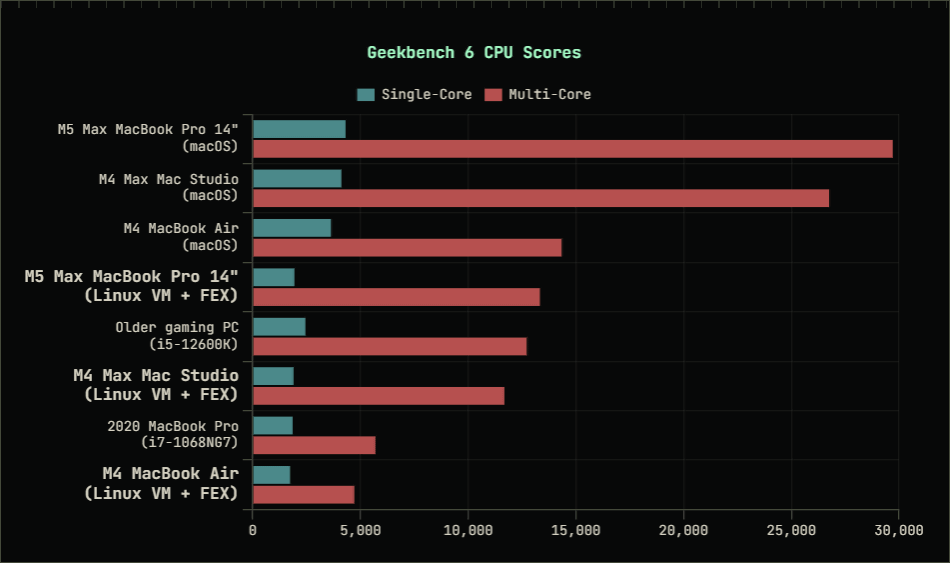
As these benchmark results show, emulating x86 applications via FEX-Emu results in a performance drop of almost 50%, and the M4-based MacBook Air is significantly affected. Its performance is even lower than the Intel-based MacBook Pro released in 2020. On the other hand, the M5 Max-based MacBook Pro performs quite well, with performance not degrading nearly as much even when running FEX-Emu via a Linux virtual machine.
Furthermore, we ran
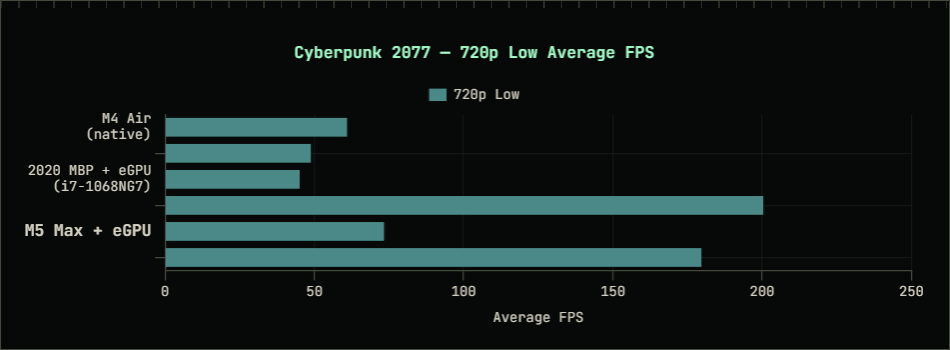
- Runs natively on a MacBook Air with an M4 processor (without Linux, virtual machines, or FEX-Emu).
- Connecting to an eGPU (RTX 5090) via a Linux virtual machine on an M4-equipped MacBook Air and running it via FEX-Emu.
- Run on a 2020 Intel-based MacBook Pro using Linux and an eGPU (no virtual machine or FEX-Emu).
- Runs natively on a MacBook Pro with an M5 Max processor (without Linux, virtual machines, or FEX-Emu).
- Connecting to an eGPU (RTX 5090) via a Linux virtual machine on a MacBook Pro with an M5 Max processor and running it via FEX-Emu.
- Run the test by connecting an RTX 5090 to an old gaming PC ( i5-12600K ).
The average FPS when Cyberpunk 2077 is set to 720p is as follows. The results show that using an RTX 5090 via a Linux virtual machine results in consistently lower FPS than running it natively. This is because at the low resolution of 720p, the GPU is hardly loaded, and only the CPU and emulation affect performance.
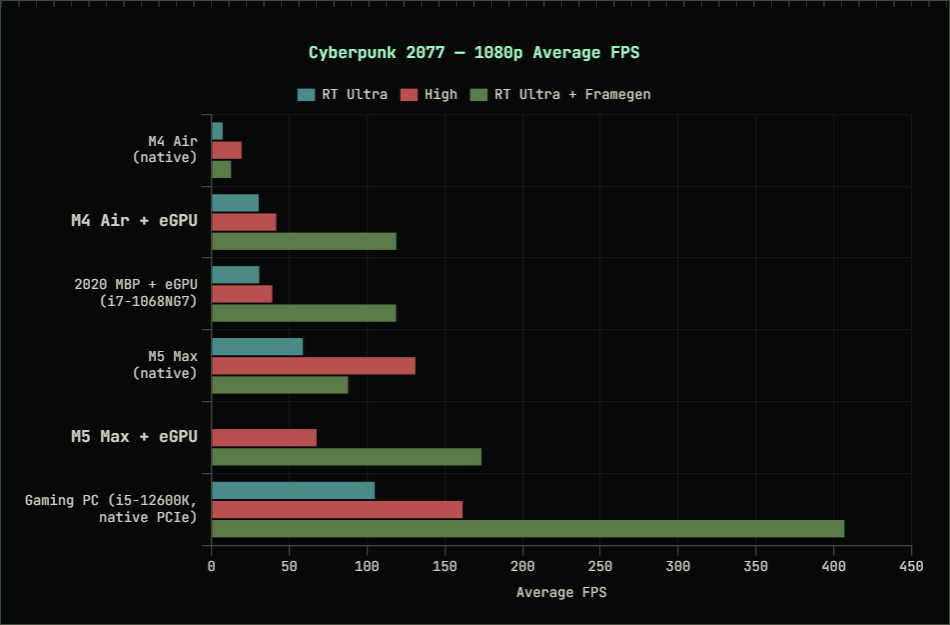
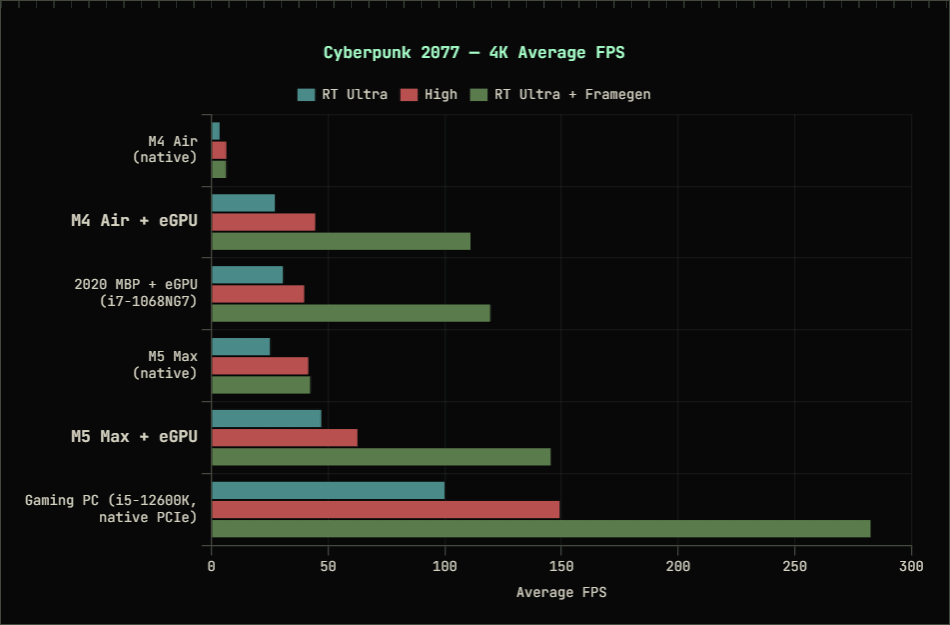
The following is a summary of the average FPS when Cyberpunk 2077 is set to 1080p resolution. Blue indicates the FPS with 'Ray Tracing: Ultra' enabled, red indicates the FPS with the graphics settings set to 'High,' and green indicates the FPS with 'Ray Tracing: Ultra' and frame generation such as FSR and DLSS enabled. When the resolution is increased, using the RTX 5090 via a Linux virtual machine clearly increases the average FPS.
The average FPS when playing Cyberpunk 2077 at 4K resolution is as follows. The GPU becomes more important when playing games at 4K. In particular, playing Cyberpunk 2077 at 4K on a MacBook Pro with an M5 Max processor barely yields a playable FPS, but using an RTX 5090 as an external GPU results in higher frame rates and stable gameplay.
Goldman stated, 'By using an RTX 5090 on a Linux virtual machine, we were actually able to play Cyberpunk 2077, Crysis Remastered , and DOOM on a MacBook Air.' However, he added that connecting the same GPU to a regular PCIe slot could result in performance that is 2 to 4 times faster for some games.
Related Posts: